

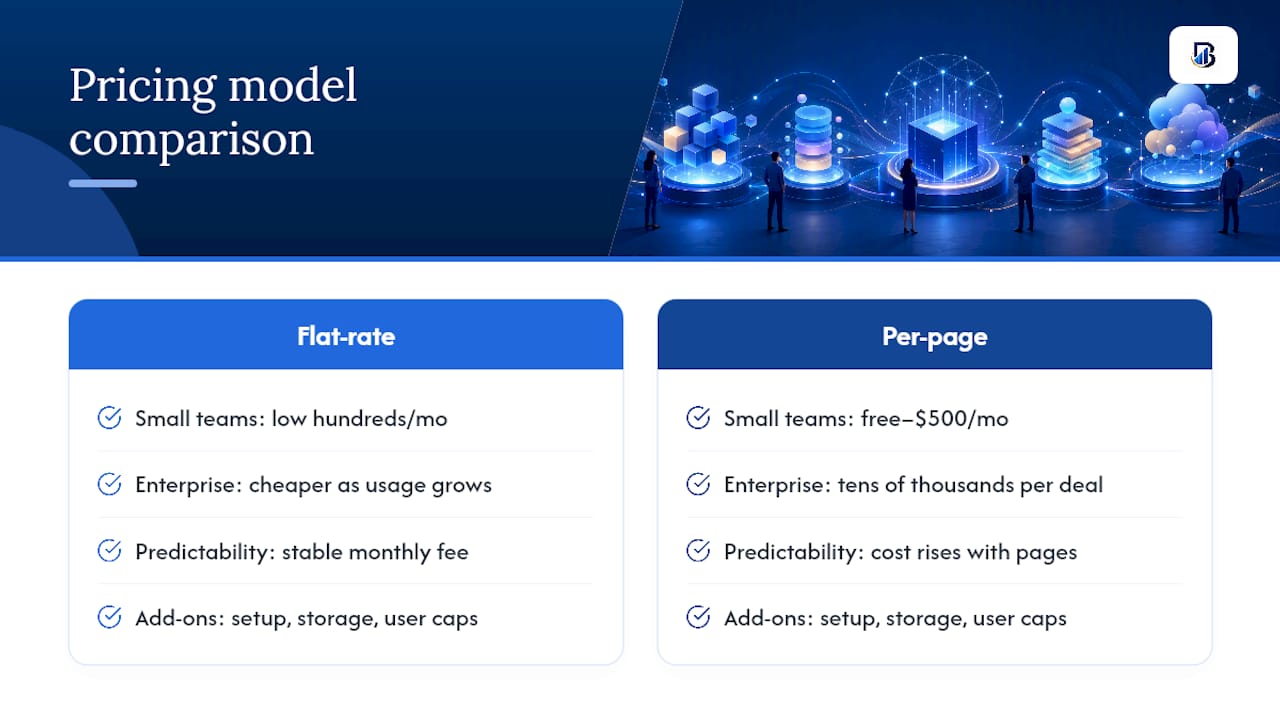
Most founders should budget $140 to $500 per month for a mid-tier flat-rate virtual data room, while startups can often get by on entry plans between free and $69 per month. Enterprise M&A deals on legacy per-page platforms can run past $50,000 for a single transaction. The fastest way to avoid a nasty invoice is simple: pick a flat-rate plan with unlimited users whenever your deal has any uncertainty around timeline or document count. Per-page pricing can become costly for deals that grow unexpectedly, which is often the case.
The 2026 shift in one line: the market is moving hard toward transparent, bundled flat-rate pricing, and vendors that still hide their rate cards behind a "request a quote" button are usually the most expensive option in the room.
If you're new to the category, a virtual data room, often shortened to VDR, is a secure online repository used to share confidential documents during fundraising, M&A due diligence, audits, or fund administration. The pricing question below applies to all of those use cases, but the numbers shift a lot depending on which one you're running.
Key Takeaways
Flat-rate virtual data room pricing controls cost overruns better than per-page or per-user billing for any deal with growing documents, users, or timeline uncertainty.
| Point | Details |
|---|---|
| Budget by use case | Startups should expect $0 to $500 a month; enterprise M&A can exceed $50,000 per deal on legacy per-page platforms. |
| Match model to deal size | Flat-rate wins for growing rooms; per-page only suits small, tightly scoped projects with a known page count. |
| Watch for hidden fees | Setup, storage overages, and extension charges can push final bills two to ten times the original quote. |
| Ask for the rate card in writing | Vendors that publish pricing tend to be cheaper and more predictable than quote-only enterprise platforms. |
| Bright's flat-rate approach | Bright Capital America bundles secure data rooms and document storage into one subscription, avoiding per-page risk during a raise. |
Table of Contents
- How Much Does Virtual Data Room Pricing Actually Vary by Model?
- What Does a Virtual Data Room Cost in 2026 by Use Case?
- Which Features and Security Requirements Push Up the Price?
- What Hidden Fees Should You Watch For in a VDR Contract?
- How Do You Choose the Right Pricing Model and Budget Accurately?
- What Do Real VDR Budgets Look Like Once You Run the Numbers?
- How Does Bright Capital America's Pricing Approach Fit This Picture?
- Why Does Pricing Transparency Change How Deals Actually Go?
- Get Predictable Pricing for Your Next Fundraise
- Frequently Asked Questions
- Sources
How Much Does Virtual Data Room Pricing Actually Vary by Model?
Virtual data room pricing comes down to four billing structures, and each one rewards a different kind of deal. Get the model wrong for your project and you'll either overpay for capacity you don't need or get blindsided by a bill that triples mid deal.
- Per-page pricing. You pay a set rate, typically $0.40 to $1.00 per page, for every document uploaded. It sounds precise and fair until your diligence room balloons from 2,000 pages to 12,000 pages in week three of negotiations. Small, tightly scoped rooms with a known document count are the only place this model doesn't bite you.
- Per-user pricing. The bill scales with how many people you invite, often split between higher rates for admins and lower rates for read-only viewers. This works fine for a two-banker deal team but turns expensive fast once you add auditors, outside counsel, and a dozen prospective buyers or investors.
- Storage-based pricing. You pay by the gigabyte, which suits data-heavy industries (video, engineering files, imaging) but rarely matches how most fundraising or M&A rooms actually consume space.
- Flat-rate and hybrid pricing. One monthly or per-deal fee covers a bundle of users, storage, and features, sometimes with soft caps that trigger overage fees only past a generous threshold. This is the model gaining share in 2026, and for good reason: it removes the incentive to nickel-and-dime every additional viewer or page.
The scalability math is what separates these models in practice. A per-page room punishes document growth. A per-user room punishes stakeholder growth. A storage room punishes file-size growth. A flat-rate room absorbs all three up to its bundle limit, which is exactly why it tends to win for:
- Deals with an unknown or shifting timeline
- Rooms expecting more than 5,000 pages
- Fundraises with a large, evolving investor list
- Any project where legal, audit, or advisory teams need seats late in the process
Short, contained rooms with a fixed scope and a defined close date are the one scenario where per-page or per-user pricing can still come out cheaper. If you can confidently predict your final page count and guest list on day one, it's worth running both numbers before you sign.
What Does a Virtual Data Room Cost in 2026 by Use Case?
The honest answer depends entirely on which kind of deal you're running, because the spread between a startup fundraise and an enterprise carve-out is enormous.
Startup and early fundraising rooms typically run free to $69 a month on modern founder-focused platforms, occasionally stretching to $140 to $500 a month if you want deeper analytics or a dedicated workspace for cap table and fundraising documents together. This is the band most seed and Series A founders should expect to see on a legitimate quote.
Small M&A transactions commonly have either a flat monthly subscription in the lower price range for the deal's duration, or a per-page total that can grow significantly as diligence documents accumulate.
Mid-market deals commonly settle into the $140 to $500 per month subscription band for platforms that publish pricing, though buyers should budget higher if the target company's data room needs six figures of file storage or a longer-than-usual exclusivity period.
Enterprise and complex cross-border deals are where the numbers get uncomfortable. Legacy enterprise platforms can charge $400 to $6,000 or more per month, or upward of $50,000 for a single deal. Part of that premium is real (dedicated support, custom integrations), but part of it is simply an opacity tax: vendors that don't publish pricing tend to skew toward this higher, quote-only tier.
A few concrete figures worth anchoring your budget conversations around:
- Per-page fees: $0.40 to $1.00 per page
- Per-user fees: often $15 to $250 per user per month depending on admin versus viewer access
- Founder-tier flat rate: as low as $17 to $69 per month
- Mid-market flat rate: $140 to $500 per month
- Enterprise flat rate or per-deal: $400 to $6,000+/month, or $50,000+ per deal
The admin-versus-viewer differential matters more than most buyers expect. A room with three admins and forty read-only investors will price wildly differently on a per-user model than the same room on a flat-rate plan with unlimited seats.
Which Features and Security Requirements Push Up the Price?
Not every "premium" feature you're quoted for actually deserves a premium price tag in 2026. Baseline security, encryption at rest and in transit, watermarking, and detailed audit logs, have become standard even on mid-tier plans, largely because document protection practices have become table stakes for any platform handling confidential deal materials. If a vendor is charging you extra for basic watermarking in 2026, that's a signal to shop elsewhere.
What genuinely does raise cost:
- Regulatory-grade compliance. SOC 2 Type II audit evidence, HIPAA-aligned controls for healthcare deals, and FINRA-relevant recordkeeping require infrastructure most vendors charge separately for.
- Advanced redaction tools. Automated, bulk redaction across thousands of pages costs more than manual, document-by-document redaction.
- Structured Q&A workflows. A formal Q&A module with routing and audit trails, common in M&A diligence, is often an add-on rather than a base feature.
- Analytics and engagement tracking. Knowing which investor viewed which page for how long is genuinely useful and genuinely a paid tier on most platforms.
- AI-assisted document review or summarization. Newer AI tools for flagging anomalies or summarizing long contracts are showing up as premium add-ons across the market.
- Dedicated account management and specialty file handling. CAD files, video, and other large or unusual formats often carry their own support surcharge.
Pro Tip: Ask every vendor to separate "included in base plan" from "billed as an add-on" in writing before you sign. Verbal assurances about what's included tend to evaporate the moment your first overage invoice arrives.
What Hidden Fees Should You Watch For in a VDR Contract?
The quote you get on a sales call is rarely the number you end up paying. Vendor pricing guides and deal data both point to the same conclusion: hidden fees are the single biggest source of budget shock in this category, and they can push a final invoice to two to ten times the original quote.
Here's where the money actually leaks out:
- Setup and onboarding fees, typically $500 to $2,500, sometimes waived for annual contracts but rarely mentioned in the initial quote.
- Storage overages once you exceed your bundled gigabyte allowance, commonly $75 to $300 per GB per month.
- User and admin caps that trigger per-seat charges the moment you add the eleventh viewer or the third admin.
- Per-page re-upload fees when a document gets revised and replaced mid-deal on a per-page plan.
- Multimedia surcharges for video, audio, or CAD files that fall outside a standard document rate.
- Extension fees when a deal runs past its original close date, which happens far more often than deal teams plan for.
Before signing anything, ask the vendor to confirm in writing: what happens past the storage cap, what an extra month costs if the deal drags, and whether re-uploaded or revised documents trigger a new page charge. A short trial period, most flat-rate vendors offer one, is the cheapest insurance you'll buy all deal.
How Do You Choose the Right Pricing Model and Budget Accurately?
Getting an apples-to-apples quote across vendors starts with knowing your own numbers before you ever get on a sales call.
Estimate these four things first:
- Total expected page count, including likely revisions
- Number of viewers versus number of admins
- File types you'll be uploading (standard PDFs versus video, CAD, or large media)
- Realistic deal length, padded by at least one extra month
Then bring a short, specific question list to every vendor conversation:
- What happens if we exceed our storage or user limit mid deal?
- What does a one-month extension cost, and is it prorated?
- Are redaction, Q&A, and analytics included, or billed separately?
- Is onboarding a flat fee, and is it waived on annual plans?
- Can we see the full rate card in writing, not just a summary quote?
As a decision rule: if your page count or timeline has any real uncertainty, or your investor list could grow past a dozen names, flat-rate pricing almost always wins on total cost. Per-page pricing only makes sense when you can confidently name your final document count on day one.
What Do Real VDR Budgets Look Like Once You Run the Numbers?
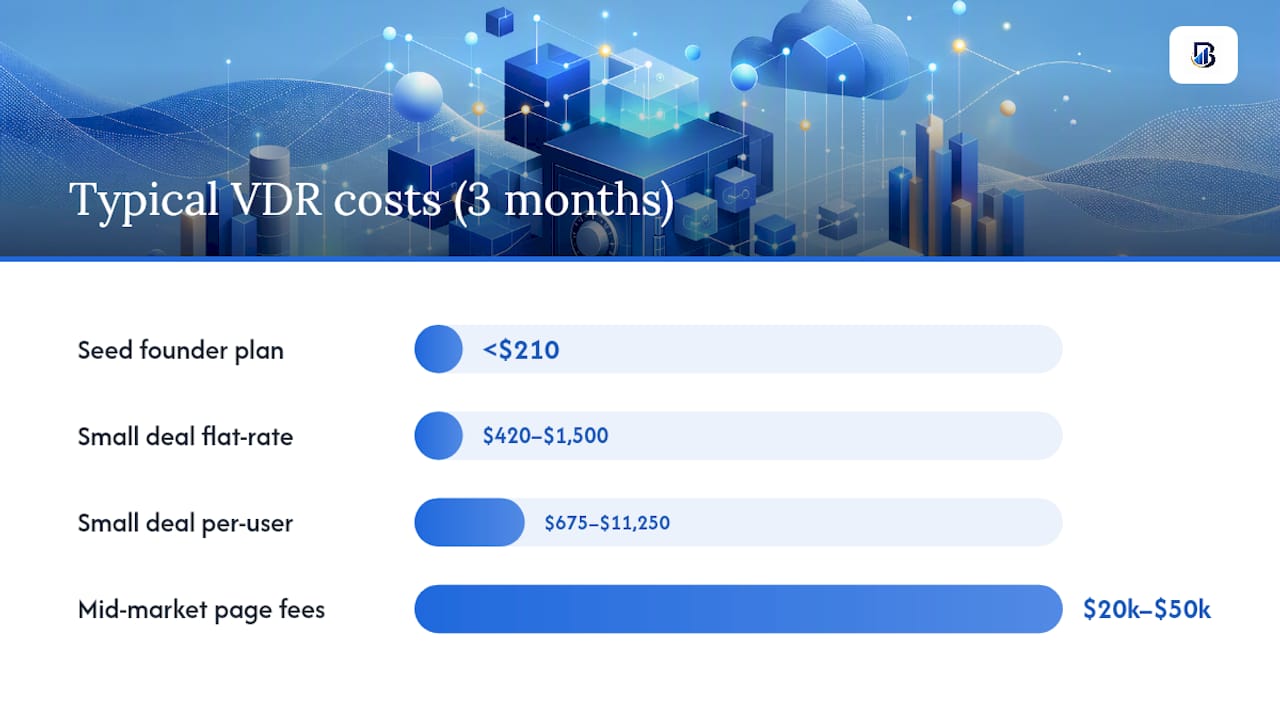
Numbers make this concrete faster than any range table. Take a founder running a seed round with 20 documents totaling 50 pages over a three-month raise: a flat-rate founder plan at $17 to $69 a month puts the entire raise's data room cost under $210, unlimited investor seats included.
Now stretch that to a three-month, 50GB, 15-user project, a common shape for a small M&A process or a Series B with active legal review. Estimated totals across pricing models run roughly $1,200 to $11,250 depending on structure:
- Flat-rate mid-tier plan: around $420 to $1,500 total for the three months
- Per-user model at $15 to $250/seat/month: $675 to $11,250 for 15 users over three months
- Per-page model, assuming steady document growth: highly variable, often the most expensive path once revisions start
Finally, picture a mid-market M&A room that grows to 50,000 pages, not unusual once financials, contracts, and IP filings all land in one repository. At $0.40 to $1.00 per page, that's $20,000 to $50,000 in page fees alone, before a single user or storage charge is added. That single scenario explains why flat-rate has become the default recommendation for anything beyond a small, contained room.
How Does Bright Capital America's Pricing Approach Fit This Picture?
Bright Capital America built its secure document workspace around the same principle this whole pricing conversation points toward: predictable, flat-rate access instead of per-page risk.
Founders using Bright's platform get secure data rooms and document storage bundled into a subscription that also includes access to more than 27,000 verified investor profiles and integrated cap table tools, so a growing document count during a raise never triggers a surprise per-page bill.
That structure mirrors the flat-rate benefits covered above: unlimited document uploads within your plan tier, no per-seat penalty for adding advisors or investors mid-raise, and one predictable line item for budgeting instead of a moving target.
Why Does Pricing Transparency Change How Deals Actually Go?
The rooms that blow past budget almost always share one trait: nobody asked "what happens if this runs long" before signing. Vague quotes create vague expectations, and vague expectations turn into painful invoice conversations three months into a deal that was supposed to close in six weeks.
Transparent, flat-rate pricing does something subtler than just saving money. It changes the negotiation itself. When a founder or deal team knows the ceiling on document costs up front, they negotiate the actual deal terms instead of quietly worrying about overage fees in the background. That's the real argument for flat-rate transparency in 2026: it's not only cheaper for most deals, it lets everyone in the room focus on the deal instead of the invoice.
Get Predictable Pricing for Your Next Fundraise
Founders shouldn't have to choose between a data room that nickel-and-dimes every added investor and one that locks them into an enterprise contract built for a much bigger deal. Bright Capital America's platform combines secure document storage with direct access to a large, verified investor network, so your fundraising documents and your investor outreach live in the same workspace instead of three disconnected tools.
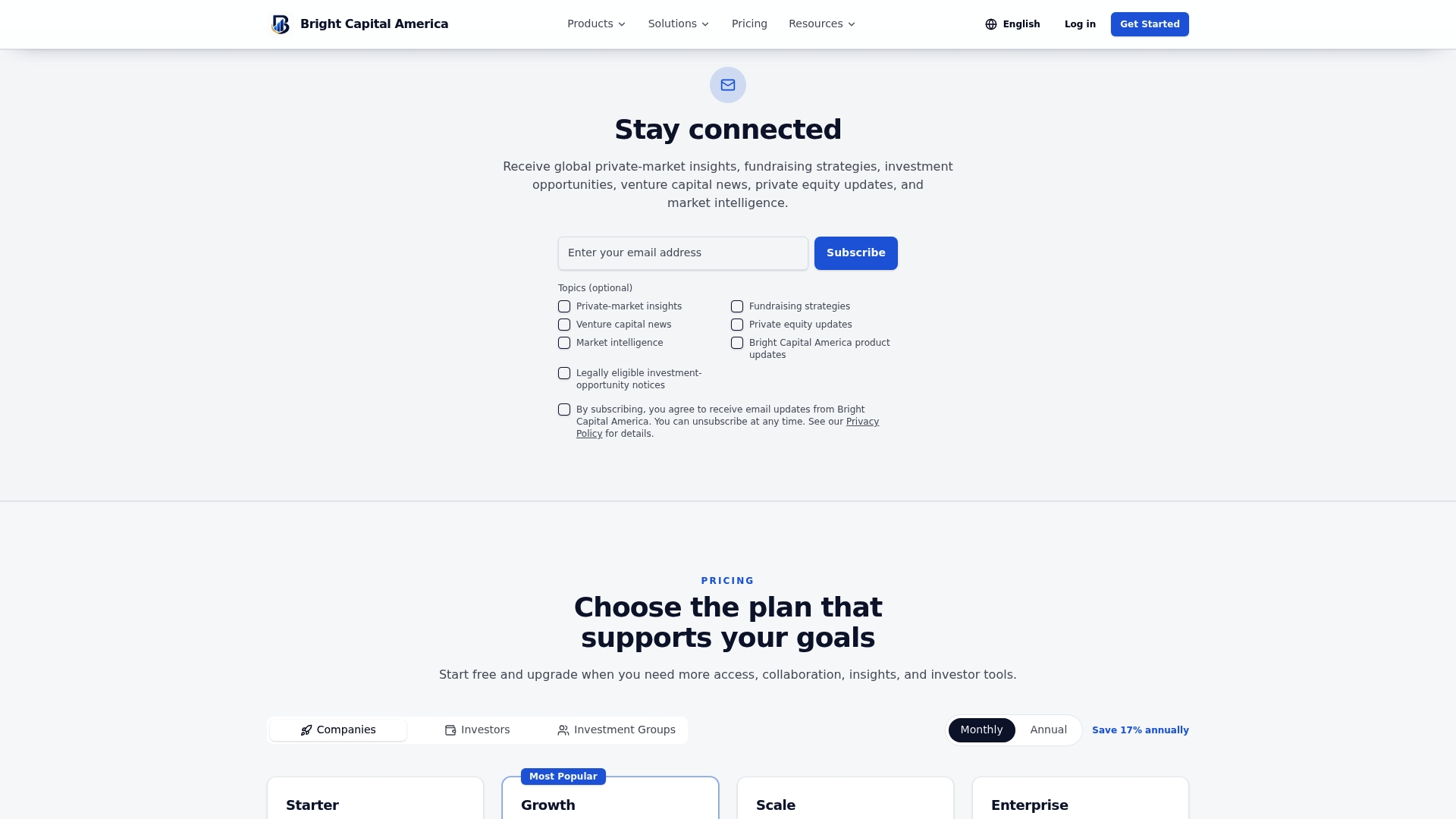
Plans start at a published, transparent rate rather than a request-a-quote form, which means you can budget your raise the same day you sign up. If you're actively preparing a raise, check the private capital raise tools built specifically for founders managing documents, cap tables, and investor communication in one place, and see the current pricing tiers before your next deal timeline forces a rushed decision.
Frequently Asked Questions
What is the average cost of a virtual data room in 2026? Most founders and small deal teams pay between free and $500 a month depending on plan tier, while enterprise M&A rooms on per-page pricing can run tens of thousands of dollars for a single deal.
Is flat-rate or per-page pricing cheaper for virtual data room fees? Flat-rate is cheaper for almost any room with growing pages, users, or timeline, since per-page and per-user models charge for every increment while flat-rate bundles a generous allowance into one predictable fee.
How much do data rooms cost for a typical small M&A deal? Small M&A rooms often land in the low hundreds of dollars monthly on flat-rate plans, but can exceed $10,000 to $20,000 in total page fees if billed per page and diligence documents pile up.
What hidden fees inflate virtual data room subscription costs? Setup fees, storage overages, per-user or per-admin charges past a cap, and deal extension fees are the most common add-ons, and together they can push a final invoice well beyond the original quote.
Do affordable data rooms sacrifice security features? No. Encryption, watermarking, and audit logs are standard on most mid-tier plans in 2026; the real cost jump comes from advanced compliance needs like SOC 2 evidence, HIPAA alignment, or FINRA-relevant recordkeeping.
Sources
- Virtual Data Room Cost in 2026: Pricing Models Compared
- Data Room Pricing Guide – Compare Costs & Features | 2026
- Virtual Data Room Cost Guide: What to Expect in 2026 - Aligned IQ
- Microsoft security blog: protect intellectual property with Govern 365 and Microsoft Purview