

Venture fund administration is the outsourced back office that handles fund accounting, NAV calculations, capital calls, investor reporting, and regulatory filings for a venture capital fund. GPs hire it to get accurate books, audit-ready records, and room to focus on sourcing deals instead of reconciling capital accounts. Platforms like Bright Capital America now pair that administrative layer with investor matching and cap table tools in one workspace.
TL;DR:
- Most venture fund administrators handle critical tasks such as NAV calculations, investor capital tracking, capital calls, and compliance support, often underestimated by GPs.
- Outsourcing fund administration saves time, ensures audit compliance, and provides ready-made technology like investor portals rather than building in-house solutions.
- Experience in venture capital-specific mechanics, clear pricing, and guaranteed NAV timelines are crucial when selecting an administrator; ambiguity and staff turnover are red flags.
- Early preparation of historical data and system integration simplifies onboarding, reducing reconciliation cycles and audit risks during the first year.
- Using an integrated platform like Bright Capital America streamlines fund administration, cap table management, and investor relations, particularly for multiple SPV structures and subsequent fundraises.
Table of Contents
- What Does Venture Fund Administration Actually Cover?
- Why Outsource Fund Administration Instead of Building In-House?
- How Do You Evaluate and Choose a Fund Administrator?
- How Do You Onboard and Manage a Fund Administrator?
- How Bright Capital America Fits Venture Fund Administration Needs
- What I've Learned Watching Funds Wait Too Long
- Get Fund Administration Built Into Your Fundraising Platform
- Sources
What Does Venture Fund Administration Actually Cover?
A fund administrator takes over the operational plumbing that keeps a venture fund compliant and defensible to auditors and LPs. The scope typically breaks down into six areas, and most GPs underestimate how much of their week each one eats until someone else owns it.
- Fund accounting and NAV calculation. Administrators calculate net asset value on a set schedule (often quarterly for venture funds), including valuation methodology for illiquid, early-stage holdings where there's no market price to reference.
- Investor accounting and capital accounts. This covers subscription processing, tracking each LP's commitment and contributed capital, and preparing K-1s for tax season.
- Capital calls and distributions. Administrators calculate call amounts, manage timing and notices, and apply waterfall logic to distributions, including carried interest calculations once a fund starts returning capital.
- Investor reporting and portals. Quarterly reports, capital account statements, and portal access are now baseline LP expectations, not a premium add-on.
- Compliance and regulatory support. This includes help preparing Form D filings, context around Form ADV or Form PF where applicable, and AML/KYC checks on incoming investors.
- Audit and tax coordination. Administrators prepare the schedules, capital account rollforwards, and supporting documentation your auditor and tax preparer need each year.
Fund administration overall spans fund accounting, registrar and transfer agency functions, investor reporting, and coordination with auditors and depositaries, and venture funds lean especially hard on the K-1 and distribution side given illiquid, multi-year holding periods.
Why Outsource Fund Administration Instead of Building In-House?
The biggest misconception about fund administration is that it's glorified data entry. It isn't. A competent administrator functions as an independent checks-and-balances layer, catching errors before they become audit findings or LP disputes. That independence is exactly what auditors and institutional LPs want to see.
Statistic Callout: VC firms typically professionalize administration not at a fixed AUM threshold but when LP transparency demands and operational complexity, multiple SPVs, layered waterfalls, growing tax reporting needs, outgrow what a spreadsheet can safely handle, according to Harvard Law School's Forum on Corporate Governance.
The practical benefits stack up quickly:
- Time back for investing. Outsourcing frees partners from reconciliation work so they can spend hours on deal flow instead.
- Consistency for audits. A dedicated administrator handles regulatory requirements like Form D and AML/KYC, which shortens audit cycles.
- Technology you don't have to build. Investor portals, reporting dashboards, and integrations come standard with most administrators rather than requiring custom development.
In-house administration can still make sense for very early funds with a single SPV and no institutional LPs, where complexity is low and the founder can absorb the reporting workload personally. That window closes fast once a second or third fund launches.
How Do You Evaluate and Choose a Fund Administrator?
Run this like a real procurement process, not a handshake deal. Venture fund mechanics, especially waterfall logic and early-stage valuation, trip up administrators who mostly serve hedge funds or real estate vehicles, so experience specificity matters more than brand recognition.
- Confirm VC-specific experience. Ask for references from other venture funds, not just private equity or hedge fund clients.
- Test their valuation approach. Ask exactly how they source and document valuation inputs for illiquid, early-stage positions.
- Walk through waterfall handling. Have them explain how they'd calculate a distribution with catch-up provisions and carried interest on a live example.
- Request a sample audit file. A strong administrator can show you what they hand an auditor without redacting half of it.
- Ask about technology. Confirm whether the investor portal, accounting system, and cap table tools are integrated or three separate logins.
- Get pricing in writing. Understand what's included versus billed as an add-on before you sign anything.
Watch for red flags: opaque or bundled pricing you can't itemize, account teams that rotate every few months, or vague answers about VC-specific mechanics like SAFE conversions and vesting schedules. Named account staff and clear SLA metrics, rather than a rotating support queue, should be a contract requirement, not a nice-to-have.
Pro Tip: Insist on written NAV timeliness guarantees and reconciliation completion metrics in the SLA. "We'll get to it" is not a service level.
Budget six to ten weeks for a proper RFP and selection process if you're comparing more than two administrators seriously.
How Do You Onboard and Manage a Fund Administrator?
Getting the relationship right starts before the contract is signed. Gather your historical capital account data, fund formation documents, and custodian statements before kickoff. Administrators who inherit clean records close their first NAV cycle weeks faster than ones piecing together scattered spreadsheets.
- Prepare your data. Historical capital accounts, subscription agreements, and prior valuation policies should be organized and complete.
- Integrate systems early. Connect your accounting platform, cap table tool, and investor portal so data flows one direction instead of three.
- Set governance rhythms. Agree on reporting cadence, reconciliation schedules, and a clear escalation path when something looks off.
- Track KPIs from day one. Monitor NAV delivery timeliness, error rates in capital account statements, and the number of audit adjustments each year.
Pro Tip: Capture your valuation policy in writing during onboarding, not during your first audit. Administrators can only be consistent with a standard you've actually documented.
Experienced U.S.-based teams paired with modern platforms tend to shrink reconciliation cycles and reduce audit friction, which shows up directly in how smoothly your first year-end close goes.
How Bright Capital America Fits Venture Fund Administration Needs
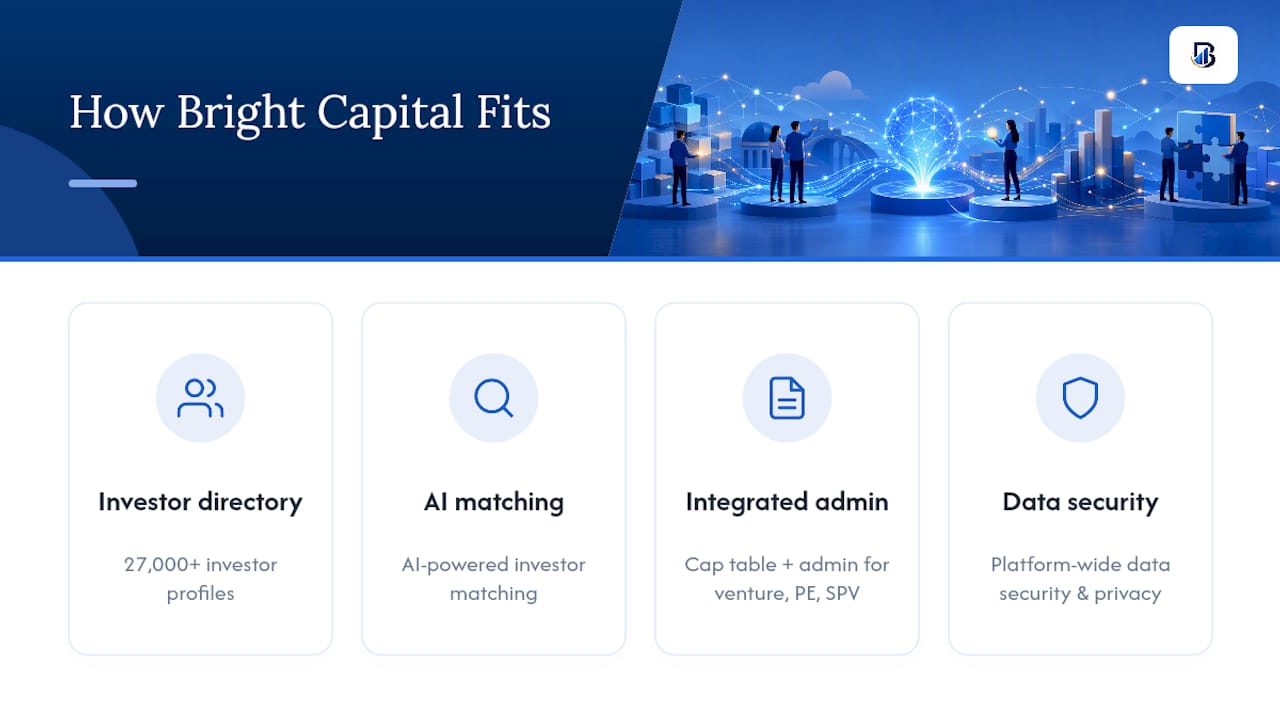
Bright Capital America approaches fund administration as part of a connected workspace rather than a standalone service. The platform pairs an investor directory of over 27,000 profiles with AI-powered matching, integrated cap table management, and fund administration built for venture, private equity, and SPV structures. That matters operationally: capital call notices, investor reporting, and cap table updates draw from the same dataset instead of three disconnected tools requiring manual reconciliation. For GPs managing multiple SPVs alongside a main fund, that integration removes a real source of reporting errors, backed by stated commitments to data security and privacy throughout the platform.
What I've Learned Watching Funds Wait Too Long
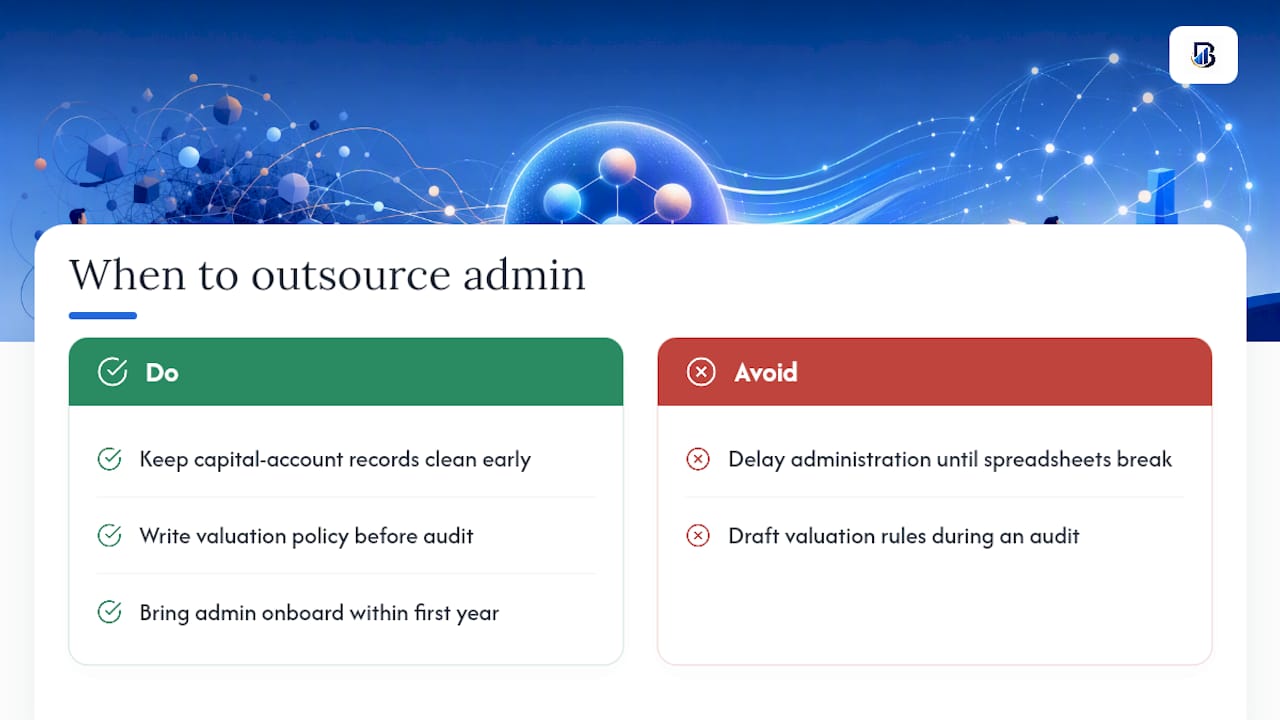
Most managers wish they'd brought in administration a year earlier than they did. By the time the pain of spreadsheet chaos becomes obvious, cleanup already costs more than it would have upfront. Two lessons hold up repeatedly: keep capital account records clean from your very first close, and write your valuation policy down before you need it for an audit, not during one.
If you take one thing from this: clean records early beat clean records eventually, every time.
— Bright
Get Fund Administration Built Into Your Fundraising Platform
Bright Capital America is the alternative to stitching together separate fund administration, cap table, and investor outreach vendors. Everything lives in one workspace instead of three logins that don't talk to each other.

That means:
- Investor directory access with AI-powered matching to LPs actively writing checks in your sector
- Integrated cap table management that stays in sync with fund administration records instead of requiring manual updates
- Secure investor portals for reporting and document sharing, built with data privacy as a core design commitment
- Fund administration support designed for venture, private equity, and SPV structures, not retrofitted from hedge fund tooling
This fits GPs launching a second or third fund who are done maintaining spreadsheets alongside three disconnected vendor logins. If you're formalizing capital raises alongside your administration needs, the private capital raise tools integrate directly with the same platform. Explore the fund administration and platform capabilities and see what an integrated setup actually looks like for your next close.