

If you need a Series A lead now, start with these nine: CRV, Andreessen Horowitz, Standard Capital, Battery Ventures, Sequoia Capital, Accel, Bessemer Venture Partners, Index Ventures, and Matrix Partners. Each leads Series A rounds regularly, each has a distinct sector or founder profile it favors, and each has a reasonably identifiable path in. This isn't a random list of logos with big AUM. It's a shortlist built around one question: which firms actually write the first institutional check and stick around for the ones after it?
Here's the fast version. CRV and Matrix Partners favor technical founders and lead early rounds with unusual consistency. Andreessen Horowitz and Bessemer Venture Partners bring large operating teams that matter once you're past the pitch. Battery Ventures and Sequoia Capital carry the fund size to follow you into growth rounds. Standard Capital runs an open application process, so you don't need a warm introduction to get in front of a partner. Accel and Index Ventures move between seed and Series A leadership with global reach that helps if you're expanding beyond one market.
For outreach, warm introductions still beat cold email at nearly every one of these firms, but Standard Capital's direct application pipeline is a genuine exception worth using if your network is thin. Your first message, whatever the channel, should lead with growth rate and retention data, not a company description.
Key Takeaways
Series A success depends on pairing quantifiable growth metrics with a short, well-targeted investor list and a data room that survives scrutiny on day one.
| Point | Details |
|---|---|
| Prioritize sector fit over check size | Match your sector to a firm's stated thesis before weighing how large a check it typically writes. |
| Lead with growth rate, not ARR | Investors weigh scaling velocity and retention alongside revenue, so front-load growth in your first outreach message. |
| Prepare before you pitch | Build a clean data room with a current model, cohort analysis, and cap table before requesting your first meeting. |
| Expect meaningful dilution from a lead | Lead investors often target roughly 10% to 20% post-close ownership tied to board involvement. |
| Use Bright Capital to run the process | Bright Capital's investor database and equity management tools help you build a shortlist, manage outreach, and keep your cap table current in one workspace. |
Primary sources and further reading
- CRV — Series A metrics VCs expect: supports the metrics guidance on growth rate, recurring revenue, and scaling velocity.
- Standard Capital — The AI-native Series A firm: source for open application pipelines and typical lead ownership ranges.
- Andreessen Horowitz — about: source for the operating-team model and platform-style support.
- Battery Ventures — about: source for thesis-driven investing and flagship fund follow-on capacity.
Last updated: February 2026.
Table of Contents
- Where to Find Series A Investors and How Each One Operates
- What Do Series A Investors Actually Look For?
- Building a Data Room That Speeds Up Diligence
- How Do You Get a Response From a Series A Investor?
- What Should You Weigh Before Choosing a Lead Investor?
- How Bright Capital Helps You Reach and Manage Series A Investors
- Timeline of the Series A Fundraising Process
- How Do You Vet a Series A Investor Before Signing?
- What Happens After Your First Investor Meeting?
- What the Data Actually Tells Founders to Do Differently
- A Faster Way to Reach Series A Investors
- Frequently Asked Questions About Series A Investors
- Sources
Where to Find Series A Investors and How Each One Operates
Series A vc firms aren't interchangeable, even though pitch decks tend to treat them that way. Some lead almost every deal they touch. Others follow a lead and add value through their network. A few will look at your deck without an introduction, but most won't. Knowing which is which before you start emailing saves weeks.
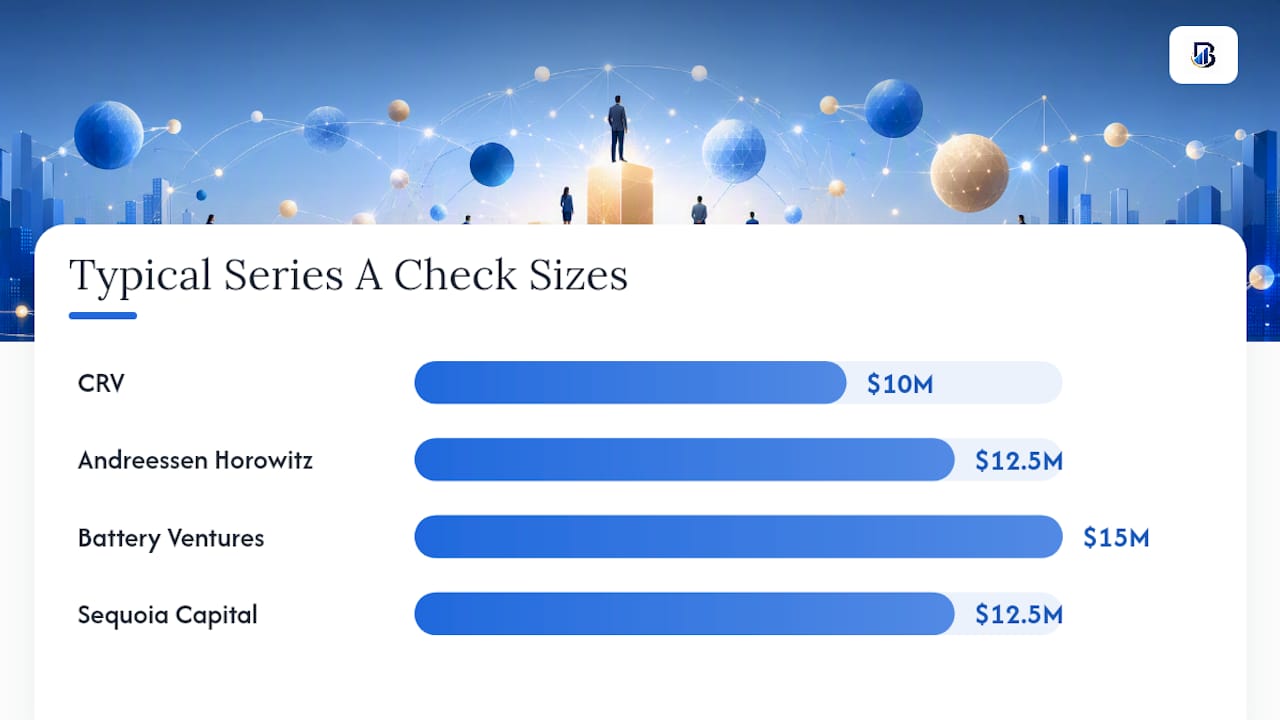
The table below reflects publicly stated firm theses and typical behavior. Treat "typical check size" as directional. Actual amounts shift with valuation, ownership targets, and round size.
| Firm | Stage Focus / Lead Frequency | Typical Series A Check | Sector Focus | Best For | Lead vs. Follow | How to Apply |
|---|---|---|---|---|---|---|
| CRV | Leads seed and Series A frequently | $5M–$15M | Technical/enterprise software | Founders wanting a lead with deep technical-sector depth and follow-on capacity | Primarily lead | Warm intro strongly preferred |
| Andreessen Horowitz | Leads across stages, large operating bench | $5M–$20M+ | Broad, including fintech, bio, crypto, consumer | Founders who need GTM, talent, and policy support post-close | Lead or follow | Warm intro; partner referrals |
| Standard Capital | Series A focused, fast decisioning | Not publicly fixed | Broad, AI-native focus | Founders without a strong VC network wanting a fast decision | Frequently leads | Open application via Standard Capital |
| Battery Ventures | Leads and co-leads, thesis-driven | $5M–$25M | Enterprise software, infrastructure | Founders seeking large follow-on capacity from a global firm | Lead or follow | Warm intro preferred |
| Sequoia Capital | Leads early, follows through later rounds | $5M–$20M+ | Broad technology | Founders aiming for long-term scale with one enduring partner | Primarily lead | Warm intro near-mandatory |
| Accel | Leads seed and Series A consistently | $5M–$15M | Enterprise, consumer, fintech | Founders who want continuity from seed through growth | Lead | Warm intro |
| Bessemer Venture Partners | Broad early-stage leadership | $5M–$20M | Broad sector coverage | Founders wanting deep scaling resources and playbooks | Lead or follow | Warm intro |
| Index Ventures | Cross-border early-stage leader | $5M–$20M | Enterprise, consumer tech | Founders expanding across US/European markets | Lead | Warm intro |
| Matrix Partners | Idea-through-Series-A partner | $3M–$12M | Technical founder teams | Technical founders wanting a founder-empathetic early partner | Lead | Warm intro |
A handful of names on the broader Series A landscape rarely lead these rounds outright but show up as co-investors, sector specialists, or scouts worth knowing: 406 Ventures, ND Capital (f.k.a. NanoDimension), 01 Advisors, 4DI Ventures, 4DX Ventures, 5AM Ventures, Harpoon Ventures, 11.2 Capital, 25M Health, Access Ventures, Acre Venture Partners, Acrew Capital, AeroX Ventures, Airbus Ventures, AirTree Ventures, Alpha Edison, Altimeter, AME Cloud Ventures, Anthem Venture Partners, Boldstart Ventures, Celesta Capital, Cleo Capital, Earthshot Ventures, and Pioneer Fund. Several of these are sector-specific: 5AM Ventures and 25M Health focus on life sciences and health, Airbus Ventures and AeroX Ventures skew aerospace and deep tech, Boldstart Ventures specializes in enterprise infrastructure at the earliest stages, and Cleo Capital and Acrew Capital have built reputations backing diverse founding teams. If your sector matches one of these, they're worth a targeted look even though they don't headline most Series A shortlists.
Reading the "best for" column matters more than reading the check-size column. A firm's typical check tells you what they can write, not what they will write for you, and valuation swings that number by millions in either direction. The "best for" fit tells you whether a partner will actually champion your deal in an investment committee meeting, which is the thing that determines whether you get a term sheet at all.
If you're choosing which column to weight most heavily, weight sector focus first, lead frequency second, and check size last. A firm with the right sector focus but a smaller typical check can often still lead your round or bring in a co-lead. A firm with a huge fund but no domain expertise in your space is a harder sell internally, no matter how much capital it has.
Pro Tip: Cross-reference a firm's recent public deals (via Crunchbase or the firm's own portfolio page) against your sector before you request an introduction. A firm that hasn't led a deal in your space in 18 months has probably shifted its thesis, even if its website still lists that sector.
Standard Capital deserves particular attention if your network doesn't include multiple degrees of separation to a16z or Sequoia partners. It's one of the few names on this list running a structured, public application process rather than relying entirely on warm introductions, and it has been explicit about targeting fast decision timelines. That doesn't mean the bar is lower. It means the door is open, which is not the case with most Series A VC firms, where a cold email to the general partner inbox is close to a dead letter.
What Do Series A Investors Actually Look For?
Series A investors want proof, not promise. At seed, a compelling story and a strong founding team can carry a round. By Series A, CRV's own guidance to founders makes clear that leads expect quantifiable evidence of scaling velocity and recurring revenue, not just a narrative about market size.
That shift trips up a lot of founders who raised a strong seed round on vision alone. Series A is where investors ask you to show your work.
The metrics that move a decision
Growth rate tends to matter more than absolute revenue, particularly for companies that have clearly found product-market fit. A company growing 15% month over month with $80,000 in monthly recurring revenue can be a more attractive Series A candidate than a company sitting flat at $200,000 MRR. CRV's own guidance backs this: investors weigh scaling velocity alongside the revenue number itself, not instead of it. Founders who lead with total ARR and bury the growth curve on slide 14 are burying their strongest argument.
Beyond growth rate, prepare to defend:
- LTV:CAC ratio. Most investors want to see a ratio meaningfully above 3:1, though the acceptable range shifts with sales cycle length and gross margin.
- Gross margin. Software companies typically need to show margins in the 70%–85% range; marketplaces and hardware-adjacent businesses get more latitude, but you need a credible path upward.
- Net revenue retention. A cohort that expands after signing, rather than shrinking, tells investors your product gets stickier over time.
- Cohort retention curves. A flattening retention curve six to twelve months out matters more than a single snapshot number.
- Payback period. How many months of gross margin it takes to recover your customer acquisition cost.
None of these numbers work in isolation. An investor who sees strong LTV:CAC but discovers your cohort retention drops off a cliff at month four will ask harder questions, not fewer.
The qualitative case investors still expect
Numbers get you into the room. They rarely close the round by themselves. Series A leads are still evaluating the founding team's ability to execute at the next order of magnitude, whether your go-to-market motion is repeatable across new segments or geographies, and whether your product has real defensibility, whether that's a data moat, network effects, or genuine switching costs.
Standard Capital's public positioning is a useful data point on the equity side of this equation: some Series A leads target roughly 10% to 20% post-close ownership to justify the board seat and hands-on support that comes with leading. That range shifts with valuation and how competitive your round is, but it's a reasonable planning assumption when you're modeling dilution before term sheets start arriving.
Building a Data Room That Speeds Up Diligence
A weak data room doesn't just slow diligence. It signals that your internal reporting is weak too, and investors read that signal loudly. Build the following before you take a single Series A meeting:
Investor-grade materials checklist:
- One-page investor summary with headline metrics and the ask
- 24 to 36 month financial model with monthly detail for the first 12
- Cohort analysis showing retention and expansion by signup month
- CAC and LTV calculations with the underlying assumptions shown, not just the output
- Fully updated cap table reflecting all SAFEs, notes, and option pool allocations
- Core legal documents: incorporation papers, IP assignment agreements, existing investor agreements
- Revenue breakdown by segment, channel, or product line, whichever cut is most relevant to your business
Organize the data room so a partner can find anything in under two minutes:
- Company overview — deck, one-pager, cap table summary.
- Financials — model, historical P&L, burn rate, and runway calculation.
- Metrics — cohort tables, CAC/LTV workbook, retention curves.
- Legal — incorporation documents, IP assignments, prior financing agreements.
- Team — org chart, key hire bios, option grant summary.
- Customer evidence — logos, case studies, churn/win-loss notes where available.
Each file should answer one question on its own, without a Zoom call to interpret it. A financial model that requires a walkthrough to make sense of is a model that will get flagged internally before it reaches an investment committee.
The most common red flags are avoidable. Inconsistent metrics between your deck and your data room (a growth rate on slide 6 that doesn't match the model in the room) reads as sloppiness at best. Missing cohort tracking suggests you don't actually know your retention curve, which is disqualifying at Series A. Forecasts that assume 20% month-over-month growth for three straight years with no stated assumption behind them get discounted fast, or worse, get you a reputation as unserious before the meeting even happens.
Pro Tip: Build a sensitivity table into your model showing outcomes under conservative, base, and aggressive growth assumptions, with the specific levers (churn rate, sales cycle length, CAC) driving each scenario. Investors trust founders who show their assumptions more than founders who show only the rosiest output.
Bright Capital's equity management tools can help keep your cap table current as SAFEs convert and option grants get issued, which matters because an out-of-date cap table is one of the fastest ways to stall diligence once a term sheet is on the table.
How Do You Get a Response From a Series A Investor?
Warm introductions still convert at a meaningfully higher rate than cold outreach across nearly every firm on this list. If a portfolio founder, advisor, or another investor can make the connection, take that path first. Cold outreach and direct applications exist for a reason, though: not every founder has a network deep enough to reach every relevant partner, and firms like Standard Capital have built entire pipelines around accepting founders who don't.
Use this priority order: warm intro first, direct application second (where one exists, as with Standard Capital), cold outreach last and only when the first two aren't available.
Cold email template:
Subject: [Company] — 40% MoM growth, raising Series A
Hi [Name],
[Company] helps [specific customer] do [specific outcome]. We're at $[X] MRR, growing [Y]% month over month, with [Z]% net revenue retention.
We're raising a Series A to [specific use of funds — expand sales team, enter new market]. I noticed [Firm]'s investment in [relevant portfolio company] and think there's a strong thesis fit.
Would you have 20 minutes in the next two weeks for an intro call?
[Name]
LinkedIn message template:
Building [Company] — [one-line description]. We've grown to $[X] MRR at [Y]% MoM, and I'd value your perspective given [Firm]'s work in [sector]. Open to a quick call?
Front-load your growth rate and retention number in the first sentence, not your company's origin story. Partners scan dozens of these a week; the ones that survive the first three seconds lead with a number that's hard to ignore.
Follow-up cadence that works without becoming a nuisance:
- Day 0: Initial outreach (email or LinkedIn).
- Day 5: Short follow-up with one new data point (a new logo, updated MRR, a press mention).
- Day 12: Final follow-up referencing a specific, recent firm move (a new fund close, a relevant portfolio announcement).
- Day 20: Close the loop. If no response, move the firm to a lower-priority tier and reallocate your energy.
When a partner takes a first meeting and shows real interest, ask directly whether they'd consider leading the round rather than waiting for them to volunteer it. Something like: "Given where we are, would [Firm] be positioned to lead this round, or would you want to co-invest alongside a lead?" That question alone filters out firms that were never going to lead, and it saves you weeks of ambiguous follow-up.
What Should You Weigh Before Choosing a Lead Investor?
The lead investor you choose shapes your company for years, not months. Check size is the least important variable in that decision, even though it's the one most founders anchor on first.
Rank prospective leads on five criteria: check size and ability to reserve for follow-on rounds, hands-on operating support, domain expertise in your specific sector, governance posture (how actively they want board involvement), and demonstrated follow-on behavior in past portfolio companies. Andreessen Horowitz built its entire platform model around the idea that operational support, marketing, recruiting, policy, and legal help, can matter as much as the capital itself. A firm without that bench isn't automatically worse, but you should know what you're trading if you pick a smaller, higher-touch firm over a large operating platform.
On equity: expect a lead to negotiate for a meaningful ownership stake, often in the 10% to 20% range post-close, which typically comes with a board seat and standard protective provisions covering major decisions like future fundraises, acquisitions, and option pool changes. Board seats aren't inherently adversarial, but they do mean a new voice in every major strategic call from here forward.
Before signing anything, ask prospective leads directly:
- How many companies in your portfolio have you followed into a Series B?
- What does hands-on support actually look like in the first six months?
- Who specifically on your team will sit on my board, and what's their track record?
- How do you typically handle a down round or a missed milestone?
Pro Tip: Negotiate structure before you negotiate valuation. A slightly lower valuation with clean terms (standard 1x non-participating liquidation preference, reasonable protective provisions) almost always beats a higher headline number wrapped around aggressive participating preferences or a low ownership threshold that triggers punitive anti-dilution clauses later.
Battery Ventures and Sequoia are useful reference points for founders prioritizing long-term follow-on capacity. Battery's flagship funds are sized specifically to support portfolio companies through multiple future rounds, which matters if you'd rather not run a full fundraising process every 12 months.
How Bright Capital Helps You Reach and Manage Series A Investors
Finding the right names on a list is one problem. Reaching them, tracking who responded, and keeping your cap table clean while you do it, is a different problem entirely, and it's the one that eats founder time during an active raise.

Bright Capital's investor database covers more than 27,000 verified investor profiles, filterable by stage, sector, and check size, so you're not manually cross-referencing firm websites and LinkedIn to figure out who's actually active in your space right now. AI-powered matching surfaces investors whose stated thesis and recent activity align with your specific metrics, rather than a generic "Series A" tag.
A typical workflow looks like this:
- Build a shortlist filtered by sector, stage, and typical check size using the venture capital database.
- Upload your financial model, cap table, and legal documents into a secure data room, organized once and shared selectively as conversations progress.
- Run outreach sequences to your shortlist, tracked in one pipeline instead of scattered across email threads and spreadsheets.
- Manage cap table updates and pro rata tracking through the same platform as new investors commit, so your equity records never drift out of sync with your actual conversations.
Founders raising Series A often lose more time to disorganized outreach and outdated cap tables than to actual investor rejection. Centralizing the process tends to compress the timeline more than any single pitch improvement.
The platform's equity management tools keep ownership records current as SAFEs convert and new investors close, which matters directly during diligence, when a lead's legal team will ask for a clean, current cap table before they'll issue a term sheet.
Timeline of the Series A Fundraising Process
A typical Series A raise runs eight to sixteen weeks from the first outreach to a signed term sheet, though sector, market conditions, and how prepared your materials are can stretch or compress that window significantly.
Weeks 1 to 3: Preparation. Build your data room, finalize your model, and identify your target list of 20 to 40 investors ranked by fit.
Weeks 3 to 6: First meetings. Warm introductions convert to partner meetings faster than cold outreach, so prioritize your network first. Expect one to two meetings per week per active firm as interest builds.
Weeks 6 to 9: Partner and committee review. Interested firms move you through associate calls, then general partner meetings, then internal investment committee discussion. This is where most of the real diligence on metrics happens.
Weeks 9 to 12: Term sheet negotiation. Once a lead signals intent, expect a term sheet within days, followed by one to two weeks of negotiation on valuation, board composition, and protective provisions.
Weeks 12 to 16: Legal diligence and close. Lawyers finalize documentation, remaining diligence items get cleared, and funds get wired. This stage often runs longer than founders expect, particularly if your legal documents weren't fully organized going in.
Running multiple firms through this timeline in parallel, rather than sequentially, is what actually creates negotiating leverage at the term sheet stage.
How Do You Vet a Series A Investor Before Signing?
Due diligence runs both directions. While a firm evaluates your metrics, you should be evaluating its track record just as rigorously.
Start by checking how many companies in the firm's recent portfolio actually received follow-on funding, either from the same firm or a later-stage investor it helped bring in. A firm with a pattern of abandoning portfolio companies after the first check is a real risk, no matter how strong its brand name is.
Talk to at least two or three founders the firm has previously backed, ideally ones no longer in that firm's portfolio, since departed founders tend to give more candid feedback than current ones. Ask specifically about board behavior during a difficult quarter, not just how supportive the partner was when things were going well.
Confirm which partner will actually sit on your board and how much bandwidth they have. A general partner spread across fifteen board seats has less time for you than a rising partner with a lighter load, regardless of how prestigious their name looks on your cap table.
Review the firm's standard term sheet before you're deep in negotiation. Firms with a reputation for aggressive liquidation preferences or unusual protective provisions tend to be consistent about it across their portfolio, and a quick call with a portfolio founder will usually confirm the pattern before you're locked into a negotiation of your own.
What Happens After Your First Investor Meeting?
A first meeting that goes well is a beginning, not a milestone. What you do in the following days determines whether it turns into a term sheet or quietly fades.

Send a follow-up within 24 hours that includes anything the partner asked for during the call, whether that's an updated cohort table, a reference customer, or a clearer breakdown of your CAC by channel. Speed here signals operational discipline, which is exactly the trait Series A investors are trying to assess.
Keep interested firms informed of real progress between meetings, a new enterprise logo, a jump in monthly recurring revenue, a key hire, but avoid manufacturing urgency with vague "lots of interest" messaging that isn't backed by an actual competing term sheet. Investors talk to each other more than founders assume, and a bluff that gets discovered costs you credibility with every firm in that circle.
If a firm passes, ask directly what would have changed their decision. Most partners will give a genuine answer, and that feedback often reveals a metric or positioning gap worth fixing before your next round of meetings, whether that's this raise or your next one.
Treat firms that pass respectfully. A firm that says no at Series A sometimes leads your Series B once the metrics you were missing this time are in place.
What the Data Actually Tells Founders to Do Differently
Most fundraising advice tells founders to "build relationships early" and "focus on the story." Neither is wrong, but neither is what actually moves a Series A decision either. The evidence here points somewhere more specific: investors are running a metrics filter first and a relationship filter second, and founders who reverse that order waste months.
The overrated piece of conventional wisdom is warm introductions as a universal requirement. They still help, but Standard Capital's open pipeline proves the model isn't fixed, and founders without deep networks shouldn't assume they're locked out.
The underrated piece is dilution math. Founders obsess over valuation and barely model what a 15% to 20% lead stake actually does to their ownership two rounds later. Do that math before your first term sheet arrives, not after.
Prioritize this order: fix your metrics story, build your data room, then start outreach. Doing it in reverse is the single most common reason good companies get slow no's instead of fast yeses.
A Faster Way to Reach Series A Investors
Building a Series A investor list by hand, cross-referencing firm websites, LinkedIn, and portfolio pages one at a time, is exactly the kind of work that eats the weeks you should be spending on your pitch and your metrics.
Bright Capital gives you access to more than 27,000 verified investor profiles in one searchable database, filterable by stage, sector, and check size, so you can build a targeted Series A shortlist in an afternoon instead of a month. AI-powered matching surfaces firms whose recent activity actually fits your metrics, and the same platform holds your data room and cap table, so nothing gets scattered across five different tools while you're trying to close a round.
If you're ready to start building your target list and running organized outreach instead of managing spreadsheets, Bright Capital's fundraising infrastructure is built to take you from shortlist to closed round in one workspace. Start by browsing the investor database and building your first shortlist today.
Frequently Asked Questions About Series A Investors
How many Series A investors should I contact?
Aim for a ranked list of 20 to 40 firms, prioritized by sector fit and lead frequency, rather than mass-emailing a hundred generic contacts. A smaller, well-targeted list with strong personalization consistently outperforms volume outreach.
Do I need a warm introduction to reach top series a vc firms?
Warm introductions convert better at most firms, including Sequoia, Accel, and Andreessen Horowitz, but Standard Capital's open application process is a genuine exception that doesn't require one.
What's the difference between seed round investors and Series A investors?
Seed investors weigh team and vision more heavily; Series A investors expect quantifiable proof, including recurring revenue, growth rate, and retention data, before committing.
How much equity does a Series A lead typically take?
Lead investors often target roughly 10% to 20% post-close ownership, though the exact figure shifts with valuation, round size, and how competitive the deal is.
What's the best way to attract investors without a large network?
Focus on metrics that speak for themselves in a cold email, use platforms with structured application processes like Standard Capital, and consider a database tool that surfaces warm-path connections you didn't know you had.
Sources
- CRV — Series A metrics VCs expect
- Standard Capital — The AI-native Series A firm
- Andreessen Horowitz — about