

Choose a post-money SAFE for most pre-seed and seed rounds. It closes faster, costs less in legal fees, and carries no debt obligation. Reach for a convertible note only when you need a short bridge to a priced round or an investor insists on debt protections like interest and a maturity date. The core tradeoff is simple: SAFEs buy speed and simplicity; notes buy structure and investor leverage.
TL;DR:
- Post-money SAFEs are the preferred choice for pre-seed and seed funding due to faster closings, lower legal costs, and no debt obligations, unlike convertible notes.
- Convertible notes accrue interest, have a maturity date, and appear as liabilities on balance sheets, giving debt holders priority over SAFE investors in winding down the company.
- Most early-stage deals, over 90 percent in 2025, use SAFEs because they simplify the process and avoid complicating the balance sheet.
- Using notes is advisable when bridging short-term periods or if investors require debt features, such as interest and a maturity date.
- Founders should model the combined effects of multiple SAFEs and notes beforehand to prevent unexpected dilution or priority issues at conversion.
Table of Contents
- SAFE vs. Convertible Note: The Core Mechanics
- What Terms Actually Move the Needle?
- The Tradeoffs Founders and Investors Actually Face
- When to Use a SAFE vs. When to Use a Note
- How the Math Actually Works at Conversion
- What Signing a Note Costs You at Tax Time
- Your Term Sheet Checklist Before You Sign
- Stacking Instruments Without Wrecking Your Cap Table
- What If the Instrument Never Converts?
- The Bottom Line on Choosing Your Instrument
- What We've Learned Managing SAFEs and Notes at Scale
- Manage Your Fundraise Without the Spreadsheet Chaos
- Sources
SAFE vs. Convertible Note: The Core Mechanics
A post-money SAFE is a contract for future equity, not a loan. The investor hands you cash today in exchange for the right to receive shares later, typically when you raise a priced equity round, sell the company, or dissolve. There's no interest, no repayment obligation, and no maturity date to track.
A convertible note is different in a way that matters legally and financially: it's debt. The company owes the investor a defined amount, that amount accrues interest, and the note carries a maturity date by which it must convert, get repaid, or get extended.
Here's how the two instruments break down at signing:
- SAFE: no interest, no maturity, converts automatically at a qualified financing, liquidity event, or dissolution.
- Convertible note: accrues interest (commonly 4% to 8%), matures in 18 to 36 months, and converts at the same trigger events plus repayment at maturity if it hasn't converted.
- Balance sheet: notes show up as a liability the moment they're signed; SAFEs generally don't, since they aren't debt.
- Dissolution: debt holders are repaid before SAFE holders, since a note is a legal creditor claim and a SAFE is not.
That seniority gap is worth remembering. If your company winds down, note holders line up ahead of SAFE investors for whatever's left, according to Y Combinator's own comparison of the two instruments.
What Terms Actually Move the Needle?
Four contractual levers determine how much of your company you give away, and how much control an investor holds over the outcome.
- Valuation cap vs. discount. The cap sets the maximum price at which the investor's money converts to equity, protecting them from paying a Series A price for pre-seed risk. The discount (often 10% to 20%) gives them a percentage off the next round's price instead. Many instruments include both, and the investor gets whichever produces more shares.
- Interest accrual. A note's interest doesn't get paid in cash. It compounds into the principal, which converts into equity, meaning the founder gives up more ownership for the same cash raised than they would under a SAFE with an identical cap.
- Maturity date. This is the investor's built-in leverage. If you haven't closed a priced round by the maturity date, the note technically comes due, and you're negotiating an extension from a weaker position.
- Seniority and reporting. Notes' debt classification triggers interest-reporting obligations and balance-sheet liabilities that complicate diligence. SAFEs largely sidestep that until they convert.
Adoption data makes the market's preference clear: 90% of pre-seed deals in Q1 2025 used SAFEs rather than notes, according to CRV's analysis of early-stage deal flow. That's not a marginal preference. It reflects how thoroughly the post-money SAFE has displaced the note as the default instrument for early rounds.
The Tradeoffs Founders and Investors Actually Face
Neither instrument is free of downsides, and the tradeoffs land differently depending on which side of the table you're sitting on.
- SAFE advantages for founders: faster closings, lower legal fees, no debt on the books, no maturity deadline forcing a renegotiation.
- SAFE disadvantages for founders: post-money SAFEs are more dilutive dollar-for-dollar than the older pre-money version, since your percentage is locked in at signing regardless of how many other SAFEs you stack afterward.
- Note advantages for investors: interest compensates for time value of money, maturity dates force a resolution instead of an indefinite wait, and creditor status offers real downside protection.
- Note disadvantages for investors and founders alike: slower to negotiate, higher legal costs from custom terms, and the balance-sheet liability complicates future diligence.
Speed and cost differences aren't cosmetic. A SAFE can often close in days using a standard template. A note usually involves more back-and-forth over interest rates, maturity length, and repayment terms, which adds real legal spend before you've banked a dollar.
When to Use a SAFE vs. When to Use a Note
Match the instrument to the situation, not to habit. Most early raises fit cleanly into one of two buckets.
Reach for a SAFE when:
- You're raising a pre-seed or seed round from angels or an accelerator.
- Speed matters more than customized investor protections.
- You want to avoid debt appearing on your cap table or balance sheet before you've generated revenue.
Reach for a convertible note when:
- You're bridging a short gap, typically three to twelve months, before a priced round you already expect to close.
- An institutional investor requires debt features as a condition of writing the check.
- You need the discipline of a maturity date to force resolution on a slow-moving raise.
Stripe's guidance for founders frames this well: SAFEs are the simpler, more flexible default, but notes still serve a real purpose in bridge financing and institutional deals that specifically want debt structure.
Pro Tip: If you're not sure which camp your raise falls into, ask how confident you are in closing a priced round within a year. High confidence points to a SAFE. Real uncertainty about your next round's timing points to a note, where the maturity date at least forces a conversation.
How the Math Actually Works at Conversion
Numbers make this concrete faster than any explanation. Assume a founder raises $500,000 on a SAFE with a $5 million post-money cap, and separately raises $500,000 on a note with a 5% interest rate over 24 months and the same $5 million cap.
- SAFE conversion: the post-money cap already reflects the investor's locked-in percentage. A $500,000 SAFE on a $5 million post-money cap converts to 10% ownership, full stop, regardless of what happens between signing and the priced round.
- Note conversion: that same $500,000 at 5% annual interest over 24 months accrues roughly $50,000 in additional principal, so the investor converts $550,000 worth of value into equity at the cap price instead of $500,000, claiming more shares for the identical cash outlay.
- Stacking multiple instruments: raise several SAFEs at different caps, and each investor's post-money percentage is fixed at signing, meaning later SAFEs compress the founder's remaining ownership rather than diluting earlier investors.
| Instrument | Principal | Extra from interest | Effective conversion amount |
|---|---|---|---|
| SAFE ($5M cap) | $500,000 | $0 | $500,000 |
| Convertible note ($5M cap, 5%, 24 months) | $500,000 | $50,000 | $550,000 |
Founders stacking multiple SAFEs or notes ahead of a priced round should model the combined effect before signing anything new. A cap-table tool that tracks each instrument's post-money percentage in real time catches stacking problems long before they show up as an unpleasant surprise at your Series A.
What Signing a Note Costs You at Tax Time
The debt classification of a convertible note isn't just a balance-sheet technicality. It creates real reporting work: accrued interest needs to be tracked and disclosed, and the liability shows up in any financial statement an acquirer or auditor reviews.
- Notes as debt: interest accrual triggers reporting obligations, and the outstanding balance is a liability that complicates due diligence during an acquisition or later financing.
- SAFE tax treatment: SAFEs raise their own open questions. Accounting bodies including FASB's private-company panel have debated how to classify SAFEs on financial statements, since they don't fit neatly into existing debt or equity categories.
- QSBS timing: whether a SAFE or note affects your Qualified Small Business Stock holding period is a real question, and the answer depends on specifics your accountant needs to review, not a generic rule you can apply universally.
- Documentation discipline: keep signed copies, cap tables, and conversion calculations organized from day one. Acquirers and later-stage investors will ask for a clean paper trail during diligence, and reconstructing it after the fact is far more expensive than maintaining it as you go.
Your Term Sheet Checklist Before You Sign
Bring these questions into every investor conversation, whether you're reviewing a SAFE or a note.
- What's the valuation cap, and how does it compare to your last round or your current 409A?
- Is there a discount, and if so, does it stack with the cap or apply only if no cap exists?
- For notes: what's the interest rate and maturity date, and what happens if you haven't converted by then?
- What's the qualified financing threshold that triggers automatic conversion?
- Are there pro-rata rights or a most-favored-nation clause that could affect future rounds?
Prioritize differently depending on your goal. If runway is the constraint, negotiate for a longer note maturity or skip notes entirely in favor of a SAFE with no deadline pressure. If minimizing dilution is the priority, push harder on the cap than the discount, since the cap usually has more leverage over your eventual ownership percentage.
Pro Tip: Resist the urge to heavily customize the YC post-money SAFE template beyond the standard negotiated fields. Experienced investors expect the unmodified form, and unusual redlines can read as inexperience rather than savvy negotiation.
Stacking Instruments Without Wrecking Your Cap Table
Founders who raise both SAFEs and notes, or several rounds of each, run into a specific problem: unclear priority at conversion. Debt holders rank ahead of SAFE holders in dissolution, but among SAFEs and notes at different caps, the waterfall can get messy fast.
- Stacking low caps from early SAFEs compresses the value available to later investors and to the founder.
- Mismatched conversion triggers between instruments create ambiguity about which converts first.
- The fix: reconcile all outstanding instruments before a priced round closes, and use explicit waterfall language in later agreements to spell out conversion order.
What If the Instrument Never Converts?
Not every SAFE or note reaches a priced round. Here's what happens in the less common outcomes.
- SAFE at dissolution: the investor typically recovers their purchase amount or the as-converted value, whichever is greater, but ranks junior to any debt holders.
- Note at maturity with no conversion event: the company either repays the principal plus accrued interest, negotiates an extension, or converts the note at a predetermined valuation, depending on what the agreement specifies.
- Documentation practice: even in these unlikely tails, keep dissolution and maturity provisions clearly documented so there's no dispute over which outcome applies.
The Bottom Line on Choosing Your Instrument
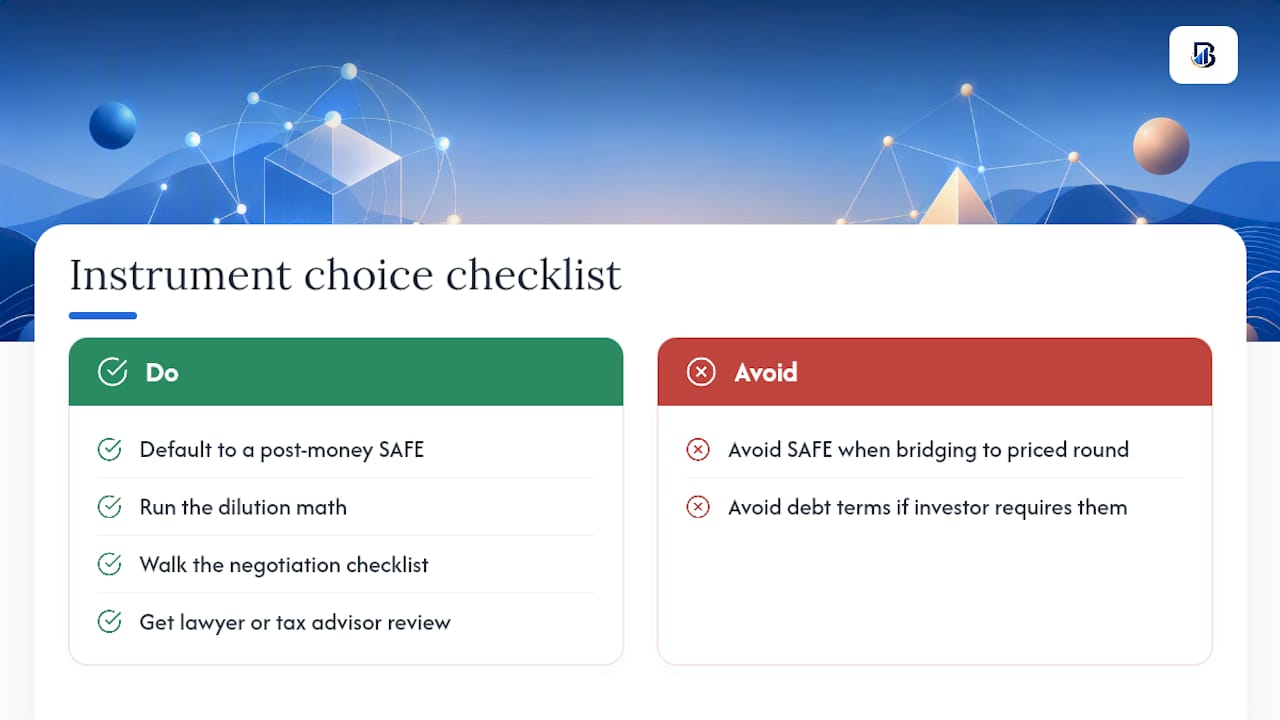
Default to a post-money SAFE for pre-seed and seed rounds unless you're bridging to a priced round on a short timeline or an investor specifically requires debt terms. Before signing anything, run the dilution math for your specific cap and discount, walk through the negotiation checklist above, and get a lawyer or tax advisor to review QSBS and reporting implications for your situation.
What We've Learned Managing SAFEs and Notes at Scale
Founders rarely struggle with the concept of a SAFE or a note. They struggle with tracking multiple instruments across several rounds without losing sight of actual ownership. Brightcapital's cap-table tools model post-money SAFE and note conversions side by side, so stacking effects show up before they become a Series A surprise. Paired with Funding Academy courses and access to a broad investor directory, founders can move from term sheet to signed round without losing track of who owns what.
— Bright
Manage Your Fundraise Without the Spreadsheet Chaos
Tracking SAFEs and notes across a spreadsheet works until your third investor asks for their exact post-money percentage and you realize two of your caps overlap in ways you didn't model. Brightcapital's platform pairs cap-table tracking directly with fundraising pipeline management, so every SAFE and note you issue updates ownership calculations automatically instead of living in a separate file you have to reconcile by hand.

That integration matters most when you're raising from multiple sources at once. Instead of juggling a cap-table tool, a CRM for investor outreach, and a document repository for signed agreements, founders using Brightcapital work from one workspace that connects to over 27,000 verified investor profiles. If you're preparing your next round and want to see how a SAFE or note affects your ownership before you sign it, explore Bright Capital America's private capital raise tools and model your term sheet before your next investor call.
Sources
- SAFE vs. convertible note — CRV
- SAFE vs. convertible note — Y Combinator
- The post-money SAFE, explained — Montague Law
- Convertible notes vs SAFEs — Stripe