

Rule 701 lets private U.S. companies grant stock options, RSUs, and restricted stock to employees, directors, and consultants without SEC registration, as long as issuers stay within strict eligibility rules and dollar-based limits. Two numbers matter most: the rolling 12-month grant cap under the three-prong test, and the $10 million threshold that triggers enhanced disclosure. Miss either one and you risk rescission claims that surface right when you're trying to close a financing or an acquisition.
TL;DR:
- Companies must carefully track grant limits using a rolling 12-month total, considering both options' exercise prices and RSUs' fair value.
- Once the $10 million sales threshold is exceeded in a rolling year, detailed disclosure must be delivered before any securities are issued or exercised.
- Eligible recipients are natural persons such as employees, directors, officers, and bona fide consultants, but not entities or individuals involved in fundraising activities.
- Common compliance issues include granting to the wrong entity, improper modeling of repricings, failure to subtract forfeitures, and late or undocumented disclosure delivery.
- Maintaining a centralized, timestamped cap table and equity ledger simplifies ongoing Rule 701 compliance and readiness for audits or diligence.
Table of Contents
- What Rule 701 Options Are and When the Exemption Applies
- Who Qualifies for Rule 701 Options (and Who Doesn't)
- How to Calculate Rule 701 Limits: The Three-Prong Test
- The $10 Million Disclosure Trigger: What to Deliver and When
- Common Rule 701 Compliance Traps and Their Consequences
- Running a Rule 701 Ledger: The Operational Checklist
- Bright's Practical Priorities for Rule 701 Compliance
- Bright Capital America: Built for Rule 701 Recordkeeping
- Sources
What Rule 701 Options Are and When the Exemption Applies
Rule 701 is a federal exemption under the Securities Act of 1933, and it exists for one narrow purpose: letting private companies compensate people with equity without running a full securities registration every time. The exemption is available only to the issuer itself, not to affiliates, and it does not cover resales of the securities once issued. Every share, option, or unit granted under Rule 701 comes out restricted, meaning the recipient can't just turn around and sell it on the open market.
To qualify, the grant has to flow from a written compensatory benefit plan or an individual written compensation contract. That's the anchor document regulators and diligence teams look for first.
The exemption covers several award types:
- Stock options (incentive and nonqualified)
- Restricted stock awards (RSAs)
- Restricted stock units (RSUs)
- Stock appreciation rights and similar compensatory instruments
If your legal team hasn't cited 17 CFR § 230.701 directly when drafting your option plan, that's worth fixing before your next board meeting. The SEC's own guidance on Rule 701 confirms the affiliate and resale carve-outs that keep the exemption narrow by design.
Who Qualifies for Rule 701 Options (and Who Doesn't)
Rule 701(c) limits eligible recipients to natural persons in specific roles. That word "natural" is doing a lot of work; it excludes entities entirely.
Eligible recipients include:
- Employees, whether full-time or part-time
- Directors and officers
- General partners
- Consultants and advisors who provide bona fide services, not capital-raising or promotional activity
Two traps catch companies constantly. First, consultants who operate through an LLC or personal services corporation aren't eligible as that entity. Structure the agreement so the individual, not the company, is the named optionee. Second, anyone whose role touches fundraising, investor relations, or market-making for your securities is excluded outright, even if they also do legitimate advisory work. An "advisory board" member who's really there to open investor doors is a Rule 701 audit finding waiting to happen.
Pro Tip: Before signing any advisor agreement, ask what percentage of their work involves introductions to capital. If it's more than incidental, route the grant through a different exemption, such as Regulation D, instead.
How to Calculate Rule 701 Limits: The Three-Prong Test
Rule 701 limits do not have one flat number, it uses the greatest of three tests, measured on a rolling 12-month basis:
- a minimum threshold in aggregate sales price or amount,
- a percentage of the issuer's total assets, measured at the end of its last fiscal year, or
- a percentage of the outstanding amount of the class of securities being sold, also measured at the last fiscal year end
Whichever of those three produces the largest figure sets your ceiling for that rolling window, per 17 CFR § 230.701.
Counting mechanics matter as much as the formula. Options count against your limit at the aggregate exercise price on the grant date, not the eventual fair market value. RSUs and restricted stock count at fair value on grant, which is why practitioner examples consistently show RSUs eating through Rule 701 capacity faster than options granted around the same time. A repricing counts as an entirely new sale for capacity purposes; forfeited or canceled awards drop back out of the running total.
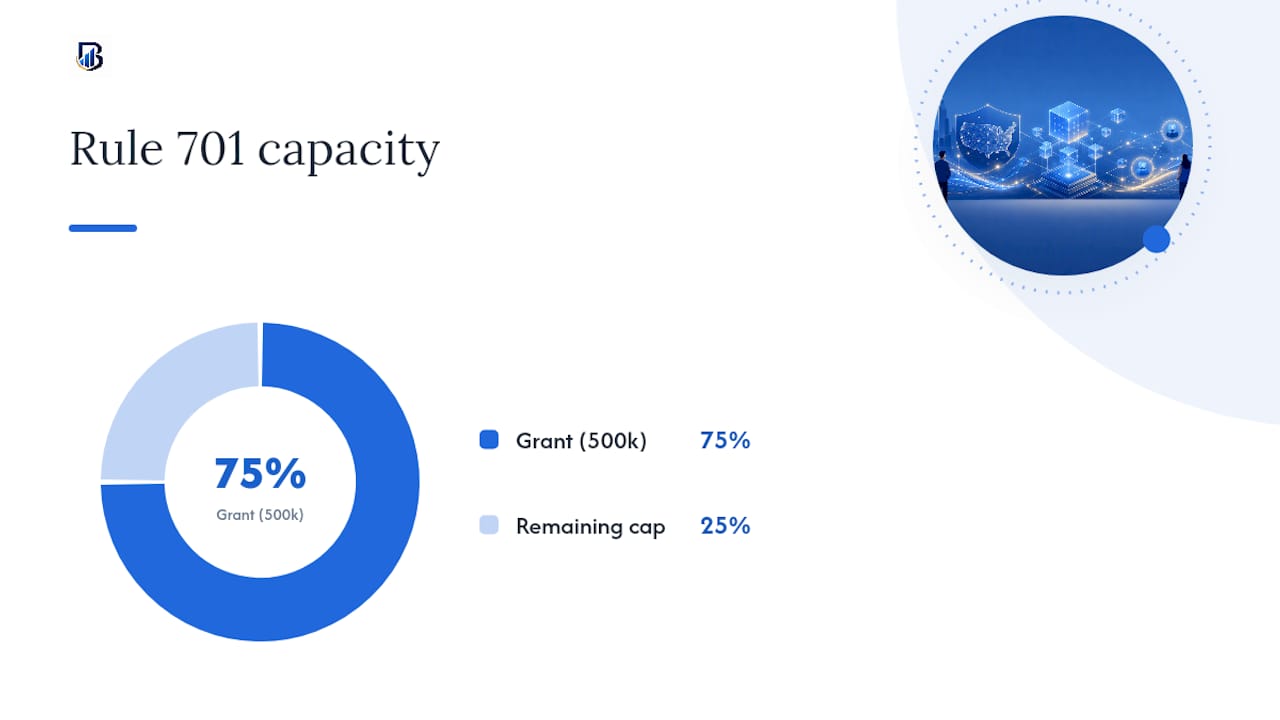
If it grants options for 500,000 shares at a $1.50 strike, that's $750,000 in exercise price consumed, three-quarters of the annual cap, before counting a single RSU.
The $10 Million Disclosure Trigger: What to Deliver and When
Once aggregate sales under Rule 701 exceed $10 million in any rolling 12-month period, the exemption stops being simple. The issuer must deliver enhanced disclosure to every investor who received securities during that period, and the delivery has to happen a reasonable period of time before the date of sale, according to the SEC's Rule 701 guidance. That $10 million bar replaced a $5 million threshold when the SEC updated the rule in its 2018 final release, giving growth-stage companies more room before the disclosure obligation kicks in.
Required disclosure components include:
- A copy of the written benefit plan or compensation contract
- Risk factors associated with investing in the securities
- Financial statements dated within 180 days of the sale
Timing differs by award type. For options, "date of sale" is generally treated as the date of exercise, so disclosure needs to reach the holder before then. For RSUs, delivery typically needs to happen before grant, since there's no separate exercise event later. SEC staff guidance issued in March 2026 reinforces that companies should plan disclosure prospectively, once they can see the $10 million trigger coming, rather than scrambling after the fact.
Pro Tip: Build disclosure delivery into a secure, timestamped portal rather than email attachments. If the SEC ever asks you to prove delivery, a login log beats a sent-mail folder.
Common Rule 701 Compliance Traps and Their Consequences
Most Rule 701 problems trace back to a handful of repeat offenders:
- Granting options to a consultant's entity instead of the individual
- Including a fundraising-adjacent advisor in the compensatory pool
- Forgetting to model a repricing as a new sale before board approval
- Failing to subtract forfeited grants from the running 12-month total
- Delivering enhanced disclosure late, or not documenting delivery at all
The consequences aren't abstract. A blown exemption gives affected holders rescission rights, meaning they can demand their money back on the sale. That same defect surfaces during M&A or IPO diligence, when a buyer's counsel runs the cap table against Rule 701's limits and finds the gap. The Cooley GO analysis of Rule 701 notes that remediation options exist, including rescission offers, reissuance under Regulation D, retroactive disclosure packages, or representations-and-warranties insurance to shift the risk in a deal. None of them are cheap, and all of them are more expensive than getting the ledger right the first time.
Running a Rule 701 Ledger: The Operational Checklist
A single ledger tied to your cap table, not a spreadsheet buried in someone's email, is the difference between confidence and guesswork at your next audit.
- Track every grant with date, award type, share count, strike price or fair value, and the amount it counts against your rolling limit.
- Flag forfeitures and repricings the moment they happen, since both change your running total in opposite directions.
- Test your 12-month total at every new grant, not just at fiscal year end, so you see the $10 million trigger coming.
- Log disclosure delivery with timestamps, downloadable PDFs, and participant confirmations, not just a note that "we sent it."
Cap-table platforms that pair equity tracking with secure document delivery make this far less manual than stitching together a spreadsheet and a shared drive. Bright's own equity calculators are built for exactly this kind of rolling-limit modeling.
Pro Tip: Run your Rule 701 test monthly, not quarterly. A single large grant can push you past the $10 million mark faster than most finance teams expect.
Bright's Practical Priorities for Rule 701 Compliance
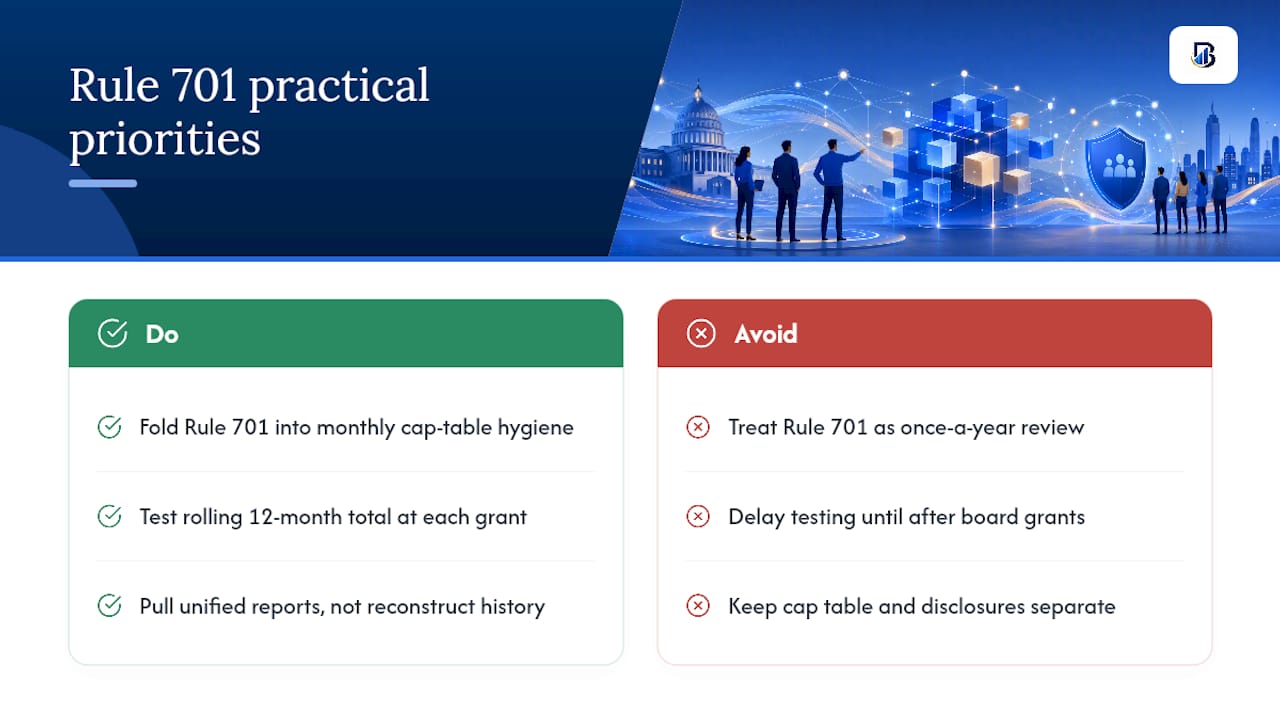
The companies that handle Rule 701 well don't treat it as a once-a-year legal review. They fold it into the same monthly cadence as their cap-table hygiene, testing the rolling 12-month total every time a grant goes to the board, not after the fact. That habit alone catches most repricing surprises before they become disclosure emergencies.
What we'd push back on is the instinct to keep equity records and document delivery in separate systems. When your cap table and your disclosure trail live in one place, you're not reconstructing history under deadline pressure. You're just pulling a report.
— Bright
Bright Capital America: Built for Rule 701 Recordkeeping
Bright Capital America gives founders and HR teams one workspace instead of three disconnected tools for the exact problem this article covers: tracking grants against Rule 701's rolling limits and proving disclosure went out on time. The platform's integrated cap table and equity management tools log grant dates, strike prices, and forfeitures against a single running total, and secure document delivery creates the timestamped access record that holds up in diligence.

For teams building out compensation programs, the Funding Academy walks through practical equity workflows alongside fundraising fundamentals, and it pairs naturally with a review of executive bonus arrangements for companies layering non-equity compensation into the same benefit plan. If you're modeling a raise alongside your option grants, Bright's private capital raise infrastructure connects that cap-table data directly to your fundraising pipeline. Start by mapping your current grants against the rolling 12-month limit; if you're within striking distance of $10 million, that's the moment to set up a compliant delivery workflow, not after.
This article is general information, not a substitute for advice from a qualified financial advisor. Consult a qualified financial professional about your own circumstances before acting on anything here.
Sources
- 17 CFR § 230.701 - Exemption for offers and sales of securities pursuant to certain compensatory benefit plans and contracts relating to compensation.
- Why Private Companies Should Know About Rule 701 – Cooley GO