

If you're running a community raise under $5 million with a mix of retail backers, Regulation Crowdfunding usually fits. If you're courting accredited investors for a larger or faster round, Regulation D, typically through Rule 506(c) or 506(b), is the better tool. Rule 504 and staged approaches cover the exceptions. The decision hinges on four axes: raise size, investor type, timeline, and how much administrative work your team can absorb. The SEC and FINRA are the two agencies whose rules govern every detail that follows.
TL;DR:
- Regulation Crowdfunding is suitable for raises under five million dollars with retail investors and requires a funding portal and Form C filing.
- Regulation D, especially Rule 506(c), is preferred for larger raises above five million dollars with accredited investors and involves less ongoing disclosure.
- Verifying investor accreditation under Rule 506(c) requires documented proof such as tax returns or third-party verification, with records kept for at least five years.
- The choice between Reg CF and Reg D depends on raise size, investor type, marketing strategy, and timeline, with staged approaches often used for scaling.
- Managing a large retail cap table from a Reg CF raise demands integrated platforms to handle investor communications and compliance efficiently.
Table of Contents
- Reg CF vs Reg D: The Full Side-by-Side Comparison
- Who Can Invest, and How Do You Verify Them?
- What Filings and Disclosures Does Each Rule Require?
- What Do These Raises Actually Cost, and How Long Do They Take?
- How Do You Decide Which Rule Fits Your Raise?
- Managing a Reg CF Cap Table Without Losing Your Mind
- A Founder-Facing Take on Control vs. Distribution
- How Brightcapital Helps You Run Either Raise
- Primary Sources to Check Before You File
- Sources
Reg CF vs Reg D: The Full Side-by-Side Comparison
Founders weighing Reg CF vs Reg D need to compare five things at once: how much you can raise, who's allowed to write a check, how you can market the deal, what paperwork you owe the SEC, and what happens to your cap table afterward. Here's how the two exemptions actually stack up.
Raise caps. Regulation Crowdfunding caps a company at $5 million in any rolling 12-month period. Regulation D works differently depending on which rule you invoke: Rule 504 permits limited offerings up to $10 million. for issuers that use it, while Rule 506, covering both 506(b) and 506(c), does not have a dollar cap. That single fact explains why growth-stage companies chasing a $15 million round almost never look at Reg CF.
Investor eligibility. Reg CF opens the door to both accredited and non-accredited investors, but caps each person's check size against their income or net worth. Rule 506(c) restricts participation to accredited investors only, full stop. Rule 506(b) allows up to 35 non-accredited investors who meet a sophistication standard, alongside unlimited accredited investors.
Marketing and solicitation. This is where founders get tripped up most often. Reg CF campaigns run publicly through a funding portal, so promotion is expected and encouraged. Rule 506(c) also permits general solicitation, meaning you can advertise the raise openly, but only if you verify every investor's accredited status. Rule 506(b) forbids general solicitation entirely; any investor relationship has to exist before you pitch the deal.
Intermediaries and filings. Reg CF transactions must run through an SEC-registered funding portal or broker-dealer, and each campaign requires a Form C filing. Reg D has no mandatory intermediary. Instead, issuers file a brief Form D notice within 15 days of the first sale.
Administrative outcomes. The practical differences show up after the money lands.
- Reg CF campaigns pay portal fees on top of legal costs, and financial statement requirements scale up (review or audit level) as the raise size increases; for tailored options, consider alternative funding options and intermediary services to move your business forward.
- Reg D deals typically involve heavier upfront legal drafting for a private placement memorandum, but lighter ongoing disclosure.
- Reg CF often leaves founders with a cap table carrying hundreds of small holders, which complicates future financing rounds and shareholder votes.
- Reg D keeps the investor roster short and concentrated, which is why venture-backed companies almost always default to it.
FINRA oversees the funding portals and broker-dealers that mediate Reg CF deals, so vetting your portal's FINRA registration status before you sign a contract is a reasonable first step.
Who Can Invest, and How Do You Verify Them?
The investor rules are where Reg CF vs Reg D diverges most sharply in daily practice, not just on paper. An accredited investor generally means someone who meets set income or net worth thresholds, or holds certain professional certifications. That definition drives almost everything else in this section.
Under Reg CF, non-accredited investors can participate, but their check sizes are capped based on income and net worth, which keeps any single retail investor's exposure proportionate. That's a built-in investor protection, but it also means your cap table fills up faster with smaller checks if you want to hit your target raise.
Rule 506(b) lets you bring in up to 35 non-accredited investors as long as they're "sophisticated," meaning they have enough financial experience to evaluate the deal's risks even without meeting the accredited threshold. Rule 506(c) skips that gray area entirely: every investor must be accredited, and the issuer has to take reasonable steps to verify accredited status rather than simply taking their word for it.
Practical verification usually means one of these:
- Reviewing tax returns, W-2s, or brokerage statements to confirm income or net worth.
- Obtaining a written confirmation letter from a CPA, attorney, or registered investment adviser.
- Using a third-party verification service that specializes in accredited-investor checks.
Pro Tip: Keep every verification document on file for at least five years. If the SEC ever questions a 506(c) raise, the burden is on you to prove you took "reasonable steps," not just that your investors happened to qualify.
What Filings and Disclosures Does Each Rule Require?
The compliance sequence looks different depending on which exemption you pick, and the paperwork gap is one of the biggest cost drivers in this decision.
- Reg CF: Form C on the portal. You file Form C directly through your funding portal, disclosing your business model, financials, use of proceeds, and risk factors. The required financial statement level (certified by management, reviewed, or audited) depends on how much you're raising, and larger raises trigger stricter scrutiny.
- Reg CF: annual reporting. After the raise closes, you owe an annual report and must update investors on material events, an ongoing obligation many founders underestimate when they first budget for a campaign.
- Reg D: Form D within 15 days. Issuers relying on Rule 504 or 506 file Form D through EDGAR within 15 days of the first sale. It's a notice filing, not a disclosure document, which is why Reg D carries far less ongoing paperwork than Reg CF.
- Reg D: state blue-sky notices. Some Reg D offerings still require state-level notice filings, so don't assume the federal exemption clears every regulatory box on its own.
- Bad-actor and resale checks apply to both. Reg CF securities generally cannot be resold for one year, and Regulation Crowdfunding offerings are subject to statutory "bad actor" disqualification provisions. Reg D deals carry similar bad-actor restrictions, so a felony securities conviction on your cap table disqualifies the whole offering under either exemption.
That one-year resale hold under Reg CF matters more than founders expect: it affects how you communicate liquidity expectations to retail investors from day one, so set that expectation in your investor updates before anyone asks.
What Do These Raises Actually Cost, and How Long Do They Take?
Numbers vary widely here because legal and accounting fees track the complexity of your cap table and disclosure level, not a flat rate. A straightforward Reg CF campaign with a simple SAFE structure costs less in legal drafting than a Reg D round with a full private placement memorandum and multiple investor side letters. Reg CF adds a layer Reg D doesn't: portal fees, which typically run as a percentage of funds raised plus payment processing charges, both of which cut into your net proceeds before you ever touch the money.
Timelines diverge just as much. Reg D rounds, especially 506(b) deals with investors you already know, can close in weeks once financials and the PPM are ready. Reg CF campaigns usually take longer, because the portal reviews your listing, investors need onboarding time, and the offering has to stay live long enough to hit your funding target.
- Legal and accounting costs scale with disclosure complexity, not the exemption's name alone.
- Portal and processing fees are a Reg CF-specific line item that doesn't exist under Reg D.
- Reg D can close faster when your accredited-investor pipeline is already warm.
- Hundreds of retail investors from a Reg CF raise create ongoing admin load that a single integrated cap-table system can absorb far more cheaply than manual spreadsheets.
Practitioner guidance from firms like Orrick notes that founders routinely underestimate this admin burden. Portal fees plus a large roster of small investors can approach the cost and complexity of a private placement once you factor in the time spent on investor communications and recordkeeping.
How Do You Decide Which Rule Fits Your Raise?
Run through this checklist before you commit to either exemption:
- Raise size under $5 million with retail appeal? Reg CF is worth exploring first.
- Raise size above $5 million, or targeting institutional or accredited money? Reg D, usually Rule 506(b) or 506(c), is the standard path.
- Need to advertise publicly? Rule 506(c) or a Reg CF portal campaign both allow it; 506(b) does not.
- Tight timeline with warm accredited relationships? Reg D 506(b) tends to close fastest.
- Want community buy-in and marketing exposure alongside capital? Reg CF delivers both, at the cost of a bigger cap table.
Get counsel involved before you file anything, not after you've already started marketing. Have your financials, an investor questionnaire, and (if you're going the Reg D route) a private placement memorandum drafted early.
A staged approach, Reg CF first to build momentum and prove demand, followed by a Reg D round with accredited investors, is used in practice. Just don't run both offerings simultaneously for the same securities; overlapping raises can trigger integration issues that jeopardize both exemptions. Coordinate with counsel to keep the timing clean.
Pro Tip: If you're eyeing a stair-step strategy, close your Reg CF round completely, including the resale-hold disclosures to investors, before you open term sheet conversations for a Reg D follow-on.
Managing a Reg CF Cap Table Without Losing Your Mind
A Reg CF raise that pulls in 300 small checks solves your funding problem and creates a governance problem in the same afternoon. Every one of those investors expects updates, K-1s or tax documents where applicable, and a say in shareholder votes. Manually tracking that in spreadsheets is how founders lose weeks of runway to admin instead of product work.

An integrated fundraising and cap-table platform closes that gap. It reduces the marginal cost of managing each retail investor and keeps reporting and communications centralized instead of scattered across email threads and disconnected spreadsheets.
Where this matters most:
- Post-raise investor communications across a large, retail-heavy cap table.
- Coordinating a Reg CF-to-Reg D stair-step without losing track of who invested under which terms.
- Keeping secure, auditable records for bad-actor checks and accredited-investor verification.
If your raise strategy depends on scale, whether that's investor count or a future follow-on round, the admin tooling you pick matters as much as the exemption you choose.
A Founder-Facing Take on Control vs. Distribution
The real tension in Reg CF vs Reg D isn't legal complexity. It's control. Reg D lets you run the raise on your own terms, choosing your investors, setting your timeline, and marketing (or not marketing) exactly as you see fit. Reg CF hands some of that control to a funding portal and to public visibility, in exchange for broader distribution and a marketing story you can't buy with a private placement.
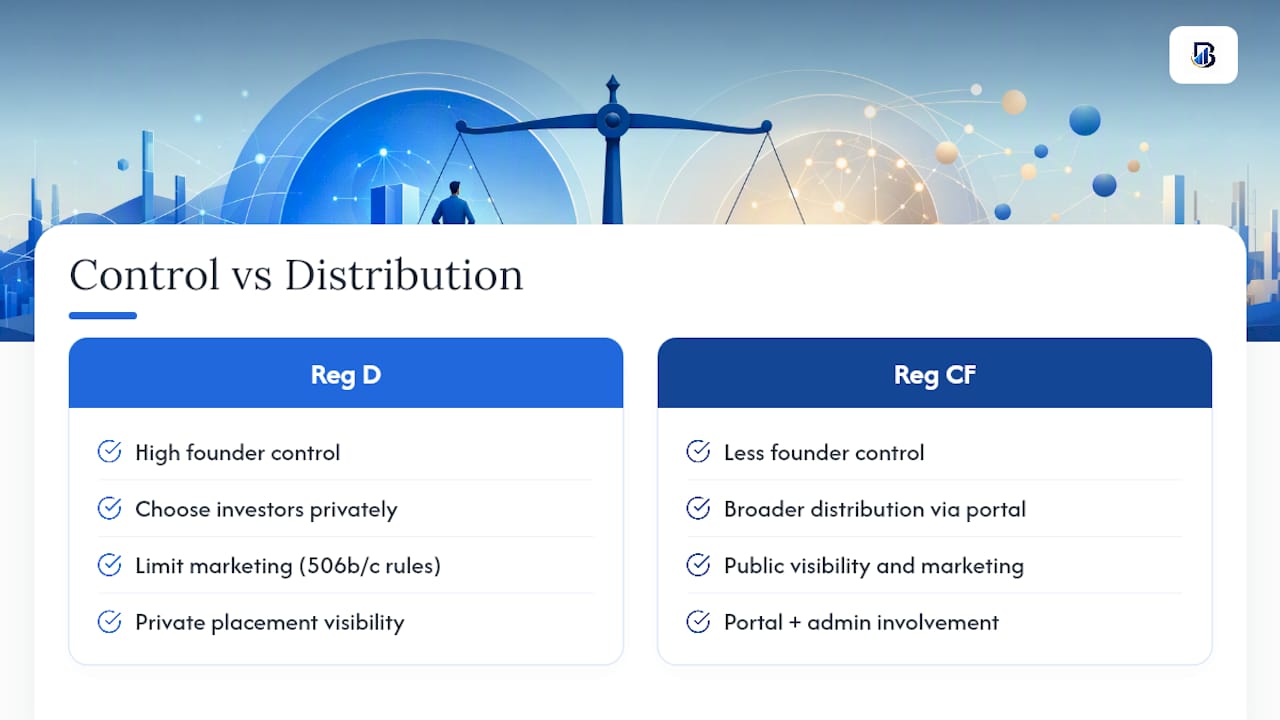
The traps that catch founders aren't exotic. Inadvertent general solicitation under 506(b) is the most common, usually from a founder posting about the raise on social media before realizing the rule bars it. Sloppy accredited-investor verification under 506(c) is the second. Underestimating portal and admin fees under Reg CF is the third, and it's the one that shows up as a smaller check in your bank account than you modeled.
Whichever exemption you choose, get your financials, disclosures, and verification process locked down before you take a single dollar.
— Bright
How Brightcapital Helps You Run Either Raise
Once you've settled on Reg CF, Reg D, or a staged combination, the next question is how you'll manage investor relationships without drowning in spreadsheets. A comprehensive capital platform can provide founders one workspace to handle both sides of that problem: access to a vast directory of verified investor profiles for sourcing your round, and integrated cap-table tools that keep every commitment, document, and update in one place instead of scattered across email and shared drives.

That combination matters most for founders running a retail-heavy Reg CF raise or a stair-step strategy into Reg D, where the number of stakeholders (and the paperwork attached to each one) grows fast. Brightcapital's fundraising infrastructure is built to keep that growth from turning into an operations bottleneck, with secure document storage and communication tools built into the same platform where you're already tracking your cap table. If you're preparing an offering and want to see how investor discovery and post-raise admin work together, start by browsing the investor database to see what a matched search looks like for your sector and stage.
Primary Sources to Check Before You File
These are the primary sources examiners and counsel actually cite, not summaries of them:
- SEC | Regulation Crowdfunding overview
- SEC | Exempt Offerings overview
- Investor
- FINRA | Funding portals we regulate
Confirm every filing detail against these before you rely on any secondary summary, including this one.
This article is general information, not a substitute for advice from a qualified lawyer. Consult a qualified legal professional about your own circumstances before acting on anything here.