

Pro rata rights give an investor the contractual option, but not the obligation, to buy enough new securities in a future financing round to maintain their existing ownership percentage. The key implication: the investor must pay real capital and act inside a defined notice window, or the right lapses. The NVCA model term sheet and Investors' Rights Agreement remain the standard vehicles for granting it, and Brightcapital's work with founders modeling these clauses shows the same pattern repeatedly: missed elections, not disputed terms, cause most lost allocations.
TL;DR:
- Pro rata rights are typically embedded in Investors' Rights Agreements, side letters, or SAFE agreements, and they usually don't auto-include in SAFEs or convertible notes.
- The basis for calculating pro rata allocations can be percentage, dollar-for-dollar, or fixed-sum, with each method impacting future rounds differently.
- Exercising pro rata is optional and should be a strategic decision based on valuation, reserves, and portfolio concentration, not an automatic entitlement.
- Proper modeling before a round, considering SAFE conversions, option pool expansion, and secondary sales, is essential to avoid cap table overhang and unexpected dilution.
- Using toolsets like Brightcapital's equity management platform helps founders track deadlines, election responses, and ownership levels to prevent dilution disputes.
Table of Contents
- Where Pro Rata Rights Live in Your Deal Documents
- Full, Partial, Super, and Time-Limited: Know Which Variant You're Signing
- A Worked Example: Calculating the Allocation
- What Each Side Actually Gains and Risks
- Drafting the Clause: Levers Founders and Investors Should Actually Use
- When Should an Investor Actually Exercise?
- Modeling the Cap Table Before You Sign Anything
- A Quick Legal Checklist Before You Send the Documents to Counsel
- Why Most Pro Rata Disputes Are Preventable, Not Inevitable
- How Brightcapital Keeps Your Cap Table Honest Through Every Round
- Where to Go Deeper on Pro Rata Terms
- Sources
Where Pro Rata Rights Live in Your Deal Documents
Pro rata rights rarely appear as a standalone contract. They live inside the Investors' Rights Agreement (IRA) that accompanies a priced round, in a side letter attached to a SAFE, or occasionally in a convertible note addendum. SAFEs and convertible notes don't include pro rata rights automatically, which is a detail that catches early check writers off guard when a founder later declines to extend the right in the priced round that follows.
The calculation basis matters as much as the grant itself. Companies typically use one of three methods:
- Percentage basis: the investor's current fully diluted ownership percentage times the new round's dollar size.
- Dollar-for-dollar: the investor commits the same dollar amount they invested previously, regardless of ownership shift.
- Fixed-sum: a flat cap negotiated at the time of the original investment, unrelated to either metric above.
Once a new round opens, the company sends a formal notice, typically a formal notice period before closing, that spells out the round size, price, and the investor's calculated allocation. The investor must respond in writing and wire funds by the stated deadline. Miss the election window, and the allocation simply reverts to the round; there's no penalty beyond the dilution that follows.
Full, Partial, Super, and Time-Limited: Know Which Variant You're Signing
Not every pro rata clause behaves the same way, and the variant you negotiate changes the math on every future round.
- Full pro rata lets the investor buy up to their exact current ownership percentage of the new round, no more.
- Partial or capped pro rata limits participation to a fraction of that percentage, or to a hard dollar ceiling, whichever comes first.
- Super pro rata allows the investor to buy more than their current percentage, often used to reward a lead investor who wants to grow their stake faster than the company grows. Super pro rata rights create friction with incoming leads because they can absorb a disproportionate share of round capacity before an outside investor even gets a look.
- Time or round-limited rights sunset automatically after a specified round (commonly Series B) or a specified number of years.
Most IRAs restrict the right to "major investors," defined by a dollar threshold, often a dollar threshold considered significant at seed, or by a minimum ownership percentage. Transferability is usually limited to affiliates of the original fund, and founders should confirm that limitation explicitly rather than assume it.
A Worked Example: Calculating the Allocation
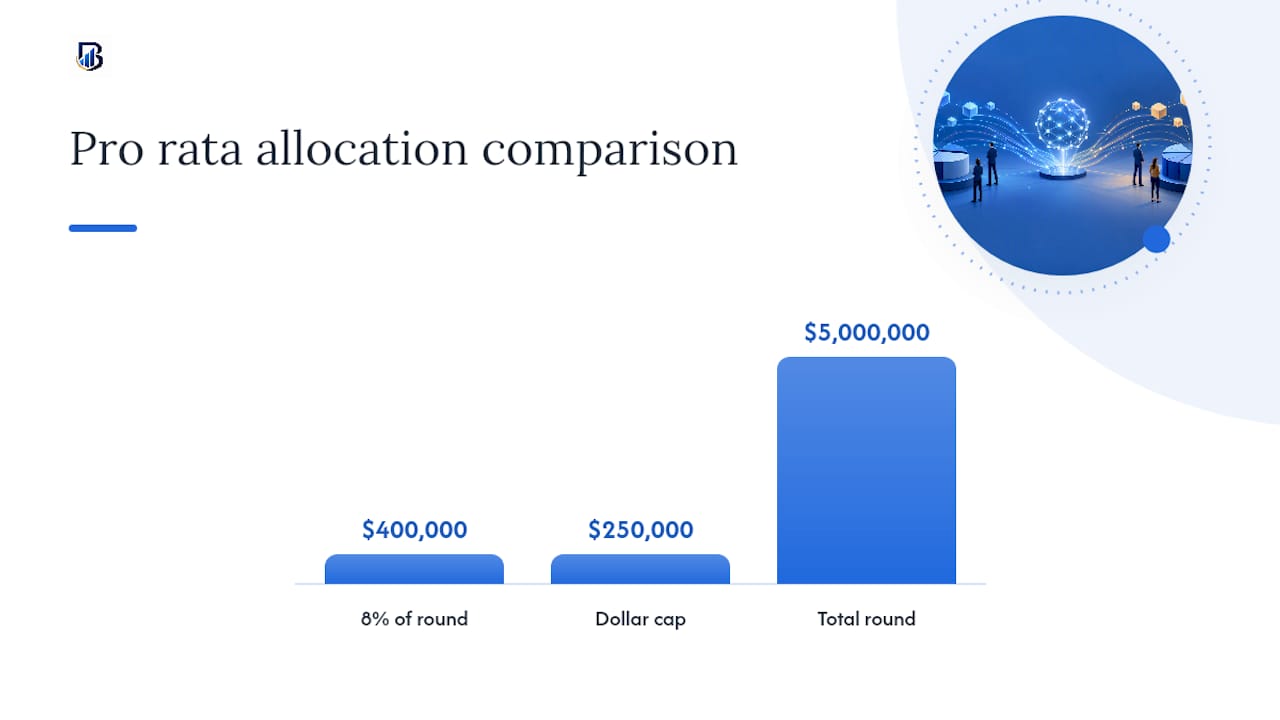
Under a percentage-basis clause, that investor's pro rata allocation equals 8% of $5 million, or $400,000. If the company instead used a dollar-for-dollar structure and that investor originally wrote a $250,000 check, their allocation caps at $250,000 regardless of how their ownership percentage has shifted since.
Statistic to watch: always exercising pro rata tends to raise an investor's mean portfolio return, while never exercising can raise the median outcome, because a small number of breakout companies drive most of the mean gain. The exercising decision is a portfolio strategy question, not a reflex.
Before modeling any round, run this checklist:
- Confirm whether outstanding SAFEs convert before or alongside the priced round, and at what valuation cap.
- Check whether the option pool is expanding as part of this round, since that dilutes everyone, including pro rata holders.
- Identify any secondary sales bundled into the round that don't count toward new-money calculations.
- Cross-check the dollar-based allocation against a share-based calculation. If they disagree, one of your inputs is wrong.
What Each Side Actually Gains and Risks
Investors get real protection from pro rata rights: the ability to defend a winning position instead of watching their stake shrink with every subsequent round, and access to allocations in competitive deals that would otherwise be closed to new money. The tradeoff is reserve pressure. A fund that grants itself generous pro rata across a large portfolio has to keep capital sitting on the sidelines for years, and concentrating too much of that reserve into a handful of follow-ons raises portfolio risk rather than lowering it.
Founders face the opposite tension. Granting pro rata broadly feels generous in the moment, but it can:
- Crowd the cap table with small checks that carry disproportionate administrative weight relative to their capital contribution.
- Reduce the room available to bring in a new lead investor who wants meaningful ownership.
- Signal, to a discerning future investor, that the round has less available upside than the headline number suggests.
Used selectively, though, pro rata is a legitimate tool for rewarding strategic angels or operators who bring more than capital.
Pro Tip: Limit formal pro rata rights to your major investors and offer smaller checks a courtesy allocation instead of a contractual right. You keep the relationship, and you skip the notice-and-election paperwork on twenty small line items every time you raise.
Drafting the Clause: Levers Founders and Investors Should Actually Use
The clause itself is where most future friction gets prevented or created. A handful of drafting levers do most of the work:
- Define "major investor" with a dollar threshold ($250,000 to $500,000 at seed is typical) rather than a vague reference to "significant" holders.
- Attach a sunset, commonly after Series B, so the right doesn't follow the company indefinitely.
- Build in a majority-in-interest waiver so the company can bypass the full group's consent when a specific strategic lead needs room.
- Cap super pro rata explicitly, or avoid granting it at all, since uncapped versions are the single biggest driver of round-crowding disputes.
- Restrict transferability to fund affiliates, or require founder consent before any assignment.
Pro Tip: Build an over-subscription waterfall into the term sheet now, before you need it. It tells every investor in advance exactly how allocations shrink if the round is oversubscribed, which avoids a renegotiation fight under time pressure.
When Should an Investor Actually Exercise?
Exercising pro rata is a decision, not a default. Run through this sequence before wiring funds:
- Confirm the company hit the milestones that justified the new valuation, not just that a new round is happening.
- Check whether the new price still makes sense relative to your entry basis.
- Verify you have uncommitted reserve capital, ideally following a 1:1 or 2:1 follow-on-to-initial reserve ratio your fund set at the outset.
- Assess concentration: does this follow-on push one position past your comfort ceiling for the fund?
- Weigh the signaling effect. Waiving can tell the market you've lost conviction, even when your real reason is simply reserve discipline.
Full exercise defends your ownership outright. Partial exercise, sometimes routed through an SPV to bring in outside capital, lets you stay in without overcommitting the fund. Waiving preserves reserves for a stronger conviction bet elsewhere in the portfolio, and it's a legitimate choice, not a failure.
Modeling the Cap Table Before You Sign Anything
Model the fully exercised case before the round opens, not after. If every eligible investor exercises to the maximum, how much of the new round's capacity do insiders consume, and how much is left for a new lead? That single calculation exposes overhang problems long before they become a live negotiation crisis.
Watch for this pattern: rounds that mix a priced tranche with converting SAFEs, an expanding option pool, and a bundled secondary sale routinely produce cap tables that look nothing like the founder's back-of-envelope math.
- Recompute fully diluted ownership after every SAFE conversion, not before.
- Treat option pool increases as dilution that hits everyone, including pro rata holders.
- Exclude secondary share purchases from new-money pro rata calculations; they're not new capital to the company.
- Build in carve-outs and waiver mechanics up front so a crowded round doesn't force an ugly last-minute renegotiation.
A Quick Legal Checklist Before You Send the Documents to Counsel
Before any document leaves your hands, confirm the scope of "fully diluted" the clause actually uses, and whether it includes unissued option pool shares.
- Verify notice periods and the exact election mechanism, written notice, wire deadline, and what happens on silence.
- Identify every termination trigger: IPO, acquisition, a specific round number, or a calendar sunset.
- Check transferability language and whether super pro rata appears anywhere, even indirectly.
- Decide whether IRA language covers this investor or whether a separate side letter is required, particularly for SAFE holders.
Why Most Pro Rata Disputes Are Preventable, Not Inevitable
The gap between what a pro rata clause promises and what it delivers almost always traces back to modeling, not malice. Founders who skip the fully exercised scenario before signing routinely discover, two rounds later, that insiders have quietly claimed more of the company's future than anyone intended. Investors who treat pro rata as an automatic entitlement rather than a capital commitment they have to actively fund tend to lose allocations to something mundane: a missed email, an ambiguous wire deadline, a fund that didn't reserve enough.
Brightcapital's work supporting founders through cap table planning surfaces the same lesson across sectors: the clause language matters less than the discipline of modeling it before you need it. The tools that prevent overhang aren't exotic, they're a checklist, a spreadsheet, and a habit of running the worst case before the best case.
If you're building out your own investor rights framework or need a second set of eyes on a term sheet before your next round, Brightcapital's team works with founders on exactly this kind of modeling every week.
— Bright
How Brightcapital Keeps Your Cap Table Honest Through Every Round
Tracking pro rata elections across a growing investor base by spreadsheet is where most cap table errors start. Brightcapital's equity management tools keep ownership percentages, election deadlines, and notice windows in one workspace instead of scattered across email threads and outdated spreadsheets, so a missed deadline doesn't turn into a dilution dispute six months later.

For founders preparing a raise, the platform's private capital fundraising infrastructure helps you model the fully exercised case, size your round with insider allocations already accounted for, and see exactly how much room remains for a new lead before you send a single term sheet. Investors evaluating follow-on opportunities can browse Brightcapital's investor marketplace to compare deal flow against reserve capacity. And if you need outside capital partners to help fill a round once pro rata allocations are set, Formosity Funding is a useful external resource on funding mechanics worth reviewing alongside your own cap table math.
Start by mapping your current investor rights inside Brightcapital's equity management module before your next notice window opens.

Where to Go Deeper on Pro Rata Terms
For the clause language itself, start with the NVCA model legal documents, the industry standard for Investors' Rights Agreements. Pillsbury Propel's founder guide and CRV's breakdown of calculation methods offer worked examples worth reviewing before your next term sheet. Have qualified counsel review final language before signature.
This article is general information, not a substitute for advice from a qualified financial advisor. Consult a qualified financial professional about your own circumstances before acting on anything here.
Sources
- NVCA model legal documents
- Pro-Rata rights (Open Almanac)
- SAFEs and convertible notes guidance (Traverse Legal)