

The fastest path to a closed pre-seed round is a targeted list of 10 to 15 active pre-seed investors, a one-page deck, and a 30-second intro sent through warm channels first. Founders who treat pre-seed like a numbers game (blasting 200 cold emails) close slower than founders who research fit and send fewer, sharper intros. The SEC's Regulation Crowdfunding rules matter here too, since crowdfunding is a real alternative channel for founders who don't fit traditional VC theses. Meanwhile, the Q3 2025 PitchBook NVCA Venture Monitor shows where early-stage capital is actually concentrating right now, which should shape who lands on your list. Platforms like Brightcapital exist specifically to compress the research phase into hours instead of weeks.
Before you send a single email, do these three things:
- Prioritize your 10 best-fit investors based on thesis, stage, and check size, not name recognition.
- Prepare a one-page deck and a 30-second verbal intro you can repeat in your sleep.
- Schedule a two-week outreach cadence with built-in follow-up touchpoints, not a one-shot email blast.
Key Takeaways
A successful pre-seed raise depends on matching a small, well-researched investor list to the right instrument and terms, not on maximizing the number of emails sent.
| Point | Details |
|---|---|
| Build a focused target list | Aim for 20 to 30 names, split into 10 primary targets and secondary backups, ranked by thesis fit. |
| Know your instrument | Most pre-seed rounds use a capped SAFE or uncapped SAFE with MFN rather than a priced round. |
| Expect $250,000 to $1,000,000 checks | Typical round sizes run $250,000 to $1.5 million, per VCSheet's active fund data. |
| Sequence outreach and follow-up | Send warm intros first, then cold outreach, with three to four scheduled follow-up touchpoints. |
| Use a matching platform to cut research time | Brightcapital's directory of 27,000+ verified investor profiles and AI matching narrows your list faster than manual research. |
Table of Contents
- Which Pre-Seed Investors and Accelerators Should You Contact First?
- Who Actually Writes Checks at the Pre-Seed Stage?
- How Big Is a Typical Pre-Seed Round?
- How Do You Find and Reach Pre-Seed Investors?
- Are You Actually Ready to Raise Pre-Seed, or Should You Wait?
- How Do Investor Platforms Speed Up Pre-Seed Discovery?
- How Should You Negotiate Pre-Seed Terms?
- What Legal Paperwork Does Pre-Seed Funding Require?
- How Do You Manage Investors After the Round Closes?
- Let Brightcapital Handle the Sourcing While You Handle the Pitch
- Frequently Asked Questions
- Sources
Which Pre-Seed Investors and Accelerators Should You Contact First?
Here's a working shortlist of the most active pre-seed investors and accelerators, current as of early 2026. Each one has a distinct application pattern, and knowing that pattern before you reach out saves you weeks.
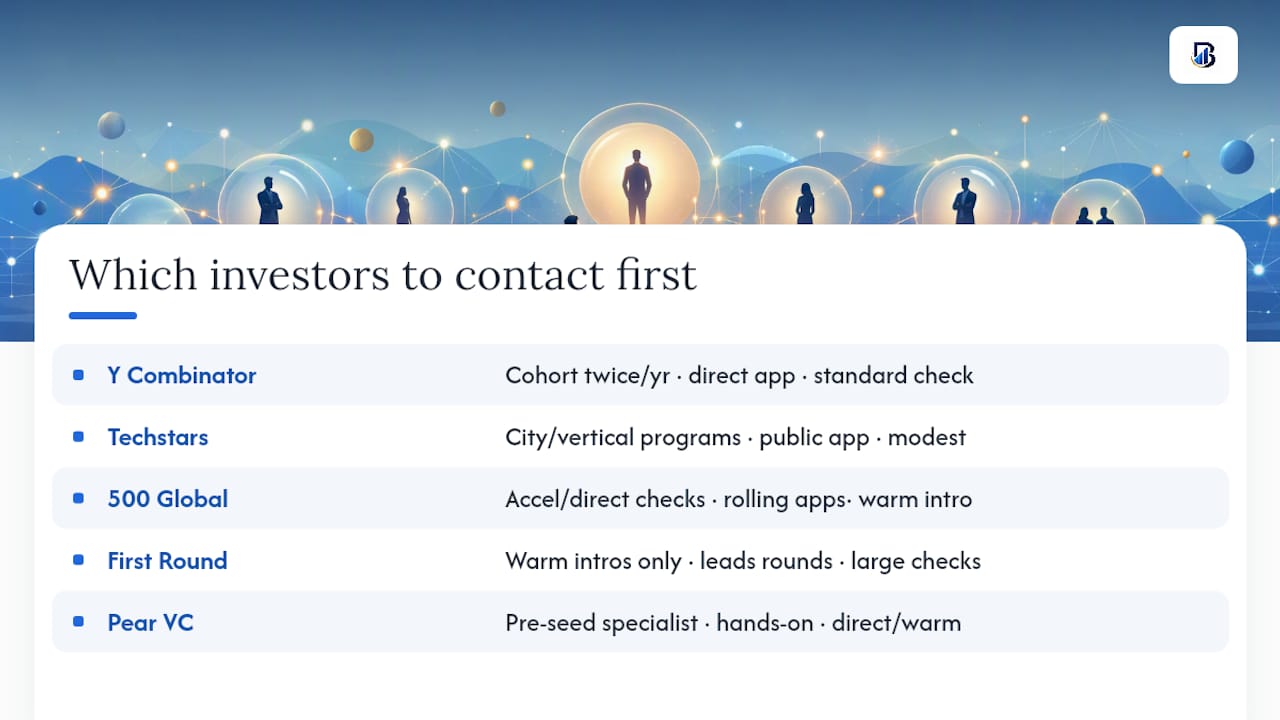
Y Combinator runs a structured, cohort-based program that invests a standard amount in exchange for equity, with cohorts twice a year. YC accepts applications directly through its own online form, no warm intro required, and evaluates almost entirely on founder-market fit and speed of execution. Notable alumni include Airbnb and Stripe at earlier stages of their history. For accelerators like YC, your application should emphasize team velocity and any early traction signal, however small.
Techstars operates dozens of city and vertical-specific programs, each investing a modest amount for equity plus mentorship access. Applications go through Techstars' public portal per program, and selection favors founders who can show they've already tested a real customer problem. Techstars alumni include SendGrid and ClassPass. Because Techstars programs are localized, applying to the program whose mentor network matches your sector matters more than applying broadly.
500 Global invests at pre-seed and seed through both a global accelerator track and direct check writing, with a portfolio spanning fintech, e-commerce, and deep tech. Its accelerator applications open on a rolling basis, while direct investment usually starts with a warm introduction from a portfolio founder or scout. Grab and Talkdesk both passed through its early programs. 500 Global tends to follow rather than lead when writing outside its accelerator cohorts.
First Round Capital writes some of the largest pre-seed and seed checks in the market and typically leads rounds when it invests. It doesn't run an open application; nearly every deal originates from a warm introduction through its founder network or existing portfolio companies. Notable, Uber, and Square all raised early capital from First Round. Because First Round leads, your intro should lean on traction metrics and a clear reason this is a venture-scale opportunity, not just a good idea.
Pear VC specializes explicitly in pre-seed and seed, pairing capital with hands-on support that includes recruiting help and pitch polishing before a founder even talks to other investors. Pear typically writes early checks and often leads or co-leads, with portfolio companies including Guardant Health and DoorDash in their early days. Pear accepts both warm intros and direct outreach through its website, making it one of the more accessible specialist funds on this list.
Precursor Ventures focuses almost exclusively on pre-seed, often as the first institutional check into a company before any other VC is involved. Typical checks are modest and the fund frequently co-invests alongside angels rather than requiring a lead. Precursor accepts direct outreach via email and values founders who can articulate a specific, narrow wedge into a larger market.
LaunchCapital invests small, early checks across a wide range of sectors and has backed companies like Cruise in their earliest stages. It rarely leads rounds, positioning itself instead as a fast, low-friction addition to a syndicate. Outreach typically comes through direct contact or intros from other early-stage investors already in a deal.
Initialized Capital invests at seed and pre-seed with a strong bias toward technical founders and has backed Coinbase and Instacart early on. It occasionally leads but more often joins a round alongside another lead investor. Warm introductions from portfolio founders or other funds in its network carry significant weight here.
Hustle Fund writes small, fast pre-seed checks and markets itself on decision speed, often turning around a yes or no within days of a first conversation. It rarely leads but moves quickly enough to anchor a round psychologically even without leading it formally. Hustle Fund accepts direct outreach through its website and has built a reputation for being unusually responsive to cold, well-targeted emails.
Andreessen Horowitz (a16z) invests at every stage including pre-seed through dedicated early-stage programs, and typically writes larger checks than most names on this list when it does lead. Its portfolio includes Coinbase and Airbnb. Because a16z operates at scale, warm introductions from its extensive network of founders, scouts, or existing portfolio companies dramatically outperform cold outreach.
This shortlist reflects active, publicly documented pre-seed investment activity and clear apply routes as of January 2026. Inclusion criteria: each fund or accelerator maintains an active pre-seed focus and a publicly available application or introduction pathway. For a broader net beyond this list, Brightcapital's venture capital database lets you filter by stage, sector, and check size across thousands of additional profiles.
Who Actually Writes Checks at the Pre-Seed Stage?
Pre-seed capital comes from a handful of distinct investor types, and matching your ask to the right type saves you months of wasted outreach.
- Angel investors write personal checks, usually from their own capital, and decide fast because there's no investment committee to convince.
- Angel syndicates pool multiple angels behind a lead who negotiates terms, giving founders one relationship that represents several checks.
- Accelerators and incubators (YC, Techstars) offer structured capital plus mentorship and a cohort community, in exchange for equity and a fixed time commitment.
- Pre-seed specialist VCs (Precursor Ventures, Pear VC) focus their entire fund thesis on this stage and often serve as the first institutional money in.
- Micro-VCs run smaller funds than traditional VCs but invest with the same institutional rigor and reporting expectations.
- Family offices invest opportunistically, often through a personal connection or thematic interest, with less structured process than a fund.
An accelerator suits founders who need structure, a peer network, and demo-day momentum; an angel syndicate suits founders who already have traction and just need capital with minimal oversight. If you need a fund willing to lead and set terms, prioritize a pre-seed specialist over a family office, which rarely wants that role.
How Big Is a Typical Pre-Seed Round?
Pre-seed rounds typically range from small five-figure angel checks up to funds writing $250,000 to $1,000,000 checks, according to curated data on active pre-seed funds. Overall round sizes usually land between $250,000 and $1.5 million, though the exact figure depends heavily on sector, founder track record, and geography. The Q3 2025 PitchBook NVCA Venture Monitor shows early-stage check sizes have stayed resilient even as later-stage megadeals dominate headlines, meaning pre-seed capital hasn't dried up the way some founders assume.
Most pre-seed rounds use a SAFE (Simple Agreement for Future Equity), either capped, uncapped with a Most Favored Nation clause, or capped with a discount. A capped SAFE gives investors a guaranteed conversion price ceiling, protecting them if your next round prices high; an uncapped SAFE with MFN protects investors by matching whatever terms later investors get. Convertible notes work similarly but carry an interest rate and maturity date, adding legal complexity most pre-seed founders don't need yet. A priced equity round is rare at pre-seed because it requires agreeing on a valuation before you have much data to justify one.
Pro Tip: If you're stacking several small non-leading checks instead of taking one lead investor, negotiate each SAFE's cap independently rather than accepting whatever the first investor offers. Early, low caps set a floor other investors will try to hold you to.
How Do You Find and Reach Pre-Seed Investors?
Building your target list is the part founders rush, and it's the part that determines whether your outreach converts.
- Source broadly first. Pull names from investor databases, your own network, accelerator alumni lists, and demo days. Aggregated directories alone list over 200 active pre-seed funds, so the scale of options is larger than most founders assume.
- Score for fit, not fame. Rank each name on thesis alignment, geography, typical check size, and whether they lead or follow. A perfect thesis match with a small check beats a famous fund that's never invested in your category.
- Build a list of 20 to 30 names, split roughly into 10 primary targets you'll pursue aggressively and the rest as backups.
- Sequence your outreach so warm introductions go out first, and cold outreach follows only after your primary warm list is exhausted.
Your cold intro should run 2 to 3 sentences: who you are, what problem you're solving, and one specific traction signal. Pair it with a subject line that names the specific thing you're building, not a vague "quick question" or "intro request." Your one-page deck needs exactly six things: problem, solution, traction, market size, team, and the ask.
A workable follow-up schedule looks like this:
- Day 1: Initial intro email or warm forward.
- Day 4: Short follow-up referencing one new data point (a signed customer, a product update).
- Day 10: Final follow-up asking directly for a 15-minute call or a decision either way.
- Day 14: Close the loop, even on a no, and ask if they know someone better suited.
Pro Tip: When you get a warm introduction, ask the connector to request a specific next step, "Can you ask if they'd take a 15-minute call?" not a vague "Would you mind connecting us?" Specific asks get faster, clearer answers from busy partners.
For sector-specific searches, tools like Brightcapital's angel investor database or its accelerator and incubator search narrow your list faster than manual research through scattered blog posts and outdated spreadsheets.
Are You Actually Ready to Raise Pre-Seed, or Should You Wait?
Pre-seed and seed differ mainly in what investors expect you to prove. Pre-seed investors accept a founding team and an early prototype as sufficient evidence; seed investors expect paying customers, retention data, and a repeatable growth motion. HBR's reporting on lean startup building makes the case that founders who stay disciplined on runway and metrics during tight funding environments end up in a stronger negotiating position later.
Before you start outreach, check that you have:
- A founding team that can speak credibly to both the product and the market.
- A working prototype or MVP, even a rough one.
- Some form of validation: early users, a waitlist, or a signed letter of intent.
- Clean cap table hygiene, meaning no informal equity promises that aren't documented.
A typical pre-seed raise takes 8 to 12 weeks from first outreach to close, though founders who skip the readiness checklist often stretch that to twice as long chasing investors who were never going to say yes.
How Do Investor Platforms Speed Up Pre-Seed Discovery?
The fundraising workflow runs through five stages: source, match, intro, diligence, close. Search filters and AI matching compress the source and match stages dramatically, since manually cross-referencing hundreds of fund websites for thesis fit is the single biggest time drain founders report.
A useful platform gives you verified investor profiles instead of stale contact lists, sector and stage filters that actually narrow results, integrated document sharing for diligence, and outreach tracking so you know who opened what and when. Brightcapital's directory of over 27,000 verified investor profiles, paired with AI-powered matching and cap table tools built into the same workspace, removes the need to juggle a spreadsheet, a data room, and a separate cap table tool during a single raise.

Pro Tip: Watch for signals that a fund is actively deploying right now, recent portfolio announcements, new partner hires, or open accelerator cohorts. Investors mid-deployment move faster than funds that just closed a round and are heads-down with existing portfolio companies.
How Should You Negotiate Pre-Seed Terms?
Negotiating a pre-seed round is less about squeezing the highest valuation and more about protecting your optionality for the next round. A SAFE's valuation cap matters more than its headline number suggests, since it directly sets the ceiling on how much equity converts when your seed round prices.
Don't let one investor's aggressive cap become your anchor for every subsequent conversation. If your first term sheet or SAFE offer comes in low, get at least one more offer before signing anything, even if it delays your close by a week or two. HBR's research on staged investment suggests founders who resist locking in large capital and high valuations too early often preserve more control and post stronger outcomes down the line.
Watch for pro-rata rights, which let an investor maintain their ownership percentage in future rounds, and information rights, which obligate you to share financials on a schedule. Neither is unreasonable to grant a lead investor, but granting broad pro-rata rights to every small check in a stacked round can complicate your cap table later. Also clarify whether an MFN clause applies retroactively if a later investor negotiates better terms; ambiguity here creates disputes months after your round closes. Finally, negotiate board and information rights separately from the capital terms themselves; a $50,000 check rarely justifies a board seat, and conflating the two slows everything down.
What Legal Paperwork Does Pre-Seed Funding Require?
Every pre-seed round needs a small set of documents done correctly, even when the round itself feels informal. The SAFE or convertible note agreement is the core document, and it should specify the cap, discount, and any MFN terms in plain, unambiguous language.
You'll also need a board consent or founder resolution authorizing the raise, since most state corporate law requires formal approval before issuing new securities, even convertible ones. Beyond that, keep your cap table updated in real time as each SAFE closes, not batched at the end of the round, since discrepancies compound quickly once you're juggling five or six separate agreements.
If you're raising from more than a handful of investors, understand which securities exemption you're relying on. Most pre-seed rounds rely on private placement exemptions rather than public offerings, but any founder considering Regulation Crowdfunding as a channel needs to understand its specific disclosure and reporting requirements before opening that door, since crowdfunding carries different compliance obligations than a traditional SAFE round with accredited investors.
Get a startup attorney to review your SAFE template even if you're using a standard form, since small deviations from standard language create real problems at your next priced round. Budget for this cost upfront rather than skipping it to save a few hundred dollars now.
How Do You Manage Investors After the Round Closes?
Closing the round is the beginning of the relationship, not the end of it. Most pre-seed investors expect some form of regular update, typically monthly or quarterly, covering key metrics, wins, and specific asks.
A good investor update runs short: headline metrics, a couple of sentences on progress, one or two specific challenges, and a clear ask if you need one (an introduction, a technical hire, feedback on a hire). Investors who feel informed become sources of introductions to your seed round; investors who hear nothing for six months become harder to reach when you need them.
Formal reporting obligations at pre-seed are usually light since SAFEs don't typically carry the covenants that priced rounds do. Still, keep your cap table current and be ready to share it whenever an investor asks, since sloppy cap table management is one of the fastest ways to lose credibility with a fund considering your seed round.
What Do Founders Get Wrong Most Often About Pre-Seed?
shows the same pattern again and again: founders over-polish their deck while under-investing in the warm introductions that actually open doors. suggests the fix is simple. Spend twice as long mapping your network as you spend on slide design, because a mediocre deck with a strong warm intro beats a beautiful deck landing cold in an inbox.
Let Brightcapital Handle the Sourcing While You Handle the Pitch
Brightcapital is the alternative to weeks of scattered spreadsheet research for founders building a pre-seed target list. Instead of cross-referencing fund websites, LinkedIn, and outdated blog posts one by one, you search over 27,000 verified investor profiles directly, filtered by stage, sector, and check size, with AI-powered matching surfacing the investors most likely to say yes to your specific company.
The platform keeps your fundraising pipeline and cap table in one workspace, so the SAFEs and terms you negotiate flow straight into your ownership records instead of living in a separate spreadsheet you update by hand. That matters most right after your round closes, when investor updates and cap table accuracy start shaping how your next raise goes. Founders get:
- Faster sourcing through filtered, verified investor search instead of manual research.
- Better-matched intros through AI-powered investor matching.
- One unified workspace for outreach tracking and cap table management, instead of three disconnected tools.
Start by browsing Brightcapital's private capital raise tools to see how the matching and cap table features fit into a pre-seed round you're planning to close in the next quarter.
Frequently Asked Questions
What exactly counts as a pre-seed investor?
A pre-seed investor is anyone, an angel, a fund, or an accelerator, who writes a check before you have meaningful revenue or a fully proven business model, typically based on team strength and early validation signals alone.
How many pre-seed investors should I contact?
Build a list of 20 to 30 targets, prioritizing your top 10 based on thesis and check-size fit rather than trying to contact every fund on a generic pre-seed investors list.
Do I need a lawyer for a pre-seed SAFE?
Yes. Even a standard SAFE template benefits from attorney review, since small language deviations create complications at your next priced round.
What's the difference between pre-seed VCs and angel investors?
Angel investors write personal checks and decide fast with no committee; pre-seed VCs invest institutional capital, often expect more structured reporting, and sometimes lead rounds by setting the valuation cap and terms.
How long does it typically take to close a pre-seed round?
Most pre-seed raises take 8 to 12 weeks from first outreach to close, though skipping a readiness checklist often stretches that timeline significantly longer.
This article is general information, not a substitute for advice from a qualified financial advisor. Consult a qualified financial professional about your own circumstances before acting on anything here.