

A PPM alone typically runs $10,000 to $25,000 when drafted by experienced securities counsel, while a full Regulation D package, including subscription documents and state filings, usually lands between $15,000 and $30,000 for a standard raise. Add state Blue Sky filings if you're marketing across multiple states, and complexity (multiple share classes, institutional investors, fund structures) can push totals well past $75,000.
TL;DR:
- A simple equity raise in one state typically costs between $10,000 and $25,000 for a full private placement package, while multi-state deals can surpass $75,000.
- The main driver of PPM costs is deal complexity, including multiple share classes, investor types, and cross-state solicitation, not the total capital raised.
- Key components of the cost include securities counsel drafting fees, Blue Sky filings, and optional financial review, which vary significantly with deal intricacy.
- Costs increase with deal complexity factors like multiple share classes, non-accredited investors, and tight deadlines, often pushing fees well above basic estimates.
- Using fixed-fee engagements and reusing previous documents can help control legal expenses, but focus on matching disclosure to the actual deal risk profile rather than the price alone.
Table of Contents
- PPM Cost Ranges by Offering Complexity
- Line-Item Breakdown: What You're Actually Paying For
- What Drives PPM Costs Higher
- How to Control PPM Costs Without Cutting Corners
- Where Bright Capital America Fits Into the Budget
- Reduce Your Non-Legal Overhead While Counsel Handles the PPM
- A Contrarian Take on PPM Pricing
- Sources
PPM Cost Ranges by Offering Complexity
Your PPM cost depends almost entirely on how complicated your deal is, not how much capital you're raising. A straightforward $500,000 SAFE round and a $50 million fund formation both need a private placement memorandum, but the legal hours behind them differ enormously.
For a simple equity raise (single class of stock, accredited investors only, one state), industry-aggregated data puts PPM-only costs between $5,000 and $15,000, with a full package (PPM plus subscription agreement and any needed state filings) landing between $10,000 and $25,000.
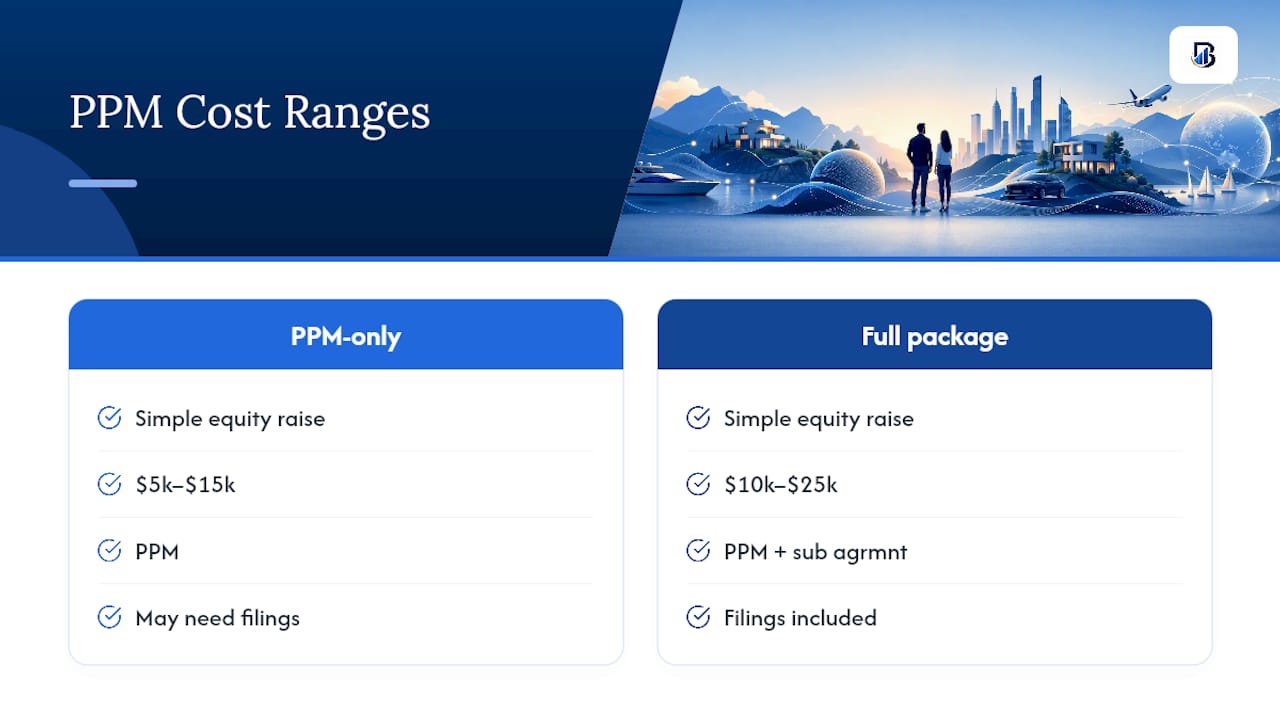
A standard startup raise, typical for seed and Series A companies, tends to cost more because it involves more disclosure detail and investor negotiation; pricing varies significantly depending on complexity and number of states involved.
Multi-jurisdictional deals inflate costs because each state where you solicit investors may require its own notice filing and, occasionally, its own counsel review. A fund manager selling into 12 states pays for 12 sets of administrative coordination, not just one legal document. That's the single biggest reason two founders raising the same dollar amount can end up with wildly different legal bills.
Line-Item Breakdown: What You're Actually Paying For
Breaking the total into components makes budgeting far less abstract. Here's how a typical PPM engagement gets priced out.
- Securities counsel drafting fees (the PPM itself): boutique securities firms typically charge $5,000 to $15,000; mid-tier firms with fund experience run $15,000 to $35,000; large firms handling institutional or multi-state deals can exceed $75,000.
- SEC Form D filing: the federal notice filing itself carries no SEC fee, but counsel typically bills a few hundred to low-thousand dollars to prepare and submit it correctly.
- State Blue Sky filings: budget $3,000 to $10,000 aggregated across the states where you're soliciting, since each state charges its own notice fee and may require separate paperwork.
- Subscription agreements and operating agreement updates: often bundled with the PPM quote, but standalone drafting can add $2,000 to $8,000.
- Accounting review, diligence, or audited financials: optional for most startup raises but expected for funds or larger offerings; costs vary widely based on scope.
- Escrow and closing fees: third-party escrow agents typically charge flat fees or a small percentage of funds held, paid at closing.
Pro Tip: Ask your securities attorney for a single flat-fee quote covering the PPM, subscription docs, and Blue Sky filings together. Piecemeal hourly billing is where budgets quietly balloon.
What Drives PPM Costs Higher
Two offerings of identical size can have very different price tags. The variables below are what actually move the needle.
- Deal structure complexity: multiple share classes, carried interest waterfalls, and side letters for anchor investors all add drafting and negotiation hours.
- Investor mix: allowing non-accredited investors triggers additional disclosure obligations under Regulation D, which lengthens the document and the review process.
- Cross-state solicitation: every additional state you market into means another Blue Sky notice, another fee, and sometimes another local counsel review.
- Document length and depth: PPMs commonly run 50 to 150 pages, and longer documents reflect more risk disclosure, which means more billable attorney time.
- Timeline pressure: asking counsel to turn around a PPM in two weeks instead of six typically carries a rush premium, sometimes 15% to 25% on top of standard fees.
Structural complexity, not the amount you're raising, is what pushes legal fees higher. A $2 million raise with three investor classes and side letters will often cost more to document than a $10 million raise with one clean equity class.
How to Control PPM Costs Without Cutting Corners
Cutting your budget the wrong way here is expensive in ways that don't show up until later. Template-only PPM services run $2,500 to $5,000 upfront, but thin disclosure language has led to costly downstream corrections when investors raise disputes or regulators flag gaps.
Smarter cost control looks like this:
- Request a fixed-fee engagement with deliverables spelled out in writing before signing.
- Bundle the PPM, subscription agreement, and operating agreement updates into one engagement to avoid duplicated review time.
- Reuse prior offering documents as a drafting base when you're raising a follow-on round with similar terms.
- Lean on experienced securities counsel for the disclosure language itself. No platform substitutes for that judgment.
Pro Tip: If two law firms quote wildly different numbers for the same scope, ask each what's included. The cheaper quote often excludes Blue Sky filings or subscription docs, and you'll pay for them separately anyway.
Where Bright Capital America Fits Into the Budget
Legal drafting costs are fixed by the complexity of your disclosure, but plenty of the time founders spend around a raise has nothing to do with legal work. Chasing signature versions, re-sending decks to the wrong investor list, and manually reconciling a cap table after each close all add real hours, even if they don't show up on a law firm invoice.
Brightcapital connects founders to a directory of 27,000+ verified investors and pairs that with integrated cap table and fundraising pipeline tools, so document version control and investor outreach happen in one workspace instead of six disconnected ones. That doesn't touch your securities counsel's drafting fee. It does cut the coordination overhead sitting around it, which is often where founders lose the most unplanned time during a raise.
Reduce Your Non-Legal Overhead While Counsel Handles the PPM
Your securities attorney still has to draft the memo, but everything wrapped around it, tracking investor conversations, managing your cap table, keeping data rooms organized, doesn't have to eat your week. Brightcapital's private capital raise tools give founders one workspace for investor matching, cap table management, and secure document sharing, with plans starting at $79 a month.
Instead of juggling spreadsheets, email threads, and a separate cap table tool while your PPM is in drafting, you can run investor outreach and document tracking in parallel through the same investor database your fundraising team already uses. Explore the fundraising infrastructure built for U.S. companies raising private capital and see which plan matches your raise size and timeline before your next investor call.
A Contrarian Take on PPM Pricing
Most guidance on private placement memorandum cost treats price as a proxy for quality, as if a $60,000 PPM must be more defensible than a $15,000 one. That's backwards. The number that actually predicts investor disputes and regulatory headaches isn't the invoice total. It's whether the disclosure language matches the real risk profile of the deal.
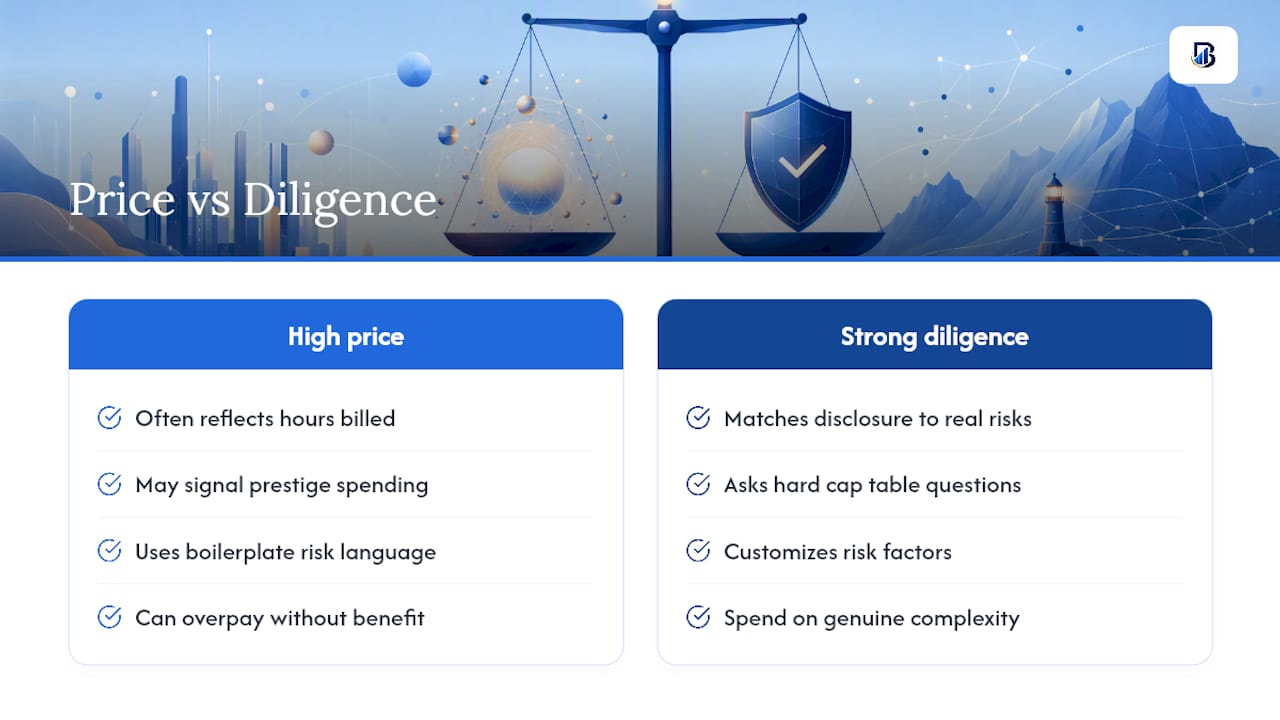
A $12,000 PPM from a securities attorney who asks hard questions about your cap table, your use of proceeds, and your investor mix will outperform a $40,000 PPM assembled by a big firm on autopilot with boilerplate risk factors. Price reflects hours billed, not diligence quality. Founders who assume the two track together often overpay for prestige and underpay attention to the parts of the document that matter most: risk factors specific to their actual business, not generic industry language pulled from a template library.
The real lesson buried in these ranges is that complexity, not budget size, should drive where your money goes. Spend more where your deal is genuinely unusual (a novel security structure, an unconventional investor base, a multi-state solicitation strategy) and resist the urge to overspend on boilerplate sections that don't need customization. That discipline, more than any specific dollar figure, is what separates a well-budgeted raise from an expensive one.
— Bright
Sources
- SEC: Frequently asked questions and answers — Form D
- Spectup — How much does a private placement memorandum cost?
- Homebase — Real estate sponsor guide and PPM cost examples