

Use a short, investor-focused 10 to 12 slide deck, close with a single specific ask tied to clear milestones, and be ready to prove traction and team credibility on demand. That's the whole formula. Build that deck first, rehearse the delivery out loud at least five times, and treat everything else, including financial models and demo polish, as supporting material for those two goals.
TL;DR:
- Most angel investors spend only 2 to 4 minutes reviewing a pitch deck, so every slide must clearly answer a specific investor question.
- The ask slide should feature a single dollar amount, a detailed use-of-funds plan tied to milestones, and the raising instrument without including a valuation.
- Traction should match the company's stage, with early indicators like customer conversations or pilot signings, not inflated metrics or vanity numbers.
- Rehearsing the pitch aloud at least five times and keeping it under 10 minutes significantly improves delivery and investor engagement.
- Targeted outreach using verified investor databases and pre-reviewed decks increases the likelihood of connecting with the right angels faster.
Table of Contents
- What Goes Into a Pitch to Angel Investors That Actually Lands?
- How Do You Turn Slides Into a Pitch Investors Remember?
- What Should the Ask Slide Actually Say?
- How Do You Present Traction and Team Without Overselling Either?
- What Questions Do Angel Investors Ask, and How Should You Answer?
- What Mistakes Kill Angel Pitch Meetings, and How Do You Fix Them Fast?
- How Bright Capital Helps You Prepare and Reach the Right Angels
- What Founders Consistently Get Wrong About Pitching Angels
- Ready to Pitch? Start With the Tools That Speed Up Preparation
- Sources
- FAQ
What Goes Into a Pitch to Angel Investors That Actually Lands?
Angels are not smaller versions of venture capitalists. They write personal checks, decide faster, and lean more heavily on founder conviction and early execution evidence than on massive market projections, according to Diligent's angel pitch deck guidance. That single distinction should shape every slide you build.
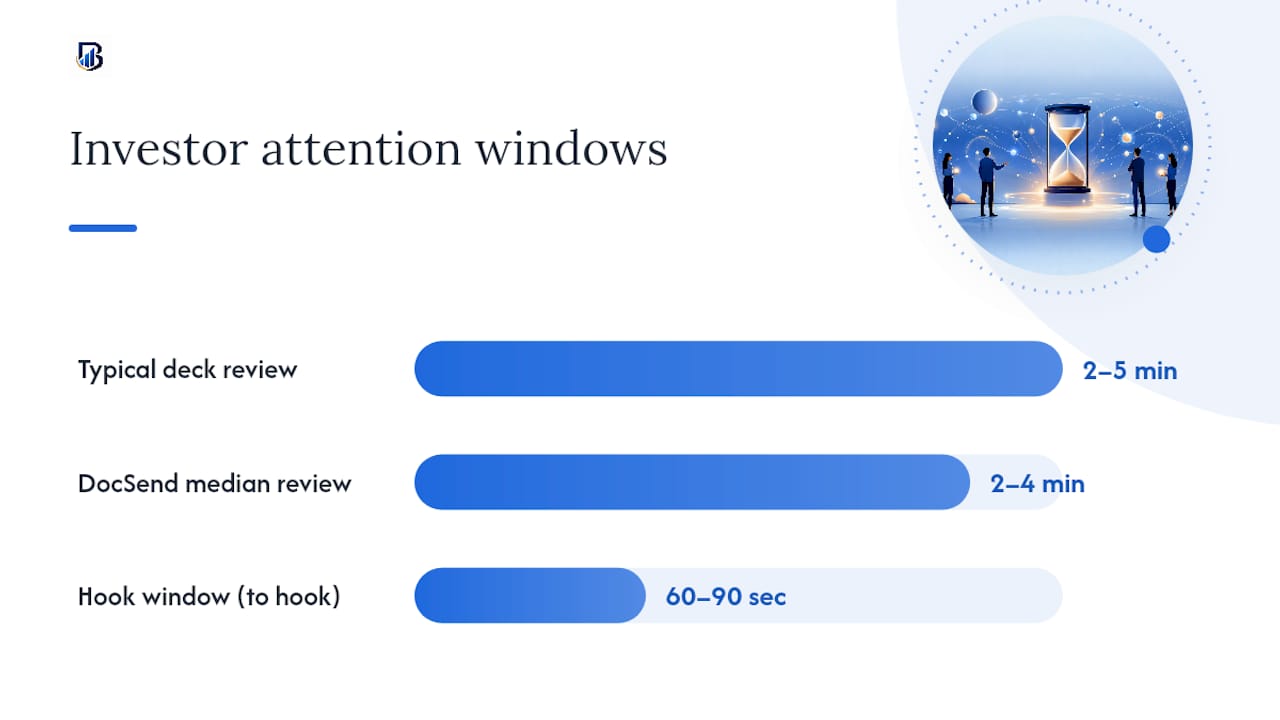
The attention window is brutally short. Investors typically spend between 2 and 5 minutes reviewing a deck, with DocSend's median attention data landing around 2 to 4 minutes depending on the stage of the company. That means every slide has to earn its place. There's no room for a slide that exists just because a template said so.
For email decks, keeping the slide count concise is recommended, and slightly more slides may be used for live presentations. Make sure each slide answers exactly one investor question, a standard Diligent recommends for angel-focused decks specifically. Here's the order that works, and what each slide needs to prove:
- Cover slide: Proves you know exactly what you do in one sentence. Company name, tagline, and contact info. Nothing clever, nothing vague.
- Problem slide: Proves the pain is real and costly enough that someone will pay to fix it. Use a specific scenario, not an abstract statistic.
- Solution slide: Proves your product solves that exact problem in a way competitors don't. One sentence, one visual.
- Market slide: Proves the opportunity is big enough to matter but grounded in real buyer behavior, not just a top-down TAM number pulled from an analyst report.
- Business model slide: Proves you know how money moves from customer to bank account. Pricing, channel, margin basics.
- Traction slide: Proves momentum exists, whatever form that takes at your stage.
- Team slide: Proves you and your co-founders can execute against the plan you just described.
- Competition slide: Proves you understand the landscape and have a defensible wedge, not that you have no competitors.
- Financials slide: Proves you understand your own unit economics and burn rate.
- Ask slide: Proves you know exactly what you need and what you'll do with it.
- Closing/contact slide: Proves you're easy to follow up with. Name, email, phone, and a single clear next step.
Timing matters as much as sequence. J.P. Morgan's guidance on investor decks emphasizes that a deck needs to tell a complete story quickly, and that story has to hook the investor in the first 60 to 90 seconds. That window belongs to your problem statement and one-sentence solution. If an angel doesn't understand what you do and why it matters within that first minute and a half, the rest of the deck is fighting an uphill battle.
Pro Tip: Build one core deck and keep it stable. Adjust your talk track for each investor's background and interests, but don't rebuild slides for every meeting. Consistency in the deck lets you focus your prep time on delivery instead of redesign.
How Do You Turn Slides Into a Pitch Investors Remember?
A deck is a visual aid. The pitch is what you say while it's on screen, and that's where most founders lose the room.
Start with a one-line elevator pitch you can say without taking a breath: "We're [company], and we help [specific customer] solve [specific problem] by [specific mechanism]." A workable example: "We're Ledger Loop, and we help independent bookkeepers close client books three days faster by automating reconciliation across five accounting platforms." Notice there's no jargon, no vague outcome word like "streamline," and no ambiguity about who the customer is.
Once you're past the opener, structure your delivery around what's sometimes called the hearts, minds, and wallets framework:
- Hearts: Open with the human cost of the problem. A founder story, a customer quote, a moment that made the pain concrete. This is where emotion belongs, and only here.
- Minds: Move into logic. Market size grounded in real buyer math, your solution's mechanism, why now is the right moment for this category.
- Wallets: Close with the money conversation. Traction, unit economics, and the ask. This is where angels lean in, because it's where they start doing math about their own return.
If you're demoing a product or mockup, treat it as a single beat inside the solution slide, not a separate act. Cap it at 90 seconds, script exactly what you'll click and say, and have a static screenshot ready as backup in case the live version glitches. Nothing burns credibility faster than a founder fumbling through a broken demo while an angel checks the time.
Rehearsal isn't optional polish, it's the actual work. Time yourself running the full 10 to 12 slide deck out loud, not in your head, and aim for 8 to 10 minutes of talking with room left for questions. Practice-first repeatability is exactly what J.P. Morgan's pitch deck framework points to as a differentiator between founders who close rounds and founders who don't. Say the pitch to a co-founder, a mentor, even a mirror, five times minimum before the first real meeting.
What Should the Ask Slide Actually Say?
Angels want one number, not a range, and not a hand-wave toward "whatever you can offer." The formula that works: a single specific dollar amount, a use-of-funds breakdown tied to three or four measurable milestones, and the instrument you're raising on, whether that's a SAFE, a convertible note, or priced equity. Leave your valuation out of the deck entirely, since angel-focused deck guidance consistently flags a stated valuation as a common way to kill momentum before a real conversation about terms even starts.
A working ask slide might read: "Raising $500,000 on a SAFE with a $6 million cap.
Below the ask, angels expect you to know your own numbers cold. Have these ready even if they don't fit on the slide itself:
- MRR or ARR, if you have any revenue at all, even early and small
- Burn rate and runway, stated in months, not just dollars
- CAC and LTV, or your best current estimate if the data set is thin
- Gross margin, especially if you're selling a product with real cost of goods
- Prior round details, including how much you've raised, from whom, and on what terms
When you show projections, keep them directional and three years out at most. Avoid the temptation to project hockey-stick revenue to year five, since angels have seen that curve a thousand times and it reads as guesswork rather than confidence. Ground your market sizing in customer conversion math instead of top-down analyst figures, a practice J.P. Morgan's guidance specifically recommends over relying purely on industry reports.
Finally, have your data room ready before you need it. If an angel asks for diligence materials, you should be able to grant secure access within hours, not days, according to Diligent's preparation guidance. That means cap table, incorporation documents, financial statements, and customer contracts organized and accessible the moment interest turns serious.
How Do You Present Traction and Team Without Overselling Either?
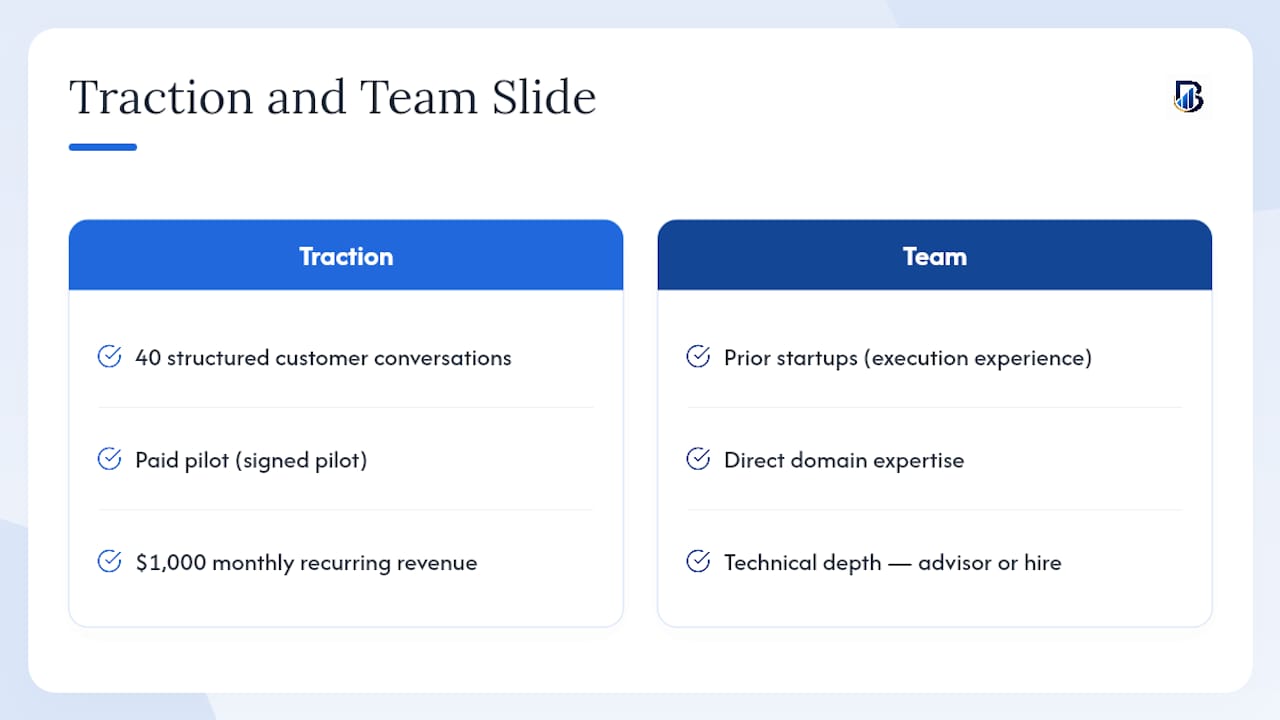
Traction means something different depending on your stage, and angels can tell within seconds when a founder is stretching the definition. Early on, traction might be nothing more than 40 structured customer conversations that validated the problem. A few months later, it might be a paid pilot, a handful of signed letters of intent, or your first thousand dollars in monthly recurring revenue. What matters is that the traction you show matches the traction you actually have.
Present unit economics simply. A single line like "68% gross margin, $42 CAC, $310 average customer lifetime value" tells an angel more in five seconds than a paragraph of qualitative description ever will. If you don't have clean numbers yet, say so directly and show what you do have, like week-over-week signup growth or retention curves from your beta cohort.
The team slide carries more weight with angels than with later-stage investors, since angels are frequently betting on the people as much as the current product. Highlight relevant execution experience: prior startups, direct domain expertise, technical depth that maps to the problem you're solving. If there's an obvious gap, like no technical co-founder for a deeply technical product, address it head-on rather than hoping nobody notices. Name the advisor filling that gap, or the specific hire you're making with the raised capital.
A strong one-slide combo pairs traction and team side by side: three traction metrics on the left, three team bullets on the right, both anchored to the same growth story. It shows an angel that your progress and your people are moving in the same direction.
Pro Tip: If your traction is thin, don't pad the slide with vanity metrics like website visits or app downloads. Angels see through that instantly. One real signed pilot beats ten thousand social impressions every time.
What Questions Do Angel Investors Ask, and How Should You Answer?
Every angel meeting eventually turns into a question and answer session, and the founders who close rounds treat that portion as seriously as the slides. Investor questions tend to cluster around five themes: market, competition, financials, exit strategy, and timing.
- Market questions: "How big is this market really, and how did you size it?" Answer with your bottom-up math, not a headline TAM figure.
- Competition questions: "What stops a bigger player from copying this?" Answer with your specific wedge, whether that's speed, distribution, or a data advantage.
- Financial questions: "What's your burn, and how long does this check extend your runway?" Have this number memorized, not estimated on the spot.
- Exit questions: "What does a realistic outcome look like for this company?" Answer honestly, referencing comparable exits in your category if you know of any.
- Timing questions: "Why now, and not two years ago or two years from now?" Tie this to a market shift, a technology change, or a regulatory update that makes the moment real.
When you don't know an answer, say so and promise a specific follow-up, ideally within 48 hours. A vague "I'll get back to you" reads as evasive. "I'll send you our updated cohort retention numbers by Thursday" reads as organized.
If a question pulls you off your strengths, acknowledge it briefly and pivot back to what you can prove. An angel asking about a competitor you haven't fully mapped doesn't need a defensive non-answer, they need you to say, "We haven't gone deep on that specific player yet, but here's how we're differentiated on the dimension that matters most to our customers."
Before the meeting ends, capture next steps out loud. Ask directly: "What additional information would help you move forward?" and write down the answer in front of them. It signals organization and gives you a legitimate reason to follow up.
What Mistakes Kill Angel Pitch Meetings, and How Do You Fix Them Fast?
Most failed angel pitches don't fail because of the idea. They fail because of execution problems that are fixable within 48 hours if you catch them early.
- Unclear ask: If your ask slide includes a range instead of one number, or skips the instrument entirely, angels don't know how to respond. Fix it by writing the exact formula: amount, use of funds, instrument.
- Cluttered slides: Text-heavy slides with multiple ideas per page dilute your message and slow down the 2 to 5 minute review window angels typically give a deck. Fix it by cutting each slide to one point and one visual.
- Missing unit economics: Founders who can't state their CAC or margin on the spot lose credibility instantly. Fix it by calculating these numbers now, even with imperfect data, and memorizing them.
- Overclaiming traction: Inflating "interest" into "traction" is one of the fastest ways to lose trust with an experienced angel. Fix it by naming your traction precisely for what stage you're actually at.
- Unpracticed delivery: A founder reading slides verbatim signals they don't know their own business cold. Fix it by rehearsing out loud at least five times before any real meeting.
| Mistake | 48-hour fix |
|---|---|
| Vague or ranged ask | Write one dollar amount, tied to named milestones and instrument |
| Overloaded slides | Cut to one point per slide, one supporting visual |
| No unit economics | Calculate CAC, LTV, and gross margin, even roughly |
| Inflated traction claims | Restate traction accurately for your actual stage |
| Unrehearsed talk track | Practice out loud five times, timed, before the next meeting |
Beyond fixing individual slides, run a short pre-meeting checklist every time: confirm your ask slide has one number, confirm your data room is accessible, confirm you've rehearsed within the last 48 hours, and confirm you know the investor's background well enough to reference it naturally. For a deeper look at financing misconceptions that trip up founders before they even get to the pitch, Jaken Finance Group's breakdown of common funding myths is worth a read.
How Bright Capital Helps You Prepare and Reach the Right Angels
Preparing a strong pitch and finding the right angels to send it to are two different problems, and the platform was built to solve both from the same workspace.
The AI Pitch Deck Reviewer gives founders automated feedback on slide clarity, ask formatting, and common structural gaps before a deck ever reaches an investor's inbox. The Angel Investors Database lets founders search across a directory of angel profiles by sector and stage, so outreach goes to investors who actually fund companies like yours instead of a generic list. The Funding Academy walks founders through fundraising readiness step by step, from narrative structure to follow-up cadence.
A practical workflow looks like this:
- Run your current deck through the AI Pitch Deck Reviewer and fix flagged clarity or structure issues first.
- Search the Angel Investors Database filtered by your sector and stage to build a targeted outreach list instead of a mass email blast.
- Use Funding Academy resources to tighten your talk track before your first real meeting.
- Track outreach and responses in one workspace instead of scattered spreadsheets and email threads.
Users of the platform gain access to a verified network of over 27,000 investor profiles, which supports targeted outreach rather than scattershot approaches.
What Founders Consistently Get Wrong About Pitching Angels
Most founders spend far more time polishing slide design than proving execution, and that ratio is backwards. Angels have seen beautiful decks attached to companies that stall out in month four. What actually moves them is evidence: a specific customer conversation, a real retention number, a founder who can answer a hard question without flinching.
The other habit worth breaking is treating rejection as a verdict on the idea instead of a data point on the deck. If three angels in a row ask the same clarifying question, that's not bad luck, that's your deck telling you where the story breaks down. Fix that one slide, pitch again, and keep iterating. Most founders who close angel rounds do it after refining a deck that failed to land the first several times, not after nailing it on attempt one.
— Bright
Ready to Pitch? Start With the Tools That Speed Up Preparation
Most founders spend weeks guessing which slides need work and which angels are even worth contacting. Brightcapital gives you both answers in one workspace: automated deck feedback and a searchable network of verified investors, instead of a scattered mix of generic templates and cold LinkedIn outreach.

Start by running your current deck through the AI Pitch Deck Reviewer to catch structural issues before your next meeting. Then build a targeted outreach list from the angel investor database, rather than sending the same generic email to a hundred names pulled from a public spreadsheet. If you're closer to launching a full raise, Brightcapital's private capital raise infrastructure manages your fundraising pipeline and cap table from the same dashboard, so you're not juggling three disconnected tools while trying to close a round. Check your deck, pull your list, and take the next meeting with real preparation behind you.
Sources
- What Angel Investors Want in a Pitch Deck | AIN 2026 Guide
- Creating an Investor Pitch Deck for Your Startup
- Angel investor pitch deck: slide outline, tips and examples
FAQ
How Much Equity Do Angel Investors Typically Take?
Equity taken depends on the amount raised, the valuation or cap negotiated, and the instrument used, so there's no fixed percentage. Founders should focus the ask slide on a specific dollar amount and instrument rather than pre-negotiating equity percentage in the deck itself.
How Hard Is It to Get Funded by an Angel Investor?
It's genuinely difficult. Roughly 1 in 400 pitches gets funded at the angel stage, and closing a round often requires dozens of investor meetings and weeks of sustained outreach.
How Do I Reach Out to an Angel Investor?
Build a targeted list of angels who invest in your sector and stage, using a resource like Brightcapital's angel investor database, then send a short, specific email that states what you do, your traction, and a clear ask for a brief call.
How Do I Get in Front of Angel Investors Faster?
Warm introductions from other founders or advisors work fastest, but a verified investor directory filtered by sector and stage is the most efficient path when you don't have warm connections yet. Pair outreach with a polished, reviewed deck so the first impression counts.
What Should I Include on the Ask Slide?
Include one specific dollar amount, a use-of-funds breakdown tied to three or four milestones, and the instrument you're raising on, whether that's a SAFE, convertible note, or equity. Leave your valuation out of the deck itself.