

A liquidation preference is a contract right that lets preferred stockholders collect a set amount from the proceeds of a sale, merger, or liquidation before common stockholders see a dollar. The clause determines who gets paid first, how much they get, and whether they also share in what's left over. For founders, that last part, participating versus non-participating, is usually the difference between a healthy exit and a disappointing one.
TL;DR:
- Liquidation preferences stack across multiple funding rounds, with seniority and participation terms significantly affecting the payout order and amounts for all stakeholders.
- Non-participating preferences are typically more founder-friendly, allowing investors to choose either their preference amount or converted common value, but not both.
- Highly leveraged exits within the two- to four-times invested capital range usually see preference clauses heavily impacting founder and employee proceeds, especially with participating or uncapped terms.
- Modeling full waterfall scenarios before negotiations helps founders understand how different preference structures will impact their actual returns at various exit levels.
- International differences in preference structures and legal mechanisms mean founders should consult local counsel to clarify how terms will be enforced across jurisdictions.
Table of Contents
- What Are Liquidation Preferences, and How Do They Work?
- Non-Participating, Participating, and Capped Preferences
- Multiples and the Priority Stack Across Funding Rounds
- Worked Exit Scenarios: What Founders Actually Take Home
- Reading the Term Sheet: Red Flags and Negotiation Tactics
- When Liquidation Preferences Matter Most
- Modeling Preferences Faster With Integrated Cap-Table Tools
- Tax Implications of Liquidation Preference Payouts
- Differences in Liquidation Preferences Across Jurisdictions
- Real-World Case Studies of Liquidation Preference Impacts
- How Liquidation Preferences Affect Later Fundraising Rounds
- Balancing Investor Protection With Founder Incentive
- Model Your Next Term Sheet Before You Sign It
- Sources
- FAQ
What Are Liquidation Preferences, and How Do They Work?
A liquidation preference is calculated off the original issue price, the per-share amount an investor paid when they bought their preferred stock, multiplied by however many shares they hold and by the agreed multiple. If a Series A investor paid $2 per share for 1 million shares with a 1x preference, they're entitled to $2 million back before common holders get anything from that layer of proceeds.
Here's the mechanical sequence that plays out at closing:
- Debts get paid first. Loans, vendor obligations, and other liabilities come out of the sale proceeds before any equity holder sees money.
- Preferred stockholders collect their preference amount, in order of seniority, per the terms in their stock purchase agreement.
- Investors choose to convert or hold. Each preferred holder decides whether taking the fixed preference amount beats converting to common stock and sharing pro rata in the remaining proceeds. They'll take whichever number is bigger, according to AngelList's Education Center.
- Common stockholders, including founders and employees with vested equity, split whatever remains.
When a company has raised multiple rounds, each series' preference stacks according to its own seniority terms. Some cap tables use pari passu treatment, where every preferred series gets paid at the same time on a pro rata basis. Others use strict seniority, where the most recent round gets paid out in full before earlier rounds see anything. That structural choice, buried in a single clause, can swing outcomes by millions of dollars in a tight exit.
Non-Participating, Participating, and Capped Preferences
The type of preference matters more than the multiple in most cap tables, because it decides whether investors double dip.
- Non-participating preferred gives the investor a choice: take the preference amount, or convert to common and share pro rata. They don't get both. This is the founder-friendlier structure, and it remains the market standard in healthy financings, typically set at 1x.
- Participating preferred lets the investor take their preference amount and then participate in the remaining proceeds alongside common stockholders. Investors call it a "double dip." Founders call it a direct hit to their payout, because the same dollars get counted twice against the pool available to common shareholders.
- Capped participation splits the difference. The investor participates in the upside, but only up to a set multiple of their original investment, say a capped total return. Once they hit the cap, they stop participating and the rest flows to common.
One thing trips up a lot of first-time founders: non-participating doesn't mean "no preference." It means the investor takes the higher of their preference amount or their converted common value, never both, a distinction the WilmerHale Launch guide makes explicit and one worth rereading before you sign anything.
Pro Tip: Ask your lead investor directly whether their preference is participating or non-participating, and get the answer in writing before you negotiate anything else. Term sheets sometimes bury this distinction in dense defined-terms language, and it's the single line that most affects your payout.
Multiples and the Priority Stack Across Funding Rounds
The multiple attached to a liquidation preference tells you how many times the original investment gets returned before anyone else collects. A 1x preference returns exactly what was invested. A 2x preference returns double. A 3x preference, now rare outside distressed or bridge financings, returns triple.
The math that matters: On a $5 million investment, a 1x preference returns $5 million off the top. A 3x preference on that same check returns $15 million before common stockholders touch a cent, regardless of how the company's actual value grew.
Multiples compound with the priority stack. Liquidation preferences combine participation terms with a multiple to form what practitioners call the priority stack, the ordered list of who gets paid, in what sequence, and how much. In a cap table with four rounds of financing, each carrying its own multiple and seniority position, the stack can consume most of a modest exit before common stockholders see anything at all.
Seniority terms decide how that stack behaves under pressure. Strict seniority (last money in, first money out) protects the newest investors but can wipe out early investors and founders in a mediocre exit. Pari passu treatment spreads the risk more evenly across rounds, which is why later-stage investors sometimes push for seniority while earlier investors and founders push back toward pari passu. The difference rarely shows up in a strong exit. It shows up hard in a weak one.
Worked Exit Scenarios: What Founders Actually Take Home
Numbers settle arguments that clause language can't.
- Small exit, $12 million sale. Series A takes its $8 million preference first. Seed takes its $2 million next. That leaves $2 million for common, split among founders and employees. Neither preferred investor converts, since $8 million and $2 million beat their tiny pro rata shares of a $12 million pool.
- Moderate exit, $40 million sale. Now the math shifts. If Series A converts to common, 30% of $40 million is $12 million, which beats their $8 million preference, so they convert. Seed compares 10% of the remaining pool against their $2 million preference and likely converts too, since 10% of $40 million is $4 million. Common stockholders end up sharing roughly 60% of $40 million, around $24 million, once both investors convert.
- Large exit, $150 million sale. Both investors convert without hesitation, since their pro rata shares dwarf their original preference amounts. Common stockholders collect close to their full 60% ownership stake, and the preference clause becomes almost irrelevant to the final split.
The decision point in every scenario is the same: each investor compares their fixed preference against their pro rata converted value and takes the larger number. That comparison, run at every plausible exit price, is what a real waterfall model shows you, and it's why exits in the two to four times invested-capital range are where liquidation preferences most often decide who actually gets paid.
Reading the Term Sheet: Red Flags and Negotiation Tactics
Term sheets rarely say "we get to double dip." They say things like "participating preferred stock" or "in addition to the Liquidation Amount, the Preferred shall participate on an as converted basis," language that sounds procedural but carries real economic weight.
Watch for these red flags during diligence:
- Uncapped participation. No ceiling on the participating investor's upside share, which erodes common stockholder proceeds in every exit above the preference amount.
- Multiples above 1x on a healthy, non-distressed round, a sign the investor is pricing in risk that the valuation should already reflect.
- Seniority stacking that pushes founders and early investors to the back of the line in every future round, not just the current one.
Law-firm guidance is consistent here: push for 1x non-participating as the default, and if an investor insists on participation, negotiate a cap, commonly 2x to 3x total return, rather than accepting an open-ended structure. A cap on participation traded for a modest valuation bump or a smaller board seat is a common, reasonable compromise that satisfies investor downside protection without permanently taxing founder upside.
Pro Tip: *Before you sign, run your own waterfall model at three or four exit values, not just the one everyone hopes for.
When Liquidation Preferences Matter Most
Preferences bite hardest in moderate exits, roughly two to four times the total capital raised, where there's enough money to cover preference amounts but not enough left over to make conversion the obvious choice for every investor. Down rounds and acquihires are the sharpest version of this: the sale price barely clears the preference stack, and common stockholders, founders included, can walk away with little or nothing even though the company sold for real money.
At the extremes, the clause matters less. A distressed sale that barely covers debt makes preference order largely academic. A breakout exit or IPO conversion makes every investor convert to common, since pro rata upside dwarfs any fixed preference. That's the range founders should game out before accepting aggressive terms, and it's also the range that should shape retention and incentive planning for employees holding common stock options.
Modeling Preferences Faster With Integrated Cap-Table Tools
Running these scenarios by hand across multiple rounds gets tedious fast, and small errors compound quickly across a real cap table with several series of preferred stock. Bright Capital America pairs cap-table management with fundraising tools in one workspace, so founders can test a proposed term, say, a 2x participating preference with a cap, against a 1x non-participating alternative, without rebuilding a spreadsheet from scratch each time.
The same integrated view helps during live negotiation: you can show an investor exactly how their proposed multiple or participation structure plays out at several exit values, using the company's actual ownership numbers rather than a generic example. That clarity tends to shorten negotiations rather than lengthen them.
Tax Implications of Liquidation Preference Payouts
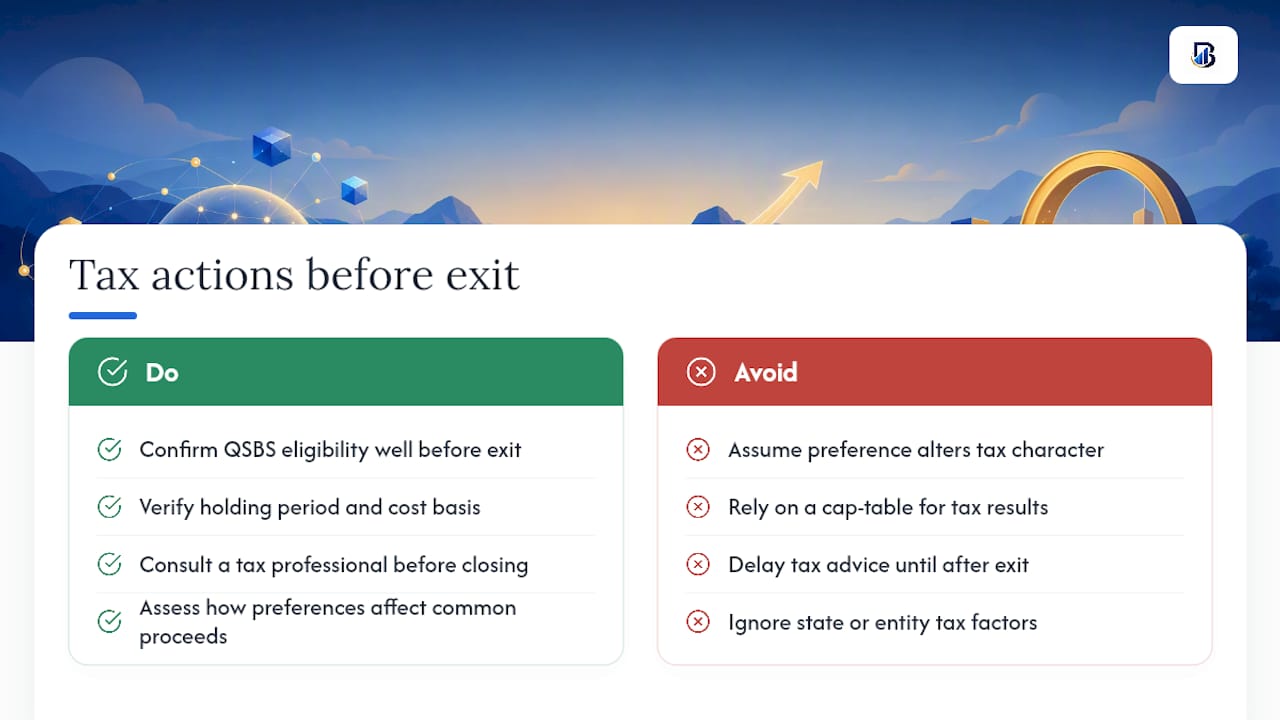
Liquidation preference proceeds are generally treated as payment for stock, which means the tax character depends on how long the stock was held and its cost basis, not on the fact that a preference clause determined the payout amount. Preferred stockholders receiving their preference amount typically recognize capital gain or loss based on the difference between that payout and their original issue price.
Common stockholders, including founders, face the same capital gains framework on whatever they receive, but the amount at stake is often smaller after preferred stockholders collect their preference, which changes the effective tax bill in dollar terms even though the tax rate mechanics stay the same. Founders holding stock that qualifies for Qualified Small Business Stock treatment under Section 1202 of the Internal Revenue Code should confirm eligibility well before an exit, since preference payouts to other shareholders don't affect an individual holder's own QSBS qualification, but the total proceeds available to common stockholders can shift what's worth planning around.
Because tax treatment turns on individual holding periods, entity structure, and state residency, founders and employees should talk to a tax professional before an exit closes, not after. Liquidation preference terms are set in the term sheet and stock purchase agreement, but how the resulting payout gets taxed depends on facts specific to each shareholder, and that's not something a standard cap-table model can calculate for you.
Differences in Liquidation Preferences Across Jurisdictions
Liquidation preference mechanics in the United States are governed primarily by the company's certificate of incorporation and the state corporate law under which it's organized, most commonly Delaware, which gives boards and stockholders wide contractual latitude to define preference terms, multiples, and seniority. The NVCA model term sheet reflects the drafting conventions most US venture deals follow, which is why so many term sheets across different firms look structurally similar even when the specific multiples and caps differ.
Outside the US, preference structures follow the same core logic, preferred stock gets paid before common, but the legal mechanisms and market norms shift by country. UK and European deals frequently route preference rights through shareholder agreements layered on top of articles of association, rather than relying solely on the certificate structure US companies use, and participation terms tend to run more conservative in some European markets than in US venture rounds.
For founders and investors operating across borders, whether through a Delaware holding company with foreign operating subsidiaries or a cap table with international investors, the practical takeaway is simple: never assume a term sheet clause means the same thing in every jurisdiction, and always have local counsel confirm how liquidation preference language will actually be enforced in the entity's jurisdiction of incorporation before signing.
Real-World Case Studies of Liquidation Preference Impacts
Square's IPO offered public confirmation of how these clauses play out at scale: some late-stage preferred investors held ratchet-style protections tied to their preference terms, guaranteeing a minimum return even as the company's public offering price came in below earlier private valuations, a structure that drew scrutiny precisely because it showed how preference terms can protect late investors at the expense of the value common stockholders and employees expected.
Down-round and acquihire outcomes tell a more common story than any headline IPO. When a company raises several rounds at rising valuations and then sells for less than the total capital invested, or barely above it, the preference stack often consumes the entire sale price. Employees holding common stock options, and founders holding common shares, can end up with proceeds close to zero even though the company found a buyer and technically had a successful exit from the acquirer's perspective. This is the scenario that makes the moderate exit range, roughly two to four times invested capital, the range worth modeling most carefully before you raise the next round, not after.
How Liquidation Preferences Affect Later Fundraising Rounds
Every new round adds another layer to the priority stack, and later investors typically negotiate for either seniority over earlier preferred series or, at minimum, pari passu treatment alongside them. That means the terms a founder accepts in a seed round don't just affect the seed investor. They set a precedent that later-round investors, and their counsel, will scrutinize closely when structuring their own preference terms.
Stacking preferences across multiple rounds also affects how future investors read the cap table. Simulating per-series payouts rather than treating the cap table as one aggregate number is the only reliable way to see how seniority or pari passu treatment across rounds actually plays out, since a promising exit price on paper can turn into a near-zero outcome for earlier common holders once every series' preference gets paid in sequence.
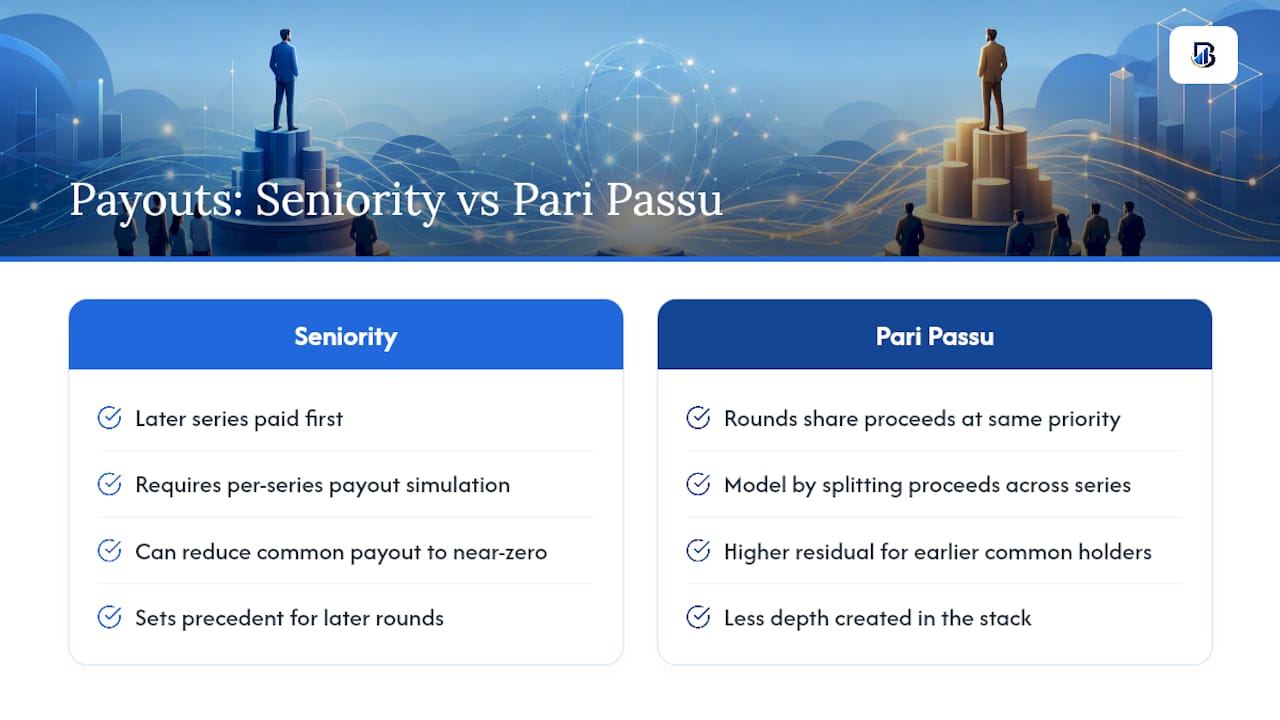
Founders raising a new round should model the full stack, not just the new term, before accepting a term sheet. The seed round's terms don't disappear when Series B closes. They just move one layer deeper into the stack.
Balancing Investor Protection With Founder Incentive
The best liquidation preference terms aren't the most founder-friendly on paper. They're the ones that keep everyone rowing the same direction through a mediocre exit, not just a great one. Uncapped participation looks reasonable at term sheet signing and feels punishing three years later when a modest acquisition offer lands.
— Bright
Model Your Next Term Sheet Before You Sign It
Running a preference clause through your head is how founders miss the math that actually matters at closing. Bright Capital America connects cap-table management directly to your fundraising pipeline, so a proposed 2x participating term or a seniority clause shows its real dollar effect on your specific ownership numbers, not a generic example, before you counter-offer.

The same workspace can give access to a large directory of investor profiles, allowing founders to move straight into outreach once terms are modeled and the cap table is clean, without switching tools or re-entering data. Founders comparing offers from multiple term sheets can use such platforms to keep every scenario and investor conversation in one place instead of scattered across spreadsheets and email threads. If you're heading into a new round, start building your investor list while your waterfall numbers are still fresh.
Sources
Review the NVCA model term sheet for standard preference language before your next negotiation.
- Liquidation preference definition — Investopedia
- How liquidation preferences work — WilmerHale Launch
FAQ
What does a 3x liquidation preference mean?
A 3x liquidation preference returns triple the invested amount before common stockholders collect anything, and it's rare in healthy market conditions since 1x non-participating remains the standard in most venture rounds.
What does liquidity preference mean?
"Liquidity preference" is sometimes used loosely to mean the same thing as liquidation preference, the contractual right determining payout order in a sale or liquidation, though the precise legal term is liquidation preference.
Is non-participating or participating preferred better for founders?
Non-participating preferred is generally better for founders, since it prevents investors from double dipping into both their preference amount and the remaining common pool, preserving more of the exit proceeds for founders and employees.