

A working fundraising pipeline template tracks every prospect through five stages: identify, qualify, cultivate, solicit, and steward. Copy it into a spreadsheet or your CRM today, and you have a live system for moving donors or investors from first contact to closed gift or signed term sheet. It works for nonprofit fundraisers building donor relationships and for founders managing an investor pipeline.
TL;DR:
- The pipeline should include only essential fields such as contact details, current stage, gift size estimate, last touch, and next action to keep it active and manageable.
- A strong prioritization system scores prospects on capacity, affinity, and accessibility, dividing them into hot, warm, and cold tiers for targeted outreach.
- Weekly pipeline reviews should focus on overdue actions, updating stages, confirming owner responsibility, and re-engaging prospects made relevant by external events or funding needs.
- Using integrated platforms with linked contact, cap table, and document management reduces friction and prevents pipelines from going stale due to disjointed tools.
- Start with a targeted list from investor directories or referral sources, and transition to CRM or platform tools when managing multiple team members or larger volumes.
Table of Contents
- What Should a Fundraising Pipeline Template Include?
- Build Your Pipeline: A Stage-by-Stage Blueprint
- How Do You Score and Prioritize Prospects?
- Spreadsheet, CRM, or Platform: Which Fits Your Team?
- How Does an Integrated Platform Support the Same Workflow?
- What Actually Breaks a Fundraising Pipeline
- Get a Pipeline That Runs Itself Between Updates
- Sources
- FAQ
What Should a Fundraising Pipeline Template Include?
A usable template needs a short list of fields—not a sprawling database. Every extra column is another thing your team forgets to update, and a pipeline that goes stale is worse than no pipeline at all.
The core fields that matter, regardless of whether you're chasing donors or investors:
- Contact details (name, email, organization or firm)
- Affiliation or role (board connection, prior donor, fund partner, angel)
- Stage (where they sit in the pipeline right now)
- Check size or gift range (target ask or estimated capacity)
- Intro path (who made the connection, or how you found them)
- Last touch (date of most recent contact)
- Next action (the single task that moves them forward)
- Owner (who on the team is responsible)
- Status and notes (active, paused, declined, closed)
Stage labels differ by pipeline type. A nonprofit fundraising pipeline commonly runs through identification, qualification, cultivation, solicitation, and stewardship, with stewardship carrying particular weight because it's what turns a one-time gift into a recurring donor relationship. An investor pipeline typically runs through research, outreach, meeting, diligence, term sheet, and closed, sometimes expanding to six or eight stages when teams want more granularity around diligence and negotiation.
Optional fields for scoring and segmentation (capacity score, affinity tag, warm/cold flag) help larger teams prioritize, but add them only after the core columns are working. Format wise, a single-sheet spreadsheet handles solo fundraisers and early founders, a multi-tab workbook suits teams tracking multiple campaigns, and a CRM makes sense once you have parallel conversations that need shared visibility.
Build Your Pipeline: A Stage-by-Stage Blueprint
Copy this structure directly into Google Sheets, Airtable, or your CRM of choice. Each stage gets one row per prospect, one purpose, and one next action.
- Identify. Purpose: build your initial list of names from research, referrals, or events. Fields to populate: contact details, affiliation, intro path, source. Next action: confirm the contact is real and reachable.
- Qualify. Purpose: decide if this prospect is worth cultivation time. Fields to populate: capacity estimate, affinity notes, initial score. Next action: schedule a first conversation.
- Cultivate. Purpose: build the relationship before you ask for anything. Fields to populate: last touch, meeting notes, interests uncovered. Next action: send a specific piece of content or invite them to an event.
- Solicit. Purpose: make the actual ask, whether that's a gift or a term sheet. Fields to populate: proposed amount, ask date, response. Next action: follow up by a set date if no response.
- Steward. Purpose: keep the relationship active after the close. Fields to populate: gift/investment date, thank you sent, next touchpoint. Next action: schedule the next update or report.
Funnel math matters here more than most fundraisers realize. On the investor side, playbooks suggest loading a moderate number of targeted investors at the top of the funnel to generate a few seed term sheets. That ratio holds because most contacts drop out at qualification or after a single meeting. Nonprofit pipelines follow a similar logic. If your gala or capital campaign needs 20 major gifts, you need to be cultivating far more than 20 names, because attrition between stewardship touches and actual gifts is real.
Pro Tip: Track exactly one next-action date per row, not per contact. If a prospect has three possible next steps, pick the single most important one and update it after every interaction. Rows with no next-action date are functionally dead. Nobody will remember to revisit them.
How Do You Score and Prioritize Prospects?
Not every name in your pipeline deserves equal attention. A simple three-axis scoring system keeps your team focused on the contacts most likely to convert.
Score each prospect on three practical axes:
- Capacity: can they realistically give or invest at the level you need?
- Affinity: do they already care about your mission or sector?
- Accessibility: do you have a real path to reach them, or are you cold?
Assign points to each axis (1 to 5 works fine), then sum them into buckets. A combined score of 12 to 15 becomes your "hot" or "A" tier, 7 to 11 is "warm" or "B," and anything below 7 is "cold" or "C." Hot prospects get weekly outreach and a named owner. Warm prospects get monthly touches. Cold prospects sit in a nurture list until something changes, like a new referral or a public event that raises their profile.
Nonprofits have long used gift range charts to translate this scoring into dollar targets, mapping the number of prospects needed at each capacity level to hit a campaign goal. Investor pipelines do the same thing with check-size bands, sorting contacts by whether they typically write $25,000 checks or $250,000 checks.
Whatever scoring model you use, track these KPIs weekly: conversion rate by stage, the count of next actions that are overdue, and pipeline coverage ratio (how many active prospects you have relative to your goal). A pipeline with plenty of names in "identify" but almost nothing in "solicit" tells you exactly where your bottleneck sits. Frameworks for screening prospects before committing resources apply the same discipline: qualify hard before you invest cultivation time.
Spreadsheet, CRM, or Platform: Which Fits Your Team?
A spreadsheet is the right call when you're a solo fundraiser or a two-person founding team moving fast and sharing a single file. It's free, instantly editable, and doesn't require onboarding. A free, minimal Google Sheets CRM template is often the fastest way for early-stage founders to get moving without overhead.
The upgrade point to a CRM comes when you have parallel conversations happening across multiple team members, need automated reminders for overdue next actions, or want segmentation and scoring handled without manual formulas. Nonprofit teams managing donor pipelines often lean on automation for segmentation and personalized messaging once volume outgrows a shared sheet.
A solid starter workbook, whether spreadsheet or CRM, should include:
- A prospect profile template capturing background, interests, and giving or investing history
- A cultivation plan template outlining touchpoints and timing
- A portfolio handoff checklist for when a prospect changes owners
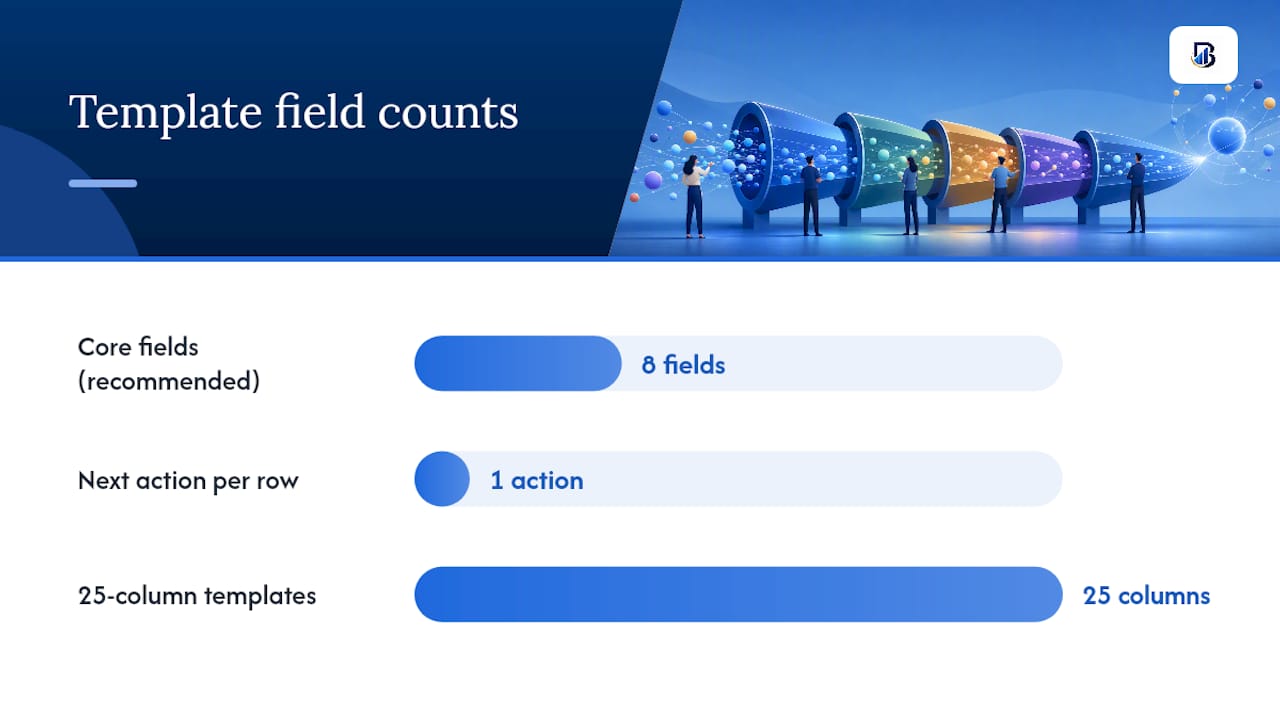
Whatever format you choose, keep it to eight core fields and one next action per row. A template with 25 columns rarely gets filled in consistently, and a half-completed pipeline is harder to trust than a simple one that's actually current.
How Does an Integrated Platform Support the Same Workflow?
Stitching together a spreadsheet, a separate contact database, a document folder for diligence materials, and a cap table tool creates exactly the kind of friction that makes pipelines go stale. Some fundraising platforms offer unified workspaces that combine pipeline tracking, outreach, and document management in one place instead of multiple tools.
That matters most at the fields level. Instead of manually updating "intro path" and "last touch" across disconnected tools, an integrated workspace keeps:
- Investor contact records synced with outreach history
- Cap table data linked directly to fundraising rounds, so ownership stays accurate as terms change
- Secure data rooms attached to each prospect, so diligence materials don't live in a separate inbox
Founders and fundraisers who want downloadable worksheets and stage walkthroughs can find them through Funding Academy, which covers the same pipeline logic laid out here with platform-specific detail.
What Actually Breaks a Fundraising Pipeline
Most pipelines fail from neglect, not bad design. The mistake I see most often is a spreadsheet with 200 names and no next-action dates. That's not a pipeline, that's a list.
Run a five-step weekly review: check overdue next actions first, move stalled prospects to a decision (advance or archive), update stage tags, confirm every active row has an owner, and add any new names from the week's outreach or events. Archive a prospect when they've gone quiet for two full cycles with no response. Re-engage instead when a life event, funding round, or public campaign makes them newly relevant. Copy the template this week and run one cycle before you judge whether it works.
— Bright
Get a Pipeline That Runs Itself Between Updates
Building a pipeline template solves the tracking problem. Finding enough qualified names to fill it is a separate challenge, and it's the one that stalls most fundraising efforts before stage two. Certain platforms connect founders directly with large networks of verified investors, enabling the "identify" stage of a pipeline to start with a matched list instead of a cold search.

Some platforms combine investor directories with integrated cap table management, fundraising tools, and secure data rooms, so the fields in your template stay connected to the actual documents and terms behind each deal instead of being scattered across separate tools. That's the friction founders usually hit once a spreadsheet pipeline outgrows a single sheet.
If you're actively raising, start by browsing the investor database to build your top-of-funnel list, or visit Private Capital Raises to see how pipeline tracking, outreach, and cap table management work together in one workspace.
Sources
FAQ
What Are the Five Stages of a Fundraising Pipeline?
The five core stages are identification, qualification, cultivation, solicitation, and stewardship, with stewardship being the stage most pipelines neglect despite its role in donor retention.
How Many Investors Should I Add to My Pipeline?
Load a moderate number of targeted investors at the top of your funnel if you're aiming for one to three seed term sheets, since most names drop out before diligence.
Should I Use a Spreadsheet or a CRM for My Pipeline?
A spreadsheet works well for solo fundraisers or small founding teams; upgrade to a CRM once you need parallel team access, automated reminders, or built-in scoring, or consider an integrated workspace like Bright Capital America that combines investor discovery with pipeline tracking.
What Fields Are Essential in a Fundraising Pipeline Template?
At minimum, track contact details, stage, check or gift size, last touch, and next action. A pipeline row with no next-action date is effectively inactive.
How Do I Prioritize Which Prospects to Contact First?
Score each prospect on capacity, affinity, and accessibility, then sort into hot, warm, and cold tiers so your team spends the most time on the contacts most likely to convert.