

If your company just closed its first sale of securities in a private offering under Regulation D or Section 4(a)(5), the clock is already running. You must file Form D electronically through the SEC's EDGAR system within 15 calendar days of that first sale, and you need EDGAR access, meaning a CIK and Login.gov credentials obtained through Form ID, before you can submit anything.
Here's what needs to happen right away:
- Confirm whether your company already has a CIK, or start the Form ID application today.
- Assemble your offering details offline: issuer information, offering amount, exemption claimed, and related persons.
- Log in through Login.gov and file through EDGAR's online forms system once every field is ready.
The legal basis for all of this sits in 17 CFR §239.500, which sets the timing and electronic filing requirements, and the SEC's own guidance on filing a Form D notice walks through the mechanics. Missing this deadline creates real exposure, so treat it as a fixed date on your closing calendar, not a soft target.
Key Takeaways
Filing Form D on time requires EDGAR access secured in advance, every field prepared offline, and a filing owner who treats the 15-day clock as fixed.
| Point | Details |
|---|---|
| 15-day deadline is firm | File electronically within within a short, firm deadline after the first sale, counted from the date an investor becomes contractually committed. |
| EDGAR access takes planning | Apply for your CIK through Form ID and coordinate Login.gov roles before your first expected sale. |
| Prepare fields offline | Use the PDF version of Form D to draft answers before logging in, since EDGAR sessions time out after one hour. |
| State notices run separately | Confirm your state's blue-sky filing requirements and fees; they don't disappear once you file federally. |
| Bright Capital America supports the raise | Formation, investor discovery, and fundraising infrastructure help founders manage the process around a Regulation D filing. |
Table of Contents
- What Is Form D and Why Does the SEC Require It?
- Who Must File Form D?
- When Is the Form D Deadline, Exactly?
- How to File Form D on EDGAR: A Step-by-Step Workflow
- What Information Does Form D Require?
- Do You Need to Amend or Renew Your Form D Filing?
- Do States Require Their Own Form D Notice?
- What Mistakes Most Often Delay or Derail a Form D Filing?
- Frequently Asked Questions
- Sources
What Is Form D and Why Does the SEC Require It?
Form D is not a registration statement. It's a notice filing that tells the SEC you're relying on an exemption from full securities registration, typically under Regulation D or Section 4(a)(5) of the Securities Act. Companies raising capital through private placements use these exemptions to avoid the cost and delay of a public offering, but the trade off is transparency: the SEC wants a record of who is raising money, how much, and under what exemption.
Form D is the SEC's mechanism for tracking exempt offerings without requiring the full disclosure regime of a registered securities sale. The requirement to file is grounded directly in 17 CFR §239.500, which governs both the electronic filing method and the signature requirements for the notice.
A few things worth locking in before you go further:
- Form D applies to offerings under Rules 504, 506(b), and 506(c) of Regulation D, plus certain Section 4(a)(5) offerings.
- The filing is public. Anyone can search EDGAR and see that your company raised capital, from whom (in aggregate terms), and under which exemption.
Who Must File Form D?
If your company or fund relied on Rule 504, 506(b), or 506(c) to sell securities, you must file. This applies to startups raising a seed round, private funds forming an SPV, and companies conducting a Section 4(a)(5) offering. It doesn't matter whether you're a two-person startup or an established fund manager. The exemption comes with a notice obligation attached.
You can file Form D before any sale actually happens, but you're required to file within 15 days after the first one. The notice must carry a signature from someone the issuer has authorized to sign on its behalf, not just anyone with EDGAR access.
- Issuers relying on Rule 504, 506(b), or 506(c) must file, regardless of company size.
- Filing early (pre-sale) is allowed; filing late is a compliance problem.
- An authorized signatory, not just any employee, must execute the notice.
When Is the Form D Deadline, Exactly?
The rule is specific: you have 15 calendar days after the date of first sale to get Form D filed, and that requirement comes straight from SEC guidance on filing a Form D notice. Calendar days, not business days, which catches a surprising number of companies off guard.
"First sale" has a precise legal meaning: it's the date an investor becomes irrevocably contractually committed to invest, not the date funds hit your bank account and not the date you sign a term sheet. If an investor executes a subscription agreement with binding wire instructions on a Tuesday, that Tuesday is day zero, even if the wire clears three days later.
- Identify the exact date the first investor became contractually bound.
- Count 15 calendar days forward from that date.
- If day 15 lands on a Saturday, Sunday, or federal holiday, the deadline shifts to the next business day.
Pro Tip: Don't wait for your scheduled closing to start the clock. If your first investor signs early, that triggers the deadline, even if your official closing is weeks away.
How to File Form D on EDGAR: A Step-by-Step Workflow
Filing Form D means working inside the SEC's EDGAR Online Forms system, and the process rewards preparation. Here's the sequence that keeps things clean.
Step 1: Apply for EDGAR access through Form ID, and do it early. You need a CIK number before you can file anything, and the Form ID application is how you get one. Processing takes time, and some information you submit, like your business and mailing address, becomes publicly viewable once granted. Plan your timeline with that transparency in mind.
Step 2: Coordinate Login.gov credentials with your EDGAR account administrators. The SEC has shifted individual EDGAR access to Login.gov, which raises individual accountability for whoever actually submits the filing. Make sure the person filing has the correct role assigned by your account administrator before the filing window opens, not during it.
Step 3: Compile every field offline first. This is the step teams skip and later regret. EDGAR's online session times out after one hour of inactivity, so drafting your answers live inside the system is a good way to lose your work mid-filing. Use the PDF version of Form D to prepare every answer in advance, then paste them in once you're logged in.
Step 4: Log into EDGAR, select Form D, complete the fields, and submit. Once submitted, you'll get a confirmation, and the filed notice becomes retrievable through EDGAR's company search tool for your records and for state filing purposes.
Step 5: Handle the aftermath. Save a copy of the filing and the acceptance email, circulate both to your legal and finance teams, and immediately turn attention to state blue-sky notice requirements, which run on a separate clock.
- Apply for your CIK well before you expect a first sale, not after.
- Keep a running list of common EDGAR validation errors (mismatched addresses, missing exemption selections) so your filer isn't troubleshooting live.
Pro Tip: Assign one specific person as the filing owner for every raise. "The team will handle it" is how deadlines get missed.
What Information Does Form D Require?
Before your EDGAR session starts, gather these details so nothing holds up submission:
- Issuer identification: legal name, principal address, state of incorporation, and CIK (plus EIN if requested).
- Offering details: total offering amount, amount sold to date, minimum investment accepted, and the type of securities being offered.
- Exemption claimed: whether you're relying on Rule 504, 506(b), or 506(c), and the factual basis for that choice.
- Related persons: names and addresses of executive officers, directors, and promoters, plus notes on accredited investor verification where applicable.
- Filing contact and signature: who the SEC should contact about the notice, and who is authorized to sign it.
| Field Category | What to Prepare |
|---|---|
| Issuer identification | Legal name, address, state of incorporation, CIK |
| Offering details | Total offering size, amount sold, minimum investment |
| Exemption claimed | Rule 504, 506(b), or 506(c) with supporting basis |
| Related persons | Officers, directors, promoters, and verification notes |
Do You Need to Amend or Renew Your Form D Filing?
Amendments aren't optional when specific facts change. You need to amend if the offering size shifts materially, if sales to date change significantly, if related persons change, or if you're correcting the exemption claimed.
Separately, if your offering is still open on or before the first anniversary of your initial filing or last amendment, an annual amendment is required to keep the notice current.
- Check your filing date against the calendar each quarter.
- Mark the EDGAR submission as an amendment, not a new filing, when updating.
- File the annual amendment before the anniversary date if the offering continues.
Do States Require Their Own Form D Notice?
Many states run their own blue-sky notice requirements on top of the federal filing, and most charge a separate fee. You cannot assume that filing with the SEC covers your state obligations.
- Confirm whether your state requires a copy of your Form D, a state-specific form, or both.
- Check NASAA's Electronic Filing Depository resources to see whether your state accepts electronic submissions or requires paper.
- Pull your accepted Form D printout from EDGAR's company search page. States often want that exact document attached.
Pro Tip: Add state notice fees and deadlines to your closing checklist the same day you file federally. State clocks often run independently of the 15-day federal deadline.
What Mistakes Most Often Delay or Derail a Form D Filing?
The most common failure is simple: missing the 15-day window because nobody owned the task. Close behind it are filing under the wrong exemption, submitting incomplete related-person data, and discovering during the filing session that EDGAR credentials have lapsed or the wrong person holds filer access.
Missing the deadline is a violation of Rule 503, though the SEC has clarified that the filing requirement is separate from whether your Regulation D exemption itself remains available. That said, chronic late filing invites scrutiny under Rule 507, which can affect your ability to rely on Regulation D in future offerings.
- Assign filing ownership at the start of every raise, not after the first sale closes.
- Keep a reusable filing template so field values transfer instead of getting re-drafted each time.
- Maintain an amendment calendar tied to your anniversary date.
Pro Tip: Save every EDGAR acceptance email in a dedicated compliance folder. Investors and future acquirers will ask for proof of filing during due diligence.
A Practical Workflow Worth Adopting
The strongest process treats Form D like a fixed operational task, not a legal afterthought. Prepare fields offline, secure your Form ID and CIK well ahead of your first expected sale, name one filing owner, submit and confirm, then immediately shift to tracking state notices. Bright Capital America's formation and investor tracking tools fit naturally into that same closing checklist.

Getting Ready to Raise? Here's Where Bright Capital America Fits In
Founders preparing a Regulation D raise usually need more than a filing checklist. They need the entity formed correctly, a real pipeline of qualified investors, and infrastructure to track commitments as they come in. Bright Capital America supports all three: formation services to get your entity filing-ready, an investor database of more than 27,000 verified profiles for outreach, and fundraising infrastructure built specifically for private capital raises like the one you're about to notice with the SEC.
If due diligence documentation is part of your prep, this founder's guide to due diligence documents pairs well with your Form D checklist. And if your offering terms shift mid-raise, triggering an amendment, a contract amendment template can save your legal team time on the drafting side.
None of this replaces legal counsel. Form D filing decisions, exemption selection, and state notice obligations carry real consequences, and you should confirm your specific situation with a securities attorney. But once counsel signs off on your approach, Bright Capital America's tools can help you execute the fundraising side faster. Explore the investor marketplace to see how founders at your stage are building their investor pipeline today.
Frequently Asked Questions
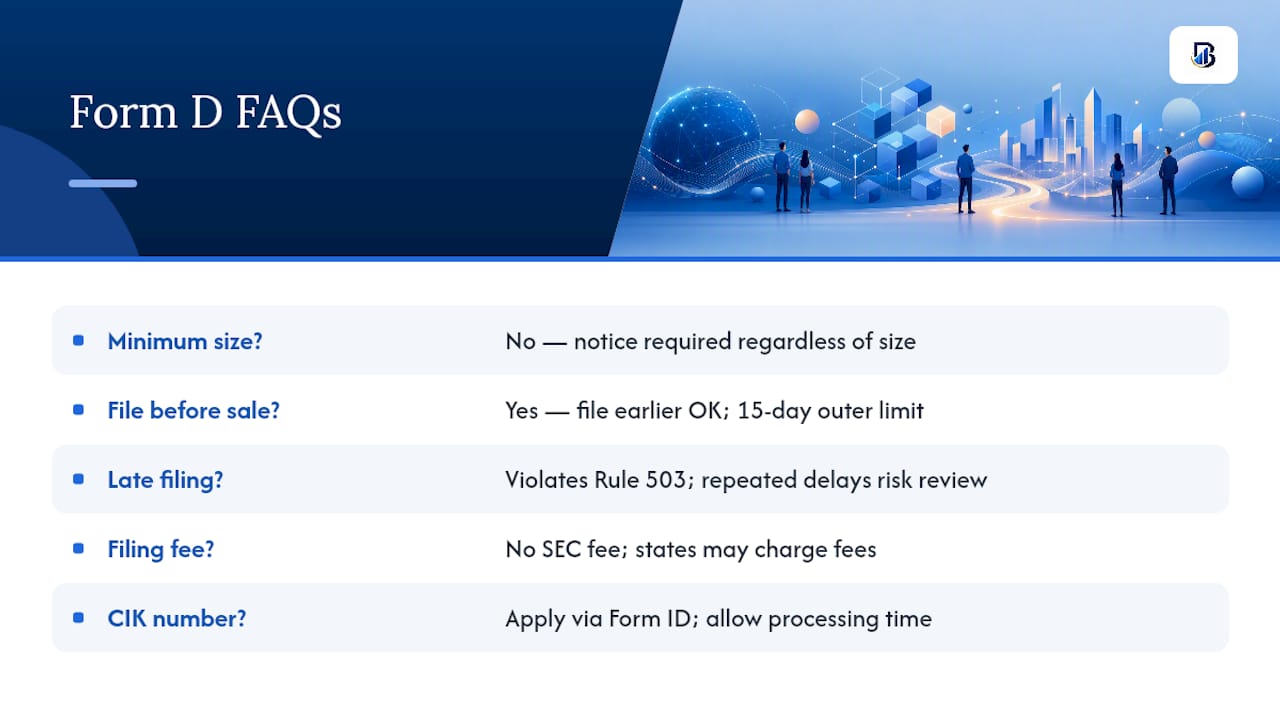
Do I need to file Form D if my offering is small? Yes. There's no minimum offering size exemption from the Form D notice requirement itself. If you're relying on Rule 504, 506(b), or 506(c), the notice obligation applies regardless of how much capital you're raising.
Can I file Form D before my first sale happens? Yes, and it's often smart to do so if your CIK and EDGAR access are already in place. The 15-day deadline only sets the outer limit; nothing stops you from filing earlier.
What happens if I file Form D late? Late filing violates Rule 503. The SEC has noted that this doesn't automatically strip your exemption, but repeated or significant delays can invite scrutiny under Rule 507 and complicate future capital raises.
Is there a fee to file Form D with the SEC? No. The SEC does not charge a filing fee for Form D notices or amendments, though many states charge their own fee for state-level notice filings.
How do I get a CIK number for my company? You apply through the SEC's Form ID process, which grants EDGAR access and issues your CIK once approved. Start this well before your anticipated first sale, since processing takes time.
This article is general information, not a substitute for advice from a qualified lawyer. Consult a qualified legal professional about your own circumstances before acting on anything here.
Sources
- Sec
- 17 CFR § 239.500 - Form D, notice of sales of securities under Regulation D and section 4(a)(5) of the Securities Act of 1933. | LII / Legal Information Institute