

Start with Bright Capital America's investor directory if you need contactable family-office leads today. With 27,000+ verified investor profiles, CRM-ready exports, and built-in outreach tools, it lets you move from search to shortlist without switching platforms.
Your first action, in two steps:
- Run a targeted filter by sector, ticket size, and geography, then export a shortlist of 10 to 20 profiles.
- Build your outreach cadence before you send the first email, not after.
From there, visit the investor database and start filtering.
Key Takeaways
A verified, regularly updated family office directory with named contacts converts far better than a static or unverified list.
| Point | Details |
|---|---|
| Start with breadth and verification | Choose a directory with tens of thousands of profiles and a visible update cadence, not just raw volume. |
| Prioritize named contacts | Profiles with a named decision-maker beat generic firm emails on response rate. |
| Use proxy signals for undisclosed AUM | Board seats and portfolio overlaps estimate ticket capacity when AUM isn't public. |
| Sequence outreach deliberately | Email, then LinkedIn, then warm introduction, on a fixed 14-day cadence. |
| Bright Capital America as your starting point | Its directory of 27,000+ profiles with CRM exports and AI matching is built for this exact workflow. |
Table of Contents
- What Is a Family Office Directory, and Who Actually Uses One?
- Which Profile Fields Actually Matter When You're Shortlisting?
- How Do You Know a Directory Is Actually Worth Paying For?
- How Do You Turn a Directory List Into an Actual Meeting?
- What Should You Expect to Pay, and How Fast Can You Get Access?
- What Does a Real Family Office Profile Look Like?
- How We Think About Verification and Data Quality
- Get Verified Family Office Contacts Without the Guesswork
- Sources
What Is a Family Office Directory, and Who Actually Uses One?
A family office directory is a structured database of family-run investment entities. It lists single-family offices (SFOs), which manage wealth for one family, and multi-family offices (MFOs), which serve several unrelated families under one roof. The distinction matters because it changes how you approach them.
Fund managers, placement agents, corporate development teams, and advisors who serve high-net-worth families are the primary users. Each group has a different job to do:
- Fund managers use directories to find limited partners for a new fund.
- Placement agents use them to map warm paths into hard-to-reach principals.
- Corporate development teams use them to identify strategic or co-investment partners.
Directories solve a real discovery problem. Most single-family offices are intentionally opaque. They don't publish deal flow or list a general inbox, and industry commentary on family office discovery confirms that indirect routes, such as filings and portfolio company overlaps, are often the only way in.
Which Profile Fields Actually Matter When You're Shortlisting?
Not every field on a directory profile carries the same weight. Some tell you whether an office can write the check you need; others tell you whether they'll ever pick up the phone.
The fields worth scrutinizing: firm type (SFO or MFO), disclosed AUM or an AUM band, primary sectors, typical ticket size, geographic mandate, named portfolio companies, decision-makers, gatekeepers, contact channels, and a verification status with a last-updated date.
| Field | Why it matters | Positive signal |
|---|---|---|
| Firm type (SFO/MFO) | Determines whether you need a relationship-first or process-first approach | MFO with a documented investment committee |
| AUM band | Filters out mismatched ticket sizes before you waste a pitch | Band consistent with your target raise size |
| Named decision-maker | Skips the gatekeeper loop entirely | Title like CIO or Managing Director, not "Info" |
| Verification date | Signals the contact still works there | Updated recently |
| Portfolio overlap | Shows appetite for your sector without asking | Two or more deals in your space |
Pro Tip: When AUM is undisclosed, don't skip the profile. Check portfolio company board seats and past transaction sizes instead. These proxy signals, used to estimate ticket capacity in multi-asset mandates, often reveal more than a self-reported number would.
How Do You Know a Directory Is Actually Worth Paying For?
Before you subscribe to any family office directory, run it through a short evaluation checklist. Vendors vary enormously in accuracy, and a bad list costs you more than money. It costs you credibility with the offices you eventually do reach.
Check for:
- A stated verification process (phone, email, or LinkedIn cross-check), not just a claim of "verified" data.
- A visible update cadence, ideally monthly or quarterly, not a static list built once and never touched.
- Field-level completeness, especially named contacts rather than generic firm emails.
- Native CRM export, so your list doesn't sit trapped in a browser tab.
- Clear privacy and security controls around how contact data is stored and shared.
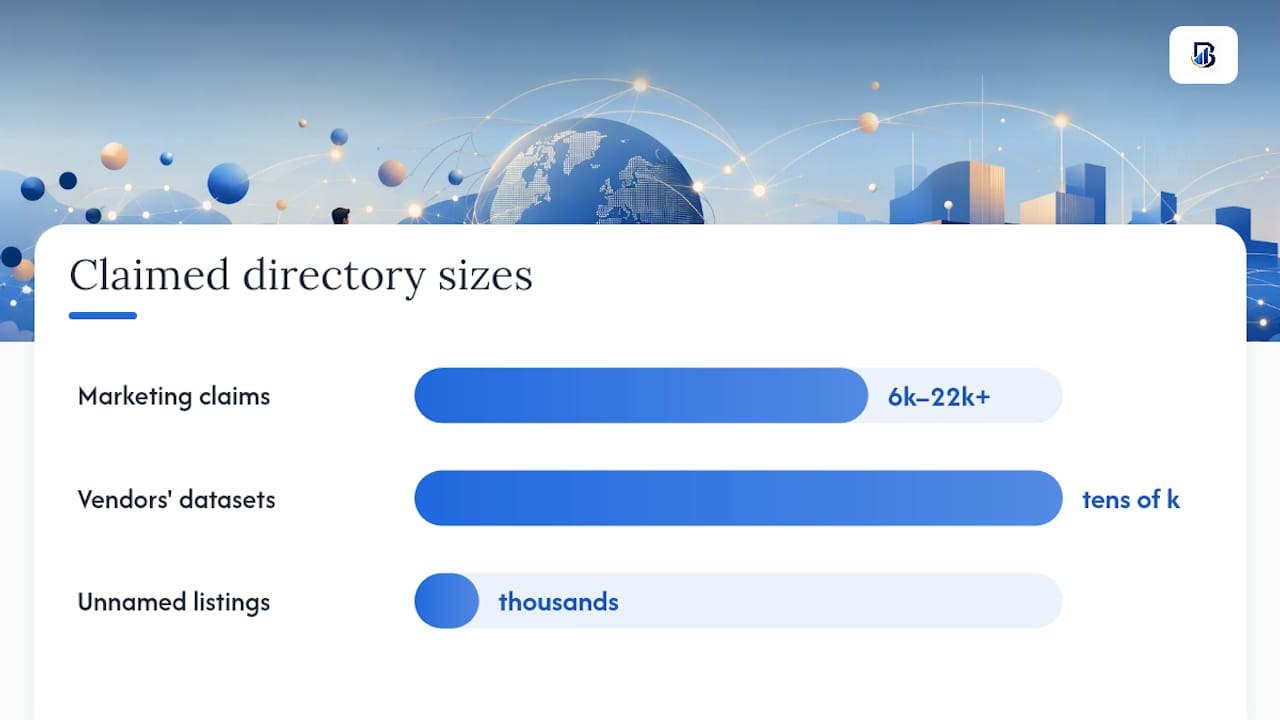
Watch for red flags: a directory that lists thousands of "family offices" with no named individual, an AUM figure with no source, or no visible timestamp on when a profile was last checked. Some vendors publish datasets in the tens of thousands, and market-sizing claims of 6,000 to 22,000+ family-office listings are common in marketing copy. Scale alone doesn't tell you whether those profiles are current.
Ask for a sample export of five to ten profiles before you commit. Cross-reference names against public filings or the firm's own site. A directory that hesitates to share a sample is telling you something.
Verification and freshness aren't cosmetic details. Recent timestamps and confirmed contact information directly affect whether an outreach email lands with the right person instead of bouncing off a departed executive's old address.
How Do You Turn a Directory List Into an Actual Meeting?
A directory only pays off if you convert it into a working process. Here's the sequence that gets results:
- Define fit criteria first. Decide your sector, stage, geography, and minimum ticket size before you open the search bar.
- Run filters, then examine profiles individually. Don't outreach off a raw export.
- Validate two or three contacts per profile against LinkedIn or the firm's own site.
- Build a shortlist of 10 to 20 targets. Anything larger dilutes your personalization per email.
- Sequence your outreach: email first, LinkedIn connection second, warm introduction request third if the first two go quiet.
- Follow up on a fixed cadence, typically day 1, day 7, and day 14, then pause.
A workable subject line names the specific overlap you found, not a generic pitch: "Portfolio overlap in [sector]" beats "Investment opportunity" every time. Keep the opener to one sentence that states who you are and why this specific office, not a form letter.
Timeline expectations matter here. Family offices typically move slower than institutional funds on a first response, often two to four weeks versus one to two for a VC firm, but they also skip several layers of committee review once interest is confirmed. A blended approach, using directory data alongside direct verification through filings or mutual connections, consistently improves meeting rates over blind outreach from an unmanaged list.
What Should You Expect to Pay, and How Fast Can You Get Access?
Directory pricing typically follows a tiered structure, and knowing the shape in advance saves you a negotiation headache later.
- Free preview: limited profile counts, usually enough to test search quality, not enough to build a real pipeline.
- Individual-seat subscription: monthly or annual billing, full profile access, standard export limits.
- Enterprise or agency license: flat fee covering multiple seats, often with priority support.
- API or CRM integration add-ons: usually sit behind the higher tiers, since advanced filters and CRM-ready exports are core features on most serious platforms.
Annual plans generally beat monthly ones on a per-seat basis. Expect immediate access to preview tiers, one to two weeks for a verified export and onboarding on a paid plan, and longer if you need a custom CRM integration built out. Before signing anything, ask for a trial export and confirm the update cadence in writing.
What Does a Real Family Office Profile Look Like?
A well-built profile gives you enough to decide fast. Here's a compact example of what a usable profile includes and how to read it.

| Field | Sample value | What it tells you |
|---|---|---|
| Firm type | Single-family office | Expect relationship-first outreach, longer cycle |
| AUM band | Undisclosed, estimated via portfolio | Use board seats as a proxy signal |
| Sectors | Real estate, private equity, venture | Multi-asset mandate, broad fit potential |
| Contact | Named CIO, recently verified | High-confidence outreach target |
| Portfolio overlap | Two prior deals in your sector | Strong reason to reference in your opener |
Samson Investment Partners, the single-family office serving the family of Roy J. Zuckerberg, illustrates a classic SFO profile: centralized investment, tax, trust, and estate services for one family, with no public deal-flow signaling. That structure calls for a patient, introduction-led approach rather than a cold pitch. An MFO with a documented, repeatable process, by contrast, often responds better to a direct filter-based approach since it's built to evaluate multiple external deals at once.
How We Think About Verification and Data Quality
Building a usable directory means treating verification as ongoing work, not a one-time data pull. Every profile needs a recheck cycle, and operator feedback from users flags stale contacts faster than any automated scan.
Bright Capital America's directory pairs that verification discipline with AI-driven matching and integrated outreach tools, so a verified contact turns into a message without leaving the platform.
Get Verified Family Office Contacts Without the Guesswork
Building your own family office list from scattered filings and LinkedIn searches eats weeks you don't have. Bright Capital America's investor directory gives you 27,000+ verified profiles, AI-powered matching, and CRM exports in one workspace, so you skip the manual cross-referencing entirely.
Subscribers get named decision-makers instead of generic inboxes, sector and geography filters built for fast shortlisting, one-click CRM export, and onboarding support to get your first list running fast. Pro Tip: Request a sample export during your trial and cross-check five profiles against public filings before you commit to a paid tier.
Visit Bright Capital America for investors to see profile depth firsthand, or head straight to the investment marketplace to start matching against active mandates today.
Sources
- Samson Investment Partners | SIP | New York | Single Family Office
- NSFO — Narotam Sekhsaria Family Office
- Multi Investment | Private Equity & Real Estate