

For most U.S. donors seeking tax efficiency and administrative simplicity, a donor-advised fund is the better starting point. Private foundations make more sense when you need permanent institutional control, staff-run programs, or grantmaking beyond public charities. The core trade-off comes down to two things: how much control you need over decisions, and how much complexity you're willing to manage to get it.
TL;DR:
- Donor-advised funds have no required payout, lower annual costs, and offer privacy, making them ideal for donors giving under $1 million or seeking speed.
- Private foundations incur a 1.39% annual excise tax on net investment income, which can significantly reduce long-term growth compared to the tax-free appreciation of DAF assets.
- Foundations provide direct legal control, family governance, and the ability to handle complex assets, but involve higher setup, maintenance costs, and public disclosure requirements.
- DAF contributions are irrevocable and automatically owned by the sponsor, while foundations offer trustees direct authority and often require public Form 990-PF filings.
- For most donors, starting with a DAF during high-income years and later transitioning to a foundation for control is a common, cost-effective strategy; complex asset giving should involve professional advice.
Table of Contents
- Donor-Advised Fund vs. Foundation: A Side-by-Side Look
- What the Tax Rules Actually Cost You Over Time
- Who Actually Controls the Money?
- What It Actually Costs to Set Up and Run Each One
- How to Decide: Checklist and Practical Strategies
- What Advisors Get Wrong About This Decision
- An Advisor's Honest Take on the Trade-Off
- How Bright Capital Supports Donors Building a Giving Structure
- Sources
Donor-Advised Fund vs. Foundation: A Side-by-Side Look
The decision usually breaks down along five practical lines: who holds legal control, how the tax code treats your gifts, what it costs to operate, how much you're required to pay out each year, and how much of your giving becomes public record.
- Control: A donor-advised fund is a charitable account housed at a sponsoring organization like Vanguard Charitable or Fidelity Charitable. You recommend grants, but the sponsor holds legal ownership and final say. A private foundation is a separate legal entity you or your family control directly as trustees or directors.
- Tax treatment: Cash gifts to a DAF are deductible up to 60% of adjusted gross income, while cash gifts to a private foundation are capped at 30%, according to IRS rules.
- Costs: DAF sponsors typically charge an administrative fee built into the account; foundations carry legal, accounting, and often staffing costs on top of investment fees.
- Payout requirements: Foundations must distribute an annual amount of net assets, generally in the mid-single-digit percentage range. DAFs carry no federal mandatory payout.
- Privacy: DAF grants can often be made anonymously. Foundations file Form 990-PF, a public document listing grants, trustees, and compensation.
If you value speed and low overhead, that list points toward a DAF. If you need your name off the grant and full authority over every dollar, it points toward a foundation.
What the Tax Rules Actually Cost You Over Time
The deduction gap between the two vehicles is bigger than most donors expect, and it compounds. Cash gifts to a DAF are deductible up to 60% of AGI, while the same gift to a private foundation tops out at 30%, per general IRS guidance. For appreciated assets, DAF limits typically run around 30% of AGI, compared to roughly 20% for foundations, with additional fair-market-value versus basis rules for non-publicly traded assets.
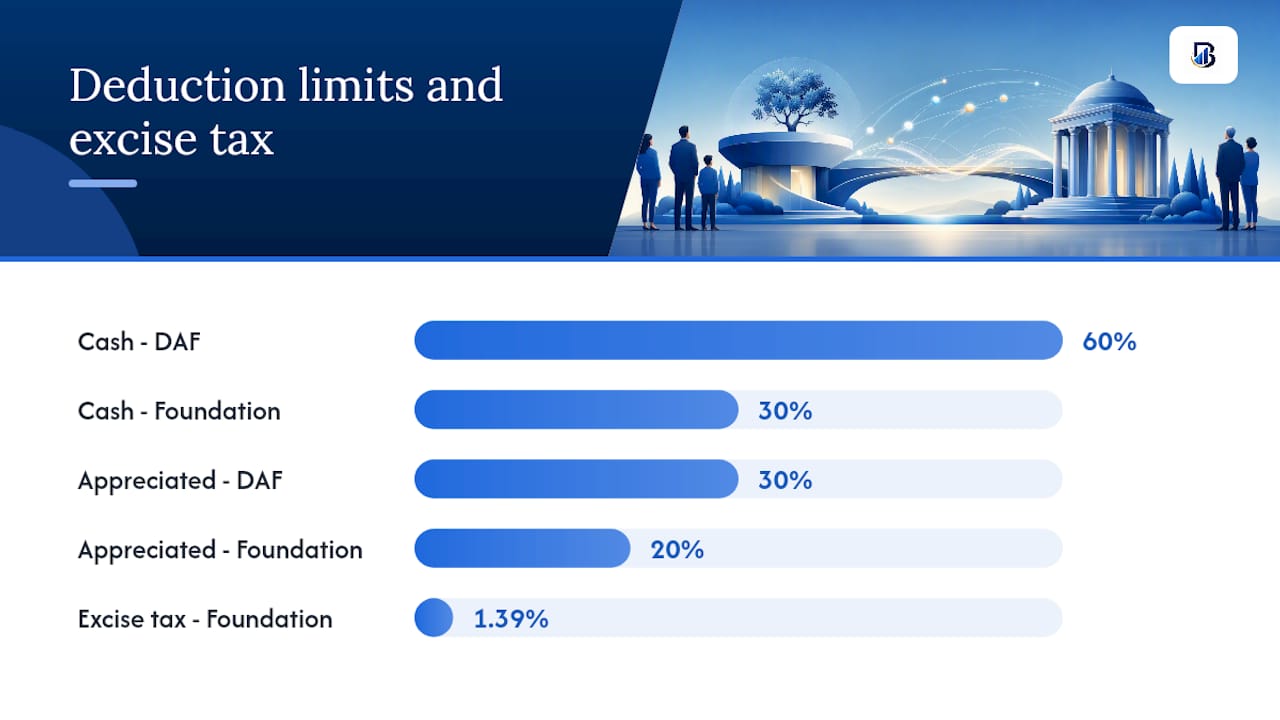
Statistic Callout: Private foundations pay a 1.39% excise tax on net investment income every year, indefinitely. DAF investment growth carries no such tax.
That 1.39% sounds trivial until you run it across decades. A foundation earning steady investment returns loses a fixed slice of growth to excise tax every single year, compounding against you the same way fees compound against an investor. A DAF's tax-free growth means every dollar of appreciation stays available for grants.
Two more things worth knowing:
- Excess charitable deductions beyond the AGI cap generally carry forward for up to five years.
- "Bunching" multiple years of intended giving into a single high-income year, then funding a DAF, lets you capture the larger deduction window in one shot rather than losing it to lower annual caps.
Who Actually Controls the Money?
Legal ownership is the real dividing line. A DAF sponsor owns the assets outright once you contribute, according to IRS guidance on donor-advised funds, which also notes that contributions are generally irrevocable. You retain advisory privileges, not legal authority. A private foundation's trustees hold that authority directly, which is why foundations can run scholarship programs, make direct assistance grants to individuals, and even issue certain grants to non-charitable entities under specific rules that DAFs simply cannot match.
Succession planning splits the same way: foundations let you formalize family board seats across generations, while DAFs typically pass advisory privileges to named successors with less governance structure.
- Foundations file public Form 990-PF returns disclosing trustees, grants, and compensation.
- DAF grant activity generally stays outside public record.
Pro Tip: If donor anonymity matters to you as much as the tax deduction, that alone often settles the decision in favor of a DAF.
What It Actually Costs to Set Up and Run Each One
DAF sponsors like Vanguard Charitable and Fidelity Charitable charge an ongoing administrative fee, typically lower than private foundation operating costs, with no separate legal or accounting bill. A foundation requires setup legal work, annual accounting, and often a Form 990-PF filing that adds real compliance overhead every year.
Practitioner guidance from firms like Baker Tilly generally suggests foundations only become cost-justified at multi-million-dollar giving scales, where the control benefits outweigh the fixed overhead.
- DAFs usually have low or no minimum funding requirement, depending on the sponsor.
- Foundations require ongoing staffing or outsourced administration to stay compliant.
- Anonymous grantmaking is standard at most DAF sponsors, rare at foundations.
How to Decide: Checklist and Practical Strategies
Run through this before committing to either structure:
- Scale: Are you giving under $1 million over your lifetime, or building something meant to outlast you at a much larger scale?
- Asset types: Are you contributing mostly cash and public securities, or complex assets like closely held stock or real estate?
- Anonymity: Do you want your giving off the public record?
- Family governance: Do you want children or grandchildren formally seated on a board?
- Timeline: Do you need grants flowing this year, or are you building a permanent institution?
A hybrid approach works well for many donors: fund a DAF during high-income years to capture the larger deduction ceiling, then decide later whether a foundation's programmatic control is worth the overhead. The two vehicles can even work together, though IRS guidance warns against arrangements structured to funnel improper private benefit between them.
Pro Tip: Never treat a DAF contribution as revocable. Once the gift leaves your hands, it belongs to the sponsor, full stop.
What Advisors Get Wrong About This Decision
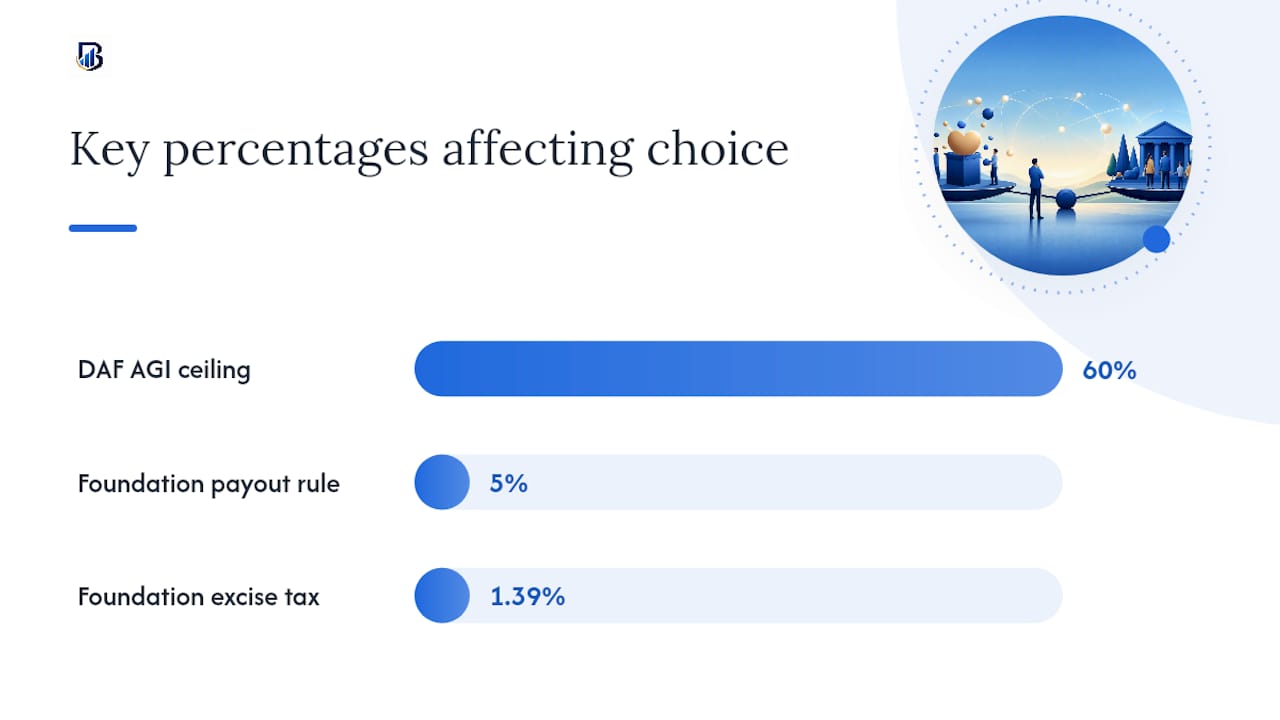
Most donors overweight the tax comparison and underweight the operational reality. A DAF's 60% AGI ceiling looks appealing on a spreadsheet, but the number that actually changes behavior over 20 years is the 1.39% excise tax foundations pay every year regardless of how much they grant out. That's not a one-time cost. It's a permanent drag on compounding.
The bigger blind spot: donors set up foundations for control, then discover the Form 990-PF disclosure and 5% payout requirement turn "control" into a part-time job. Some firms work with donors and fund managers who need help structuring philanthropic vehicles correctly, including 501(c)(3) formation and ongoing fund administration once a structure is chosen.
- Formation support matters most when a donor is building a foundation from scratch, not converting an existing DAF.
- Fund administration tools matter most once a foundation exists and needs consistent 990-PF-ready recordkeeping.
An Advisor's Honest Take on the Trade-Off
The trade-off is simple to state and hard to feel until you've lived with it: a DAF buys you speed and a bigger deduction ceiling; a foundation buys you permanence and authority, at a real annual cost. Three quick profiles: a donor giving under $500,000 over their lifetime almost always starts with a DAF. A family wanting to run a named scholarship program with staff and multi-generational governance usually needs a foundation. A donor with a sudden liquidity event, like a business sale, typically funds a DAF first to capture the deduction, then decides on a foundation later. For gifts involving complex assets, closely held business interests, or cross-border giving, talk to a tax attorney or CPA before you file anything.
— Bright
How Bright Capital Supports Donors Building a Giving Structure
Choosing between a donor-advised fund and a private foundation is only step one. If you land on a foundation, or you're launching a hybrid structure alongside an existing DAF, you still need formation paperwork, governance documentation, and ongoing fund administration that stands up to Form 990-PF scrutiny.

Bright Capital supports nonprofit founders and fund managers through 501(c)(3) formation workflows and fund administration for philanthropic structures, including secure data rooms for grant records and governance documents. Donors who need help evaluating investor and capital infrastructure alongside their philanthropic planning can also explore the investor database or start with a broader look at services for investors. If you're ready to move past the comparison stage and actually set up your structure, consider consulting a provider for formation and fund administration services.
This article is general information, not a substitute for advice from a qualified financial advisor. Consult a qualified financial professional about your own circumstances before acting on anything here.
Sources
- Internal Revenue Service (general resource) | IRS
- Donor-Advised Funds vs. Private Foundations | Vanguard Charitable
- What is a donor-advised fund? | Fidelity Charitable