

If you plan to raise institutional venture capital, form a Delaware C-corp; if you plan to stay small, self-funded, or owner-operated, an LLC is usually the better fit. The gap between them shows up fastest in two places: QSBS eligibility, which only exists for C-corp stock, and timing, since converting late can cost you tax benefits you can't get back.
TL;DR:
- Venture-backed startups should form a Delaware C-corp to access institutional investment, preferred stock, and QSBS benefits, avoiding LLC restrictions.
- C-corps face higher formation and ongoing costs tied to authorized shares, but they better suit long-term exit strategies and investor expectations.
- LLCs are more flexible and cheaper to maintain initially but are rarely favored by venture funds and do not qualify for QSBS benefits if converted later.
- Converting an LLC to a C-corp early preserves QSBS eligibility and reduces legal risks during fundraising, whereas late conversions can trigger tax and timing issues.
- Founders should evaluate their plans for institutional funding, employee incentives, and exit timelines before choosing their company structure to avoid costly changes later.
Table of Contents
- Delaware C Corp vs LLC: A Side-by-Side Comparison
- Which Entity Do Venture Investors Actually Prefer?
- How Does Entity Choice Affect Your Taxes and QSBS Eligibility?
- How Do Governance and Legal Predictability Differ?
- What Will Delaware Formation Actually Cost You?
- How Do You Convert an LLC to a Delaware C-Corp?
- Bright's Decision Checklist for Founders
- How Bright Capital America Supports Formation and Fundraising
- Where to Verify Delaware Filing Rules and Fees
- Sources
Delaware C Corp vs LLC: A Side-by-Side Comparison
The two structures diverge sharply once you look past the paperwork. A Delaware C-corp runs on a three-tier governance model (shareholders, board, officers) and issues stock in classes. An LLC runs on a contract, the operating agreement, and issues membership interests instead of shares.
Taxation splits them further. A C-corp pays corporate income tax on profits, then shareholders pay tax again on dividends, the classic "double taxation" critics point to. An LLC is a pass-through entity by default: profits flow to members' personal returns, but active members often owe self-employment tax on that income, which can offset the pass-through advantage for founders drawing a salary-like distribution.
- Governance: Board-driven and formal for C-corps; flexible and contract-driven for LLCs.
- Tax: Corporate tax plus dividend tax for C-corps; pass-through tax with self-employment tax exposure for LLCs.
- Investor fit: Institutional investors generally require a C-corp structure because most funds can't hold pass-through interests.
- Equity plans: C-corps support standard incentive stock options (ISOs); LLCs use profits interests, which are less familiar to option-plan administrators and employees.
- Cost and admin: Both carry Delaware franchise tax or annual tax, registered agent fees, and possible foreign qualification if you operate outside Delaware.
Pro Tip: Don't pick an entity based on today's tax bill alone. Model the exit scenario, too. A structure that saves you a few thousand dollars a year in self-employment tax can cost you a QSBS exclusion worth millions at sale.
Which Entity Do Venture Investors Actually Prefer?
Venture funds almost never invest directly in LLCs, and it's not a preference so much as a constraint. Most institutional limited partners, including pension funds and endowments, face tax and compliance complications when their capital flows through a pass-through entity's unrelated business taxable income rules. A Delaware C-corp sidesteps that problem entirely, which is why it's the default vehicle across the venture ecosystem.
Term sheets reflect this. Preferred stock, board seats, standardized charter documents, and a clean capitalization table all assume a corporate structure. Try to raise a priced VC round as an LLC and you'll likely hit friction on every one of those points, often forcing a rushed conversion mid-raise.
- Institutional LPs face tax complications holding pass-through interests.
- Investors expect preferred stock, board representation, and standard governance documents.
- Late-stage LLC-to-C-corp conversions during active fundraising create timing risk and legal cost.
- Exceptions exist: angel-only rounds, SAFEs, or convertible notes sometimes tolerate an LLC temporarily, but priced institutional rounds rarely do.
Founders researching early-stage venture investors will notice this expectation baked into almost every fund's investment criteria before a term sheet ever gets drafted.
How Does Entity Choice Affect Your Taxes and QSBS Eligibility?
A C-corp's profits get taxed twice, once at the corporate level and again when distributed as dividends. An LLC's profits get taxed once, on members' personal returns, but active members typically owe self-employment tax on their share. Neither structure is automatically cheaper. It depends on how much you plan to reinvest versus distribute, and whether you're building toward a sale.
The $10 million question: Qualified Small Business Stock lets eligible C-corp shareholders exclude up to $10 million (or 10 times their basis) in capital gains from federal tax, but only if the stock is held at least five years and the company was a C-corp when the shares were issued. LLC members get none of this.
- QSBS requires a holding period from the date of issuance, not from founding.
- LLC members can elect corporate tax treatment using IRS Form 8832, but that election doesn't create stock, a board, or QSBS eligibility.
- Delaware taxes an LLC in line with its federal classification, so a single-member LLC defaults to disregarded-entity status unless it elects otherwise.
- Forming as a C-corp from day one, rather than converting later, preserves QSBS eligibility on your earliest and often most valuable shares.
How Do Governance and Legal Predictability Differ?
Delaware corporations run through a fixed hierarchy: shareholders elect a board, the board appoints officers, and each layer has statutory duties spelled out in the Delaware General Corporation Law. LLCs skip most of that. The operating agreement can assign voting rights, profit splits, and management authority however the members negotiate, which is powerful for a family business or a firm with unusual profit-sharing needs.
That flexibility has a cost when things get contentious. Delaware's Court of Chancery is a specialized business court with decades of corporate case law, giving investors and founders a predictable body of precedent for disputes. LLC disputes, governed by whatever the operating agreement says, don't benefit from the same depth of settled precedent.
- Corporate governance follows statute; LLC governance follows contract.
- The Court of Chancery's business-only docket produces faster, more predictable rulings on shareholder disputes.
- LLC flexibility works well for closely held businesses with complex distribution waterfalls, but it can create ambiguity investors dislike.
Pro Tip: If you're building a company you might eventually hand to a family member or long-term partner rather than sell, that LLC flexibility isn't a downside. Founders weighing succession alongside fundraising should loop in an estate planning advisor before finalizing the structure.
What Will Delaware Formation Actually Cost You?
Delaware C-corps pay an annual franchise tax calculated primarily off authorized shares, not issued shares. Authorize too many shares early, thinking you're being generous with your future option pool, and you can trigger a franchise tax bill running into the thousands instead of a few hundred dollars.
Delaware LLCs pay a flat annual tax, no franchise tax calculation involved. Both entity types need a registered agent, typically $50 to $300 per year depending on the provider, and both may owe additional fees if you operate primarily outside Delaware, since most states require foreign qualification and its own filing fees and taxes for out-of-state entities doing business there.
- C-corp franchise tax scales with authorized shares; keep the share count lean at formation.
- LLC annual tax is a flat $300 in Delaware.
- Registered agent fees apply to both entity types.
- Foreign qualification in your home state adds separate fees and filings if you're not physically operating in Delaware.
Corporate formalities, board minutes, annual meetings, stock ledgers, add modest recordkeeping costs for C-corps but signal to investors that governance is buttoned up.
How Do You Convert an LLC to a Delaware C-Corp?
Two paths exist: a statutory conversion, where the LLC becomes a corporation directly under Delaware law, or a merger, where members contribute their LLC interests to a newly formed corporation in exchange for stock. Statutory conversion is usually faster and cheaper; a merger sometimes fits better when multiple entities or complex cap tables are involved.
Timing determines whether your equity qualifies for QSBS going forward, since the five-year clock only starts once C-corp stock exists. Converting early protects that window.
- Clean up the cap table and resolve any ambiguous membership interests.
- Draft the conversion or merger documents and file with Delaware.
- Adopt a stock ledger and an option plan with standard ISO mechanics.
- File 83(b) elections promptly for any founders receiving restricted stock.
- Update all investor-facing documents to reflect the new corporate structure.
Typical legal fees for a clean conversion typically runs several thousand dollars in legal fees (https://beginpulse.com/blog/delaware-c-corp-vs-llc), depending on complexity.
Pro Tip: File your 83(b) election promptly after receiving restricted stock to avoid unintended tax consequences. Missing that window can turn a tax-free conversion into a taxable event you didn't plan for.
Bright's Decision Checklist for Founders
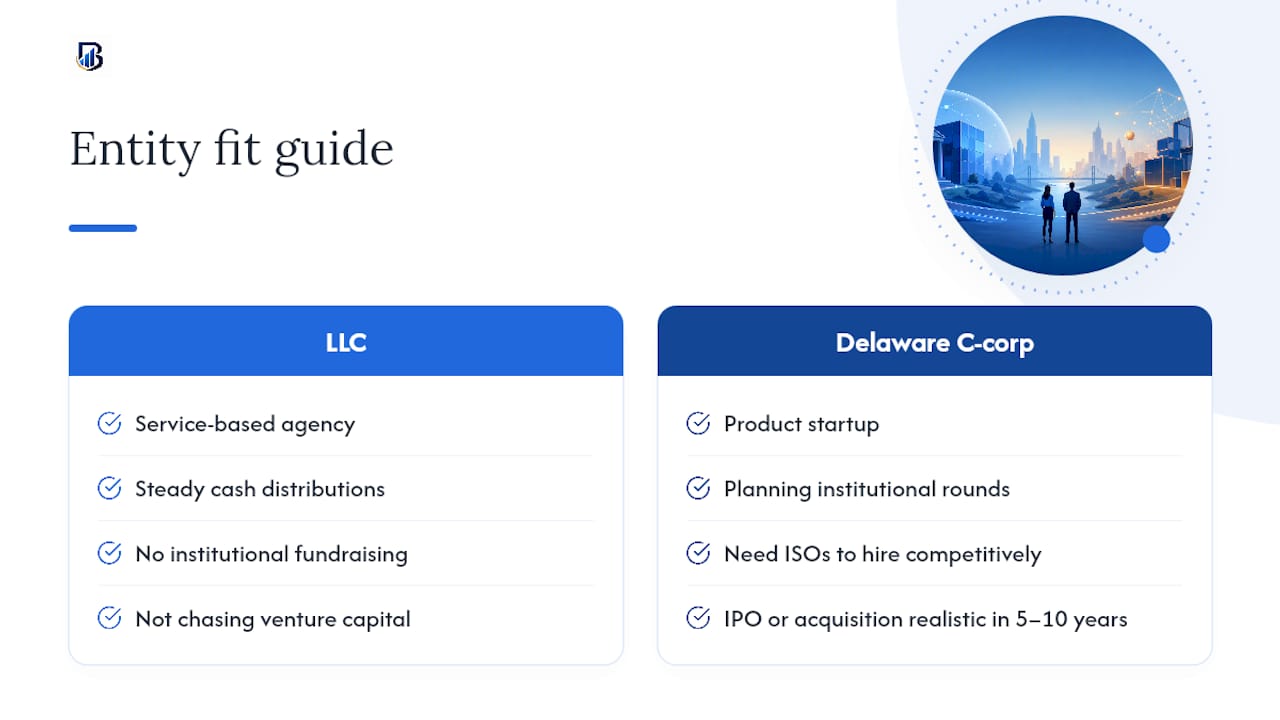
Run your situation through five questions: How soon do you plan to raise institutional money? Do you need ISOs to hire competitively? Does QSBS materially change your exit math? Is an IPO or acquisition realistic within 5 to 10 years? Do you need contractual flexibility over standardized governance?
A service-based agency with a few partners, steady cash distributions, and no plans to chase venture capital fits an LLC well. A product startup building toward institutional rounds, hiring with equity, and eyeing acquisition or IPO fits a Delaware C-corp from day one. The mistake we see most often isn't picking the wrong entity. It's picking the right one two years too late, after equity has already been issued and the QSBS clock never started.
— Bright
How Bright Capital America Supports Formation and Fundraising
Choosing the right entity is only step one. What comes next, building a cap table, finding the right investors, and managing the raise, is where most founders lose momentum. Bright Capital America supports company formation alongside fundraising infrastructure, so the transition from "we just incorporated" to "we're closing a round" doesn't require juggling five disconnected tools.

The platform pairs cap table management with direct access to a directory of investor profiles, letting founders match with the right funds and angels instead of cold-emailing blind. That integration matters most right after a conversion, when your stock ledger, option pool, and investor pipeline all need to stay in sync. If you're preparing to raise, explore private capital raise infrastructure or browse the investor database to see who's actively funding companies at your stage.
Where to Verify Delaware Filing Rules and Fees
Before finalizing your structure, confirm the current details directly with official sources rather than relying on secondhand summaries.
- Check current filing forms and fee schedules at the Delaware Division of Corporations.
- Use the franchise tax calculator referenced by formation services before authorizing shares.
- Review Section 1202 of the tax code directly with a qualified tax advisor before assuming QSBS eligibility.
- Confirm LLC classification elections and deadlines with the Delaware Division of Revenue.
Talk to a corporate attorney and a tax advisor who can model your specific numbers. This article gives you the framework; they give you the math for your company.
Sources
- Qualified Small Business Stock (QSBS): What it is and how to use it — SBA
- Court of Chancery — Delaware Courts
- Limited liability company (LLC) FAQs — Delaware Division of Revenue