

Forming a Delaware C corporation means filing a Certificate of Incorporation with the Delaware Division of Corporations, and your company legally exists the moment that filing is accepted. Two dates and figures matter most right now: your Annual Report and franchise tax are due March 1 every year, with a minimum tax of $175, and the state charges real penalties if you miss it. Before you file, you need to lock down three things:
- A unique corporate name that meets Delaware's naming rules
- A registered agent with a physical Delaware street address
- The number of authorized shares and their par value
Get those three settled, and the rest of the process moves quickly. Bright Capital America works with founders through every stage that follows, from filing to fundraising.
Key Takeaways
Forming a Delaware C corp requires filing a Certificate of Incorporation correctly, meeting the March 1 franchise tax deadline every year, and completing Day 1 corporate formalities before any investor conversation begins.
| Point | Details |
|---|---|
| File the Certificate correctly | Include your name, registered agent's Delaware street address, authorized shares/par value, and incorporator information. |
| Budget for the minimum fee | The baseline Certificate of Incorporation filing fee is $109, rising with more authorized shares or pages. |
| Never miss March 1 | Annual Report and franchise tax are due March 1, with a $200 penalty plus monthly interest for late filings. |
| Document Day 1 immediately | Adopt bylaws, issue founder stock, and file any 83(b) election within 30 days to stay investor-ready. |
| Use integrated tools post-formation | Bright Capital America pairs formation services with cap table management and investor matching in one workspace. |
Table of Contents
- How Do You File for Delaware C Corp Formation?
- What Should You Do Right After Incorporating?
- When Are Delaware Annual Report and Franchise Tax Due?
- Why Do So Many Startups Incorporate in Delaware?
- What Mistakes Do Founders Make Most Often?
- Delaware C Corp Formation for Founders Who Want to Move Fast
- Let Bright Capital America Handle Formation and What Comes Next
- Where to Find Official Delaware Forms and Filing Resources
- Frequently Asked Questions About Delaware C Corp Formation
- Sources
How Do You File for Delaware C Corp Formation?
Filing the Certificate of Incorporation is a documentation exercise, not a legal maze, but the order you do things in matters. Skip a step and you'll either pay more than you should or get bounced back by the state.
1. Confirm your name is available and follows Delaware's designator rules. Your corporate name needs a designator like "Inc.," "Corp.," or "Incorporated," and it can't be confusingly similar to an existing Delaware entity. If you're not ready to file immediately, you can reserve a name for 120 days for $75.
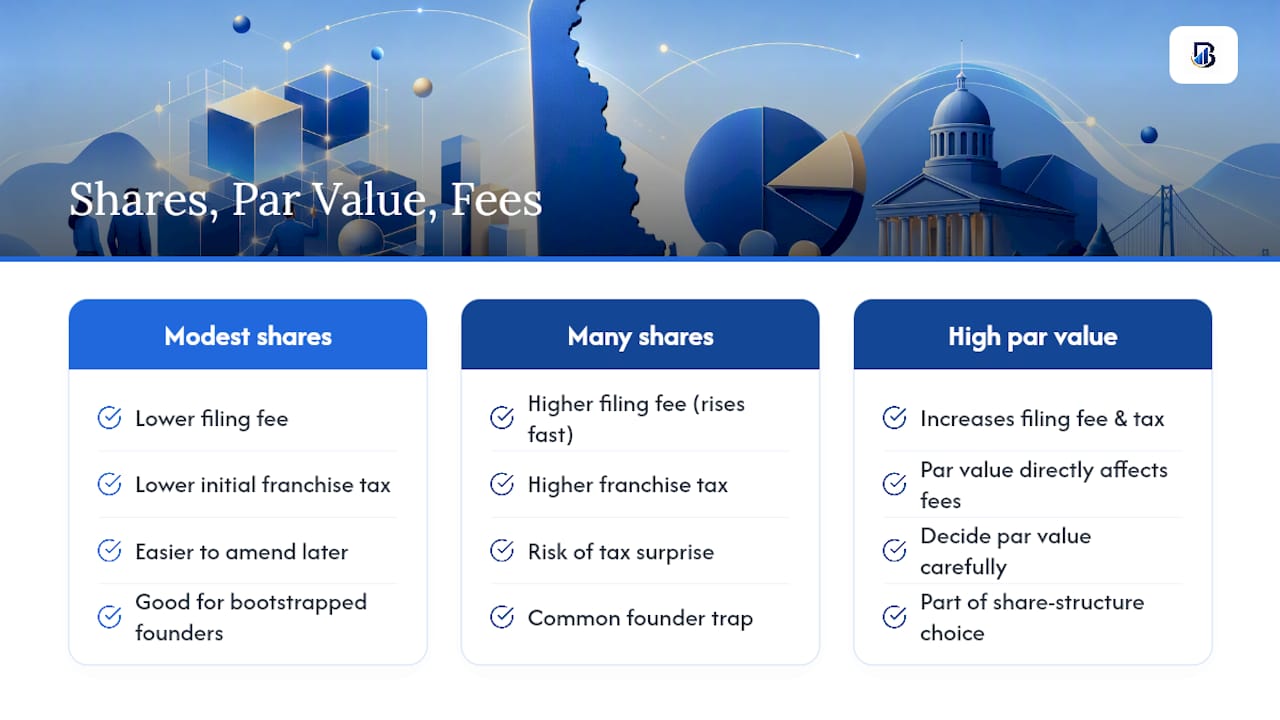
2. Decide on your share structure and par value. This isn't just a formality. The number of authorized shares and their par value directly shapes your filing fee and, later, your franchise tax bill. Founders who authorize far more shares than they need often get an unpleasant surprise on their first tax bill.
3. Line up your registered agent. Delaware requires every corporation to maintain a registered agent with a Delaware street address, not a P.O. box. If you're not physically located in Delaware (most founders aren't), you'll use a third-party registered agent service.
4. Complete the Certificate of Incorporation itself. The sample form from the Division of Corporations requires the corporate name, registered agent name and address, total authorized shares and par value, and the incorporator's name and address, plus a signature to execute it.
5. File and choose your method. Delaware accepts filings through its online Document Filing service, by mail, or via expedited in-person and courier service if you need same-day turnaround. Once it's processed, you'll receive a stamped, filed copy, and you can order certified copies if a bank or investor requires one.
Pro Tip: The minimum Certificate of Incorporation filing fee, but that number climbs fast with more authorized shares or additional pages. If you're a bootstrapped founder without a term sheet yet, keep your initial share count modest and amend later once you know your cap table needs.
Delaware's own step-by-step formation guide walks through each of these fields in more detail, including sample forms and current fee schedules.
What Should You Do Right After Incorporating?
Filing the Certificate of Incorporation creates your corporation, but it doesn't make it operational. Investors, banks, and the IRS all expect to see specific documentation in place almost immediately, and gaps here are one of the most common reasons due diligence stalls during a raise.
Handle these in the first days and weeks:
- Adopt corporate bylaws that govern how your board and officers operate
- Appoint your initial directors and hold the first board meeting, with minutes recorded
- Elect corporate officers (CEO, secretary, treasurer, at minimum)
- Issue founder stock and record it properly in a stock ledger
- Execute intellectual property assignment agreements so the company, not the individual founders, owns the IP
- Apply for an Employer Identification Number (EIN) from the IRS
- Open a corporate bank account
- Evaluate whether an 83(b) election applies to your founder stock
That last item deserves attention. An 83(b) election must be filed with the IRS within 30 days of your stock issuance date, no exceptions, and missing that window can create a significant tax burden down the road as your shares vest and appreciate in value.
Pro Tip: Loop in your attorney or CPA before you issue founder stock, not after. Getting the 83(b) timing and equity paperwork right the first time is far cheaper than fixing a documentation gap an investor's counsel flags during a term sheet negotiation.

Once your records are in order, set up a corporate records book to keep bylaws, minutes, and your stock ledger together, and order a Certificate of Good Standing if a bank or investor asks for one.
When Are Delaware Annual Report and Franchise Tax Due?
Every Delaware corporation, regardless of revenue or activity level, owes an Annual Report and franchise tax payment by March 1 each year. Missing this deadline is one of the most avoidable and most common compliance failures among first-time founders.
The exact tax owed depends on your authorized shares and how you calculate it, and the state's franchise tax calculator lets you run the numbers under either the authorized shares method or the assumed par value capital method, whichever produces a lower bill for your structure.
A few things worth calendaring now:
- Set a recurring reminder well before March 1, not on the day itself
- If your franchise tax liability exceeds $5,000, you owe estimated payments throughout the year, not just at filing time
- Keep your registered agent's contact information current, since most agents forward the state's renewal notices
Why Do So Many Startups Incorporate in Delaware?
Delaware's appeal isn't accidental. The state built its Court of Chancery, a specialized court that hears business disputes without juries, specifically to give companies faster, more predictable rulings on corporate law questions. Combined with a deep body of case law developed over decades, that predictability is a major reason investors and venture capital firms default to Delaware when evaluating a term sheet.
That said, the Division of Corporations is explicit that it handles procedural filings only. It does not offer legal advice, and choosing your entity type or structuring your cap table is a decision best made with an attorney or CPA who understands your specific situation.
One misconception worth correcting: Delaware isn't a secrecy haven. Your Certificate of Incorporation, including your registered agent and incorporator information, becomes a public record the moment it's filed. You get efficient, predictable corporate law, not anonymity.
What Mistakes Do Founders Make Most Often?
The same handful of errors show up again and again in Delaware C corp formations, and nearly all of them are preventable with a little planning.
- Over-authorizing shares. Authorizing millions of shares "just in case" inflates your franchise tax calculation under the default method, sometimes dramatically.
- Skipping bylaws and board minutes. No paper trail for board decisions is a red flag investors' counsel catches immediately during diligence.
- Failing to properly issue and document founder stock. A verbal agreement about equity split isn't a stock ledger entry.
- Missing the March 1 deadline. The $200 penalty plus monthly interest adds up faster than founders expect.
Pro Tip: Build a simple compliance checklist the day you file, covering bylaws, minutes, stock issuance, EIN, and your March 1 tax deadline. Founders who treat corporate housekeeping as a one-time task, rather than an ongoing habit, are the ones scrambling when a term sheet shows up.
Watch for red flags if you use a formation service, too: hidden fees beyond the advertised price, vague answers about who actually serves as your registered agent, and post-formation "packages" that leave out EIN filing or bylaws entirely.
Delaware C Corp Formation for Founders Who Want to Move Fast
Most guides treat Delaware formation as a legal checkbox exercise, and that's exactly where founders get into trouble. The filing itself is the easy part. What actually determines whether you're investor-ready six months later is what happens in the days after you file, not the filing itself.
The conventional advice tends to overweight the Certificate of Incorporation and underweight the Day 1 paperwork. Bylaws, board minutes, a real stock ledger, IP assignment, and a timely 83(b) election matter more to your first term sheet than any clever authorized-share strategy. We've seen founders spend weeks agonizing over par value while leaving their stock issuance undocumented for months, which is backward.
If you take one thing from this guide, prioritize the boring stuff first: get your registered agent locked in, file cleanly, then immediately turn to bylaws, minutes, and equity documentation. Franchise tax optimization can wait until your CPA has real numbers to work with. VC readiness can't wait at all.
Let Bright Capital America Handle Formation and What Comes Next
Filing your Certificate of Incorporation is only the beginning. Most founders quickly discover they also need a registered agent, a place to track equity as it's issued, and eventually a way to reach investors, and juggling separate tools for each adds friction at the exact moment you're trying to move fast.

Bright Capital America's formation service handles U.S. incorporation and registered agent setup, then connects directly into the platform's cap table and equity management tools, so your stock ledger doesn't live in a separate spreadsheet from day one. Once your corporation is formed and your equity is documented, Bright's investor database gives you a direct path to a large number of investor profiles when you're ready to raise. If you need help with governance or equity documents beyond formation itself, Bright's venture legal services connect you with support built for startups.
This article is educational information, not legal or tax advice. Talk to a licensed attorney or CPA before finalizing your entity choice or equity structure.
Ready to get started? Begin your Delaware formation with Bright and set up your cap table in the same workspace.
Where to Find Official Delaware Forms and Filing Resources
Go straight to the source when you need forms or official fee schedules:
- Delaware Division of Corporations for the state's full filing services and general information
- Corporate Forms and Certificates for fillable Certificate of Incorporation forms and certified copy requests
- Delaware franchise tax calculator to estimate your annual tax before you file
- Bright Capital America's "For Companies" page for formation and post-formation support in one place
Frequently Asked Questions About Delaware C Corp Formation
How long does Delaware C corp formation actually take? Standard online filings are often processed quickly, while expedited or courier filing can return a stamped Certificate of Incorporation the same day for an added fee.
What's the minimum cost to form a Delaware C corp? The state filing fee starts at $109, plus $75 if you reserve your name in advance and whatever your registered agent service charges annually.
Do I need a lawyer to file a Delaware C corp formation? The filing itself doesn't require one, but the Division of Corporations recommends consulting an attorney or CPA before choosing your entity type or structuring equity, since those decisions are hard to unwind later.
What happens if I miss the March 1 franchise tax deadline? You'll owe a late penalty plus monthly interest on the unpaid balance until it's paid in full.
Can I be my own registered agent in Delaware? Only if you have a physical street address in Delaware. Most founders based elsewhere use a third-party registered agent service instead.
This article is general information, not a substitute for advice from a qualified lawyer. Consult a qualified legal professional about your own circumstances before acting on anything here.
Sources
- Forming a Delaware Corporation - Delaware Corporate Law - State of Delaware
- Delaware franchise tax information and calculator
- How to Form a New Business Entity - Division of Corporations - State of Delaware
- Certificate of Incorporation for Stock Corporation (form and instructions)