
A secure data room requires AES-256 encryption at rest, TLS 1.2 or 1.3 in transit, and mandatory multi-factor authentication for every user, with no exceptions for time pressure or convenience. These two controls stop the two most common failure points: stolen credentials and intercepted files. But encryption and MFA are the floor, not the ceiling.
A data room worth trusting with a fundraising round or an M&A transaction also needs:
- Granular, folder-level permissions built on least privilege
- Dynamic, user-specific watermarking on every viewed and downloaded page
- Immutable audit logs capturing user, device, IP address, and timestamp
If you need the fast version, skip to the How Do You Evaluate a Data Room Against NIST Standards? below and run it against any provider before you upload a single document.
Key Takeaways
A secure data room combines AES-256 encryption, mandatory MFA, granular permissions, and immutable audit logs, and no single control substitutes for the others.
| Point | Details |
|---|---|
| Encryption baseline | Require AES-256 at rest and TLS 1.2/1.3 in transit as the minimum standard for any provider. |
| MFA is non-negotiable | Enforce phishing-resistant multi-factor authentication for every account, including external reviewers. |
| Certifications need verification | Request current SOC 2 Type II and ISO 27001 reports plus recent pen-test summaries, not just badges. |
| Detection needs correlation | Pair audit logs with SIEM integration and behavioral baselines to catch anomalies before a leak spreads. |
| Training closes the human gap | Recurring, deal-phase-specific security training reduces the errors that encryption alone cannot stop. |
| Brightcapital integrates the workspace | Brightcapital pairs secure data rooms with cap table and investor tools in one governed platform. |
Table of Contents
- What Is a Virtual Data Room and Why Does Security Matter More Here?
- Core Security Features Every Data Room Must Provide
- What Certifications Actually Prove a Data Room Is Compliant?
- What Are the Most Common Ways Data Rooms Get Breached?
- How Do You Evaluate a Data Room Against NIST Standards?
- How Do You Set Up a Data Room So It Stays Secure Through Closing?
- How Does Bright Capital America Align With These Security Standards?
- What Should You Do the Moment You Suspect a Data Room Breach?
- Can You Spot a Data Leak Before It Becomes a Breach?
- Why Does Security Training Matter as Much as the Software Itself?
- Brightcapital Gives You a Secure Workspace Built Into Your Fundraising Process
- Sources
What Is a Virtual Data Room and Why Does Security Matter More Here?
A virtual data room (VDR) is a secure online repository built specifically for sharing confidential documents during high-stakes transactions. It is not a substitute name for cloud storage. It is a distinct category of software with controls that generic file-sharing tools were never designed to provide.
Three use cases dominate: mergers and acquisitions due diligence, fundraising rounds where founders share financials with dozens of investors, and legal proceedings involving privileged material. Each raises the stakes because dozens of outside parties, many of them unknown to each other, need access to the same sensitive files within a narrow window.
That's what separates a VDR from a generic cloud drive:
- Auditability: every view, download, and print is logged with forensic detail, not just "file modified" timestamps.
- Information rights management (IRM): control persists after the file leaves the platform, restricting screenshots, printing, or forwarding.
- Regulatory expectations: buyers, auditors, and regulators expect documented chain-of-custody, something consumer-grade sharing tools cannot provide.
A missed permission setting in a shared drive is an inconvenience. The same mistake in a data room mid due diligence can expose cap tables, IP filings, or customer contracts to the wrong bidder.
Core Security Features Every Data Room Must Provide
Vendors will hand you a feature list. Your job is knowing which items on that list actually reduce risk, and which are marketing filler.
- Encryption standards and key custody. AES-256 encryption at rest and TLS 1.2 or 1.3 in transit are the minimum bar for any provider handling transaction documents. For the most sensitive raises or acquisitions, ask whether the vendor supports customer-managed keys (CMEK) or bring-your-own-key (BYOK) arrangements, which keep decryption authority in your hands rather than the vendor's.
- Authentication and identity controls. Mandatory MFA should apply to every account, not just admins. Phishing-resistant factors, such as hardware security keys or authenticator apps rather than SMS codes, close the gap that credential theft exploits most often.
- Permissions and least privilege. Access should be configurable down to the individual folder or document, not just the top-level project. A bidder in an early round should never see the same materials as a party in exclusive negotiations.
- Document-level protections. Dynamic, user-embedded watermarking is the standard that actually deters leaks, because it must be robust enough that cropping or screenshotting can't remove it. View-only modes and fence view (which blurs content outside the cursor's focus) add further friction against casual screen capture.
- Logging and audit trails. Every action needs to generate a record with user identity, timestamp, IP address, and device fingerprint, detailed enough to reconstruct exactly who saw what and when.
Pro Tip: Ask any prospective provider to show you a sample audit log export, not a screenshot of the dashboard. If the export doesn't include IP address, device type, and page-level view duration, you're looking at a shallow log, not a forensic one.
Document-view metadata, like how long a page was open or whether it was viewed page by page, adds real forensic value beyond simple download counts, because it helps attribute a leak to a specific viewer session rather than a vague list of everyone with access.
What Certifications Actually Prove a Data Room Is Compliant?
Certifications are shorthand, but only if you know what each one actually verifies.
SOC 2 Type II validates that a vendor's security controls operated effectively over a sustained period, typically six to twelve months, not just on the day of an audit. ISO 27001 validates something different: that the vendor runs a formal information security management system with documented policies, risk assessments, and continuous improvement processes. Neither certification alone tells the whole story, but together they cover both the "controls exist" and the "controls work" questions.
Beyond those two baseline credentials, ask for industry-specific compliance depending on what you're sharing:
- HIPAA if any documents touch protected health information, common in healthcare-sector M&A.
- SEC 17a-4 if you're dealing with broker-dealer records that require specific retention and immutability standards.
- GDPR if any counterparty, investor, or data subject sits in the European Union, regardless of where your company is headquartered.
Don't just accept a badge on a marketing page. Request the actual audit report, verify the certification's issue and expiry dates, and ask for the executive summary of the vendor's most recent penetration test. A vendor whose last pen test is outdated or has unresolved critical findings, should be treated as a red flag regardless of what certifications they display.
What Are the Most Common Ways Data Rooms Get Breached?
Most data room incidents don't start with a sophisticated hack. They start with something mundane: a reused password, a permission set too broadly, or an employee forwarding a link they shouldn't have.

Credential compromise and phishing remain the primary vectors for VDR breaches, which is exactly why MFA sits at the top of every serious checklist rather than as an optional add-on. Attackers don't need to break encryption if they can simply log in as someone who already has access.
Misconfigured permissions compound the problem, especially during compressed deal timelines when teams grant broad access to move fast and forget to narrow it back down once diligence phases shift. Insider risk and accidental sharing, like a well-meaning associate forwarding a confidential financial model to the wrong distribution list, round out the human-error category that no amount of encryption fixes.
The threat landscape has also gotten faster and more automated. Automated, AI-powered scans are now hitting infrastructure very frequently at high speed, and a rising share of breaches trace back to human-factor incidents rather than pure technical exploits. That combination, machine-speed reconnaissance paired with human-speed mistakes, is why detection and access governance matter as much as encryption strength.
How Do You Evaluate a Data Room Against NIST Standards?
The NIST Cybersecurity Framework 2.0 organizes security evaluation into six functions, and mapping a data room evaluation to that structure keeps you from missing governance and recovery questions in favor of only checking technical boxes.
- Govern: Request the vendor's data processing agreement, list of subprocessors, and internal roles and responsibilities documentation.
- Identify: Ask how the vendor classifies and maps sensitive data across its own systems, not just yours.
- Protect: Verify encryption standards, key custody options, MFA enforcement, IRM controls, and watermarking depth.
- Detect: Confirm log scope, whether logs stream to a SIEM, and what alert rules exist for anomalous behavior.
- Respond: Request pen test cadence, named incident contacts, and documented response service-level agreements.
- Recover: Confirm backup frequency and the vendor's secure data disposal procedure once a deal closes.
| NIST Function | What to Request | Red Flag |
|---|---|---|
| Govern | DPA, subprocessor list, role documentation | No named security contact or outdated DPA |
| Identify | Data classification and mapping evidence | Vendor can't describe how sensitive data is tagged |
| Protect | Encryption specs, MFA policy, IRM depth | SMS-only MFA or no watermarking option |
| Detect | Log scope, SIEM integration, alert rules | Logs lack IP address or device data |
| Respond | Pen test summary, incident SLA | Pen test older than 12 months |
| Recover | Backup policy, disposal procedure | No documented data destruction process |
How Do You Set Up a Data Room So It Stays Secure Through Closing?
A checklist only helps if it gets applied before the first document goes live, and again after the deal closes.
- Stage before you populate. Configure folder structure, permission tiers, and watermarking settings in a blank workspace before uploading a single file, so access rules are already correct when documents arrive.
- Verify every external reviewer. Require MFA enrollment and, where possible, device verification before granting any outside party access, even under deal-timeline pressure.
- Review logs on a set cadence. Daily log review during active diligence catches anomalies, like unusual download volume or off-hours access, while they're still small.
- Revoke and preserve at closeout. Once a transaction closes, revoke every external permission immediately, export and preserve the full audit log for your records, and confirm the vendor's secure deletion timeline for any remaining copies.
Pro Tip: Build your permission tiers around deal phases, not individual names. When a bidder moves from early interest to exclusive negotiation, you should be able to promote their access with one action instead of rebuilding permissions from scratch.
How Does Bright Capital America Align With These Security Standards?
Brightcapital documents its approach to data protection directly, rather than leaving founders and investors to take vendor claims on faith. The security and data protection page outlines the specific controls behind the platform's secure data rooms and document storage.
That mapping matters against the checklist above:
- Encryption and access controls are addressed as part of the platform's core infrastructure, not an add-on module.
- Auditability is built into the same workspace where fundraising, cap table management, and investor communication already happen, so security isn't bolted onto a separate tool.
- Founders and fund managers evaluating a workspace can review these commitments directly rather than relying on sales claims.
What Should You Do the Moment You Suspect a Data Room Breach?
A breach in a fundraising or M&A data room is a different animal from a typical IT incident, because the exposure often involves competitively sensitive information shared with parties who are, in some cases, direct competitors of your own company.
The first move is containment, not investigation. Suspend the suspected account or credential immediately rather than waiting to confirm intent, since every additional hour of access widens potential exposure. Pull the audit trail for that account's entire session history, including every document viewed, downloaded, or printed, before you revoke access, since some logging systems limit historical detail once an account is deactivated.
Notification obligations depend on what was exposed. If personal data covered by GDPR or state privacy laws was accessible, you may face mandatory disclosure timelines measured in days, not weeks. Legal counsel should be looped in within the same hour containment happens, not after an internal investigation wraps up.
Document everything as you go: what was accessed, when access was cut, who was notified, and what remediation steps followed. That record matters twice over, once for your own legal defense, and once for any counterparty or investor who asks how the incident was handled.
Build the response plan before you need it. Waiting until mid-diligence to figure out who owns incident response, legal, IT, or the deal lead, costs you the hours that matter most.
Can You Spot a Data Leak Before It Becomes a Breach?
Most leaks don't announce themselves. They show up as small deviations from normal behavior, which is exactly why raw access logs aren't enough on their own.
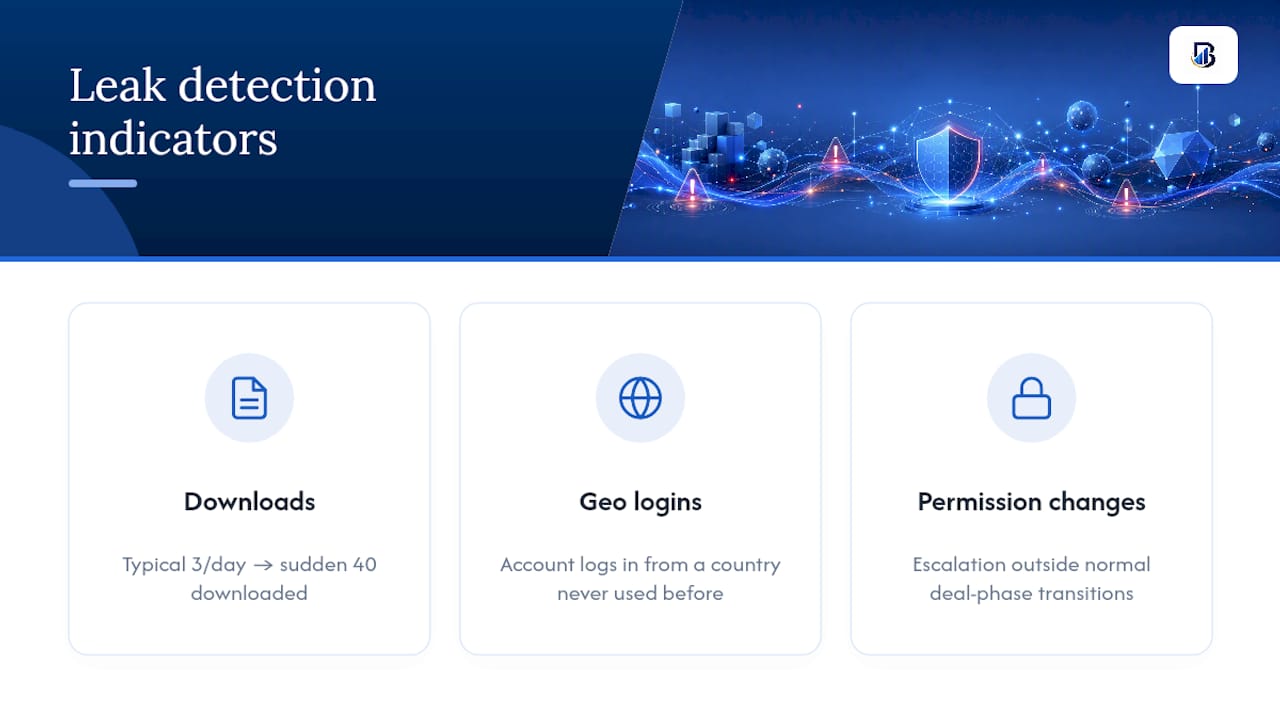
Effective anomaly detection in a data room means correlating log data against behavioral baselines: a user who typically views three documents a day suddenly downloading forty, an account logging in from a country it's never accessed from before, or a permission escalation that happens outside normal deal-phase transitions. None of these individually proves wrongdoing, but together they're the pattern security teams should flag for review.
The technical requirement behind this is streaming integration with a SIEM (security information and event management) system, so alerts fire in near real time rather than surfacing during a weekly log review. By the time a manual review catches a bulk download, the documents may already be off the platform.
This is also where document-view metadata earns its keep. A download log tells you a file left the platform. Page-by-page view duration tells you whether someone skimmed a document or studied it closely, which matters when you're trying to figure out who actually absorbed sensitive terms before a leak surfaced elsewhere. Combined with watermarking, that view-level detail turns a vague suspicion into an attributable trail.
Why Does Security Training Matter as Much as the Software Itself?
The most sophisticated encryption in the world doesn't stop someone from forwarding a confidential link to their personal email out of habit.
Human error remains a leading contributor to data exposure incidents, which means the people using a data room need periodic, specific training, not a one-time onboarding email. That training should cover the basics that get skipped under deal pressure: recognizing phishing attempts that impersonate deal counsel or investors, understanding why MFA can't be disabled "just for this one login," and knowing exactly who to notify if a device with data room access is lost or stolen.
Training cadence matters more than training depth. A single annual session gets forgotten by month three. Short, recurring reminders tied to actual deal activity, like a reminder at the start of every new diligence phase about permission hygiene, stick better than a lengthy policy document nobody rereads.
External parties need this too, not just internal staff. Investors, outside counsel, and advisors granted temporary access should receive a brief orientation on the platform's controls: what watermarking means for them, why downloads are logged, and what happens to their access at closing. A five-minute walkthrough at onboarding prevents the awkward conversation later about why someone's screenshot ended up somewhere it shouldn't have.
Security training isn't a compliance checkbox. It's the difference between a workspace where controls are respected and one where they're worked around.
A Practitioner's View on Speed Versus Security
Every deal team wants to move fast, and I understand the instinct to skip a control that feels like friction when a term sheet is due Friday. Don't skip MFA or granular permissions to save an afternoon. Those two controls stop the majority of real incidents, and rebuilding trust after a leak costs far more than the day you saved.
Run a short pre-launch staging drill before every transaction: configure the workspace, test permission tiers with a dummy account, and confirm watermarking actually renders before real documents go live. Teams that need this built into an existing fundraising workflow rather than managed as a separate tool should look at how Bright Capital America structures its platform around integrated document security.
— Bright
Brightcapital Gives You a Secure Workspace Built Into Your Fundraising Process
Instead of stitching together a separate data room tool, a cap table spreadsheet, and an investor CRM, Brightcapital keeps secure document storage inside the same workspace where you're already managing your raise.

That matters because the biggest security gaps in fundraising rarely come from any single tool failing. They come from information scattered across five disconnected platforms, each with its own permission settings that nobody fully tracks. Brightcapital's private capital raise infrastructure pairs secure data rooms with cap table management and investor matching across a directory of more than 27,000 verified profiles, so your sensitive documents live in one governed environment instead of an email chain and three shared drives.
If you're preparing for a raise and want your financials, cap table, and diligence materials secured from day one rather than bolted on before your first investor call, explore how Brightcapital's investor tools work alongside its secure document infrastructure.
Sources
- Virtual Data Room Security: The Complete Guide to Features and Standards
- Data Room Security: Essential Strategies for 2026 - Aligned IQ
- Data room security controls: a technical checklist for IT and deal teams
- AI powering a dramatic surge in cyberthreats