

The best cold email to an investor leads with a specific traction metric, names a portfolio company or thesis that proves you did your homework, and closes with a direct ask for a 20-minute call. It runs under 150 words, skips the attached deck, and gets sent from your company domain. A reply that says "send your deck" or "are you free Thursday" means the email worked.
TL;DR:
- Cold emails are most effective when they highlight a specific traction metric, such as revenue or user growth, rather than relying on intention or broad claims.
- Targeting investors who have recently invested in similar stages or sectors yields better response rates than mass emailing a large, unfiltered list.
- Keep emails concise, under 150 words, with a clear subject line containing relevant numbers or familiar names, and include a concrete ask for a short call.
- Personalize the message by referencing a portfolio company, investor thesis, or recent activity to demonstrate genuine research and relevance.
- Follow up with one or two brief, value-adding updates, avoiding pressure or attached decks, and ensure your outreach is technically optimized for deliverability.
Table of Contents
- Should You Even Be Cold Emailing Investors Right Now?
- What Makes a Cold Email to an Investor Actually Get Opened?
- How Do You Research an Investor Before You Email Them?
- When and How Often Should You Follow Up?
- Cold Email Templates You Can Send Today
- Where a Curated Investor List Fits Into This Playbook
- Our Take: Personalization Beats Polish, Every Time
- Try Bright to Turn This Framework Into a Repeatable Process
- Sources
- FAQ
Should You Even Be Cold Emailing Investors Right Now?
Cold email works best as a supplement, not a substitute. Warm introductions convert at 40 to 60 percent, while cold outreach typically lands somewhere between 1 and 5 percent. That gap doesn't mean cold email is a waste of time. It means you should mine your network first and treat cold outreach as the channel that fills gaps a warm intro can't reach.
Before you write a single subject line, run your traction through a quick filter. Investors respond to signals, not intentions.
- Revenue or paying pilots, even small ones, beat a polished deck with zero customers.
- User growth with a repeatable pattern, like week over week sign ups from one channel, tells a better story than total downloads.
- A notable design partner or pilot customer in your sector gives an investor a reason to take the meeting.
- Founder background relevant to the problem, especially if you've built or sold something adjacent before.
If you have none of these yet, cold email will still work, but your opener needs to lean harder on the problem and your specific insight into it, since you can't lean on metrics.
Target selection matters more than volume. A list of 300 generic VC emails will underperform 20 investors chosen because they've written checks in your exact stage and sector within the last 12 months. Use a filtered list, like Bright's venture capital database, to sort by stage, sector, and recent activity rather than blasting a spreadsheet you bought off a forum.
Combine channels instead of picking one. Send the cold email, but also try to get a mutual connection to forward it or comment on the investor's recent post referencing your company. A cold email that arrives with even a sliver of warmth behind it performs differently than one that lands in a stranger's inbox with zero context.
Pro Tip: Before emailing, check whether the fund has a "how to reach us" page or an open application form. Some funds explicitly say they prefer cold email over warm intros for certain check sizes, which tells you exactly how to approach them.
Here's a simple decision rule: if you have one concrete traction signal and a shortlist of investors actively writing checks in your stage, send the email now. If you have neither, spend two more weeks building the metric or the network path before you start pitching investors via email.
What Makes a Cold Email to an Investor Actually Get Opened?
YC's own guidance is blunt: keep it readable in 60 seconds, send it from your company email address, and put the core facts up front. That's the whole philosophy. Everything below is how to execute it.
Subject line. Skip the cute hooks. The subject lines that get opened are specific and low-friction: "Series Seed, $40K MRR, fintech for freelancers" or "Intro via [mutual connection] — [Company Name]." A number or a recognizable name does more work than a clever phrase ever will.
Opening sentence. Lead with a metric or a sharp, research-based hook. Reply rates rise materially when founders open with something concrete instead of a warm-up line like "Hope you're doing well." Compare these two:
Weak: "My name is Sam and I'm building a startup in the logistics space that I think you'd find interesting."
Strong: "We've grown from $8K to $52K in monthly recurring revenue in four months by selling directly to regional trucking dispatchers."
The second sentence tells the investor exactly what you do, how fast you're growing, and who your customer is, all in one breath.
Here's the structure that consistently outperforms generic templates:
- One-sentence hook with a metric, milestone, or sharp insight about the market.
- One or two sentences on what the company does, tied directly to that metric or outcome, not a mission statement.
- One "why you" sentence referencing a specific portfolio company, thesis, or public statement from that investor.
- The ask, phrased as a short call with two concrete time windows.
- Signature with your name, title, company, and a link to your site, LinkedIn, or a one-pager, never a deck attachment.
That "why you" line deserves its own attention. Founders who reference a specific portfolio company or an investor's stated thesis convert better than founders who write "I love your firm's mission" or some other line that could apply to any fund on the internet. If you can't find something specific to say about why this investor, you probably haven't researched them enough to email them yet.
The ask should remove friction, not create it. "Would you be open to a brief call?" leaves the investor to do scheduling work. "I have 20 minutes free Tuesday at 10 AM or Thursday at 2 PM ET, would either work for a quick call?" gives them a one-word answer to send back.
Pro Tip: Keep the whole email under 150 to 200 words and readable on a phone screen without scrolling. Investors triage cold email between meetings, and a short, fast email respects that reality in a way a three-paragraph pitch never will.
Do not attach your deck. Investors consistently say they'd rather ask for it than open an unsolicited PDF from someone they've never met, and a deck attached to a cold email often signals a founder who hasn't internalized how little time investors give first contact. Send from your company domain, not a personal Gmail account, both for credibility and for deliverability reasons covered later.
How Do You Research an Investor Before You Email Them?
Fifteen minutes of research separates a personalized email from a mail-merge blast, and investors can tell the difference immediately. Here's what to check, in order of speed and payoff:
- The firm's website and thesis page for stated sector or stage focus, so you're not pitching a seed-stage SaaS company to a fund that only writes Series B checks.
- Recent portfolio additions on the firm's site or Crunchbase, looking for a company adjacent to yours in sector, model, or customer type.
- The individual investor's recent posts on LinkedIn or X, which often reveal what they're currently thinking about or actively looking for.
- Podcast appearances or interviews, which tend to surface an investor's actual thesis in more detail than a website bio ever will.
The goal isn't to collect trivia. It's to convert one fact into a single sentence that proves you did the work. If a partner invested in a company solving supply chain visibility for mid-size manufacturers, and you're building something adjacent, write: "I noticed your investment in [Company], and we're solving a similar visibility problem one layer down the supply chain, for the distributors those manufacturers sell through." That sentence alone signals more credibility than an entire paragraph of flattery.
On who to email: associates and principals often screen deal flow and can move quickly on companies that fit the fund's stated thesis, while partners carry final decision authority but far less bandwidth. For a first cold email, an associate or principal at your target stage is frequently the faster path to a real conversation. A partner works better when you have a specific, verifiable reason to believe they personally care about your space.
Watch for red flags that should disqualify a target before you write a word. A fund whose last three deals were all Series B or later probably won't seriously consider your seed round. A partner whose bio lists a sector focus that has nothing to do with your business is a wasted email regardless of how well written it is. And a fund with no public deal activity in over a year may be quietly winding down or between funds, which makes a reply unlikely no matter how sharp your pitch is.
When and How Often Should You Follow Up?
Timing affects your odds more than most founders realize. Avoid the last two weeks of December and the first week of January, when most funds are between partner meetings and slow to respond to anything. Late summer carries the same risk. Early in the week, Tuesday through Thursday mornings, tends to outperform Monday inbox pile-up and Friday afternoon distraction, though no schedule guarantees a reply.
Follow-up cadence should be short and finite:
- First follow-up, roughly seven days after the original email, one or two sentences, no re-pitch.
- Second and final follow-up, sent with a new data point, like a new customer, a press mention, or a metric update since the first email.
- Stop after two follow-ups. A third message reads as pressure, not persistence.
Deliverability is where a lot of technically sound emails quietly die in spam folders. Setting up SPF for your sending domain reduces the chance your domain gets flagged as a spoofing risk, and DKIM signing lets receiving servers verify the email actually came from you. Both, paired with a DMARC policy, meaningfully improve the odds your message lands in an inbox instead of a spam filter, and both take under an hour to configure on most email providers.
If you're tracking opens and click-through rates, use the data to diagnose, not to panic. A low open rate points to a weak subject line. A high open rate with no replies points to a weak opener or ask. Change one variable at a time before concluding an entire list is dead.
On attachments: don't send a deck cold. If an investor asks for more detail before agreeing to a call, share a tracked link, like DocSend, rather than a PDF attachment, so you can see whether it was opened and which pages held attention.
Cold Email Templates You Can Send Today
Each template below runs under 150 words. Swap the bracketed sections with your own metric, investor detail, and ask.
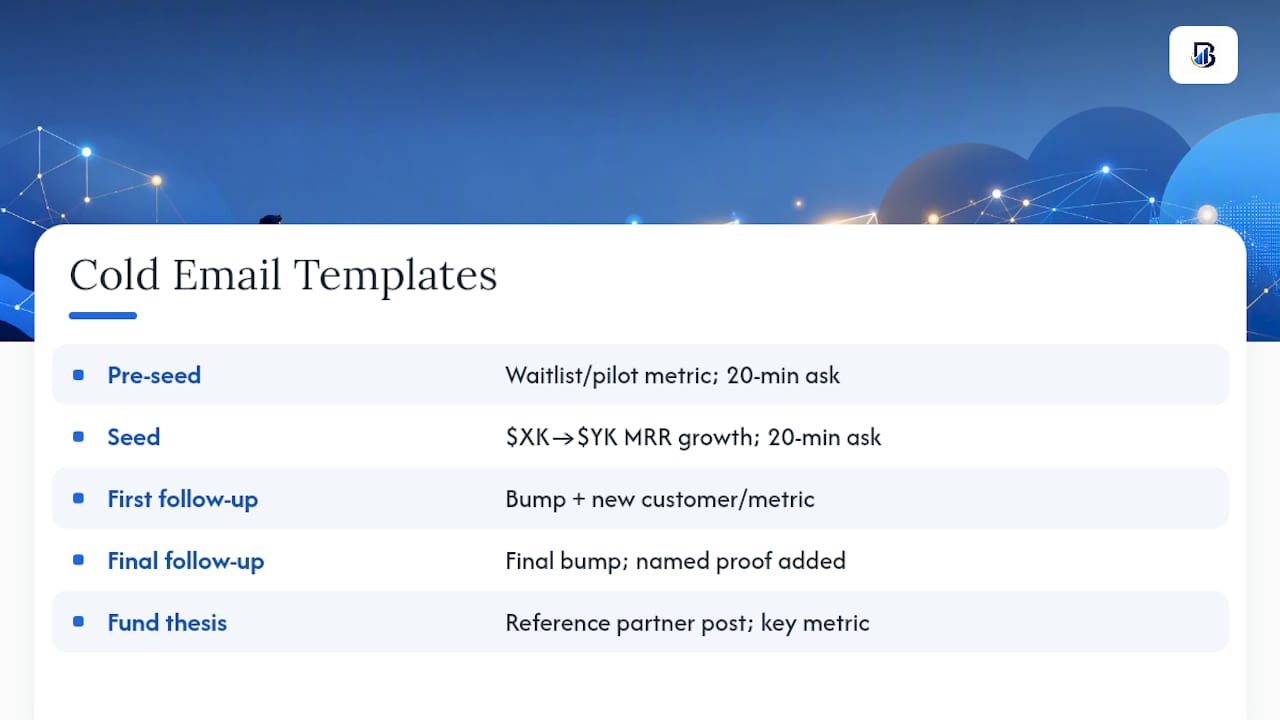
1. Pre-seed, no revenue yet
Subject: Pre-seed, [Sector], built by [relevant background]
We're building [one-sentence product description] for [specific customer type]. I spent [X years] at [relevant company] and saw this problem firsthand, which is why we started building six months ago and now have [waitlist number / pilot commitment] signed on.
I noticed your firm's investment in [portfolio company] and think there's real overlap with what we're solving. Would you have 20 minutes Tuesday or Thursday for a quick call?
[Name], [Title], [Company] [Link to one-pager or LinkedIn]
2. Seed, early revenue
Subject: $[X]K MRR, [Sector], seed round
We've grown from $[X]K to $[Y]K in monthly recurring revenue over the last [Z months] selling to [customer type]. [One sentence on why growth is repeatable, e.g. channel or retention number.]
Given your thesis around [specific area from their site or a post], I think this could be a fit. I have 20 minutes free Wednesday at 11 AM or Friday at 2 PM ET if either works.
[Name], [Title], [Company]
3. Traction-led follow-up (first bump)
Subject: Re: [original subject line]
Wanted to bump this in case it got buried. Quick update since I last wrote: we closed [new customer / hit new metric]. Still happy to grab 20 minutes if it's useful.
[Name]
4. Momentum update (second and final follow-up)
Subject: Update since last email — [new metric]
Last note on this one. Since my first email we've added [specific new proof point, e.g. a named customer, a press mention, a funding commitment from another investor]. If the timing works better now, I'd still love 20 minutes.
[Name]
5. Referencing a specific fund thesis
Subject: [Company] — solving [specific problem] for [customer type]
Saw [Partner Name]'s recent post on [specific topic] and it maps closely to what we're building at [Company]: [one-sentence description tied to a metric]. We're currently at [key metric] and growing [growth detail].
Would love 20 minutes to share what we're seeing in the market. Free Monday at 1 PM or Wednesday at 10 AM ET.
[Name], [Title], [Company]
The line-by-line logic stays the same across every template: hook with a number, describe the company in one breath, prove research with a specific reference, and ask for a narrow, easy-to-accept meeting. Swap the bracketed sections, but don't stretch any version past 150 words. Investors notice length before they notice content.
Where a Curated Investor List Fits Into This Playbook
Every tactic above assumes you know who to email and that the list is current. That's the part most founders get wrong, not the copywriting. Cold outreach fails as often from bad targeting as from bad emails.
Bright Capital America maintains a directory of more than 27,000 verified investor profiles, filterable by sector, stage, and recent check activity, which turns the 15-minute research step described earlier into a faster, more reliable process at scale. Founders sending multiple emails weekly benefit from filtering by stage and sector, integrated fundraising tools, and AI-assisted matching to identify investors active in their sector and stage.
None of this replaces the personalization principles covered above. A curated list still requires a specific, research-based opener and a direct ask. What changes is how fast you can build a target list worth emailing in the first place.
Our Take: Personalization Beats Polish, Every Time
Most cold email advice obsesses over subject lines and formatting, and both matter, but the research points somewhere else entirely: the single biggest lever is specificity. An email with a plain subject line and a real, verifiable "why you" sentence will outperform a beautifully designed template with generic flattery, every time.
The conventional advice to "personalize your outreach" is true and also nearly useless, because it doesn't tell founders what personalization actually looks like at the sentence level. Referencing a portfolio company by name is personalization. Saying "I love your firm's approach to innovation" is not, and investors can tell the difference in the first five words.
If you take one thing from this guide, prioritize the research step over the writing step. A mediocre email built on a sharp, specific insight about the investor will beat a polished email built on nothing. Write the metric first, find the specific reason this investor should care second, and let the template structure handle the rest.
— Bright
Try Bright to Turn This Framework Into a Repeatable Process
Writing one great cold email is straightforward once you know the structure. Sending 40 of them a week, to the right people, while tracking who replied and who needs a follow-up, is where most founders' systems break down. A platform designed for that second part provides a workspace where you filter investors by stage and sector, access contact and portfolio details quickly, and manage your outreach pipeline alongside your cap table instead of across multiple disconnected tools.

The pragmatic case for a platform over a spreadsheet isn't about replacing the work in this guide. It's about spending your limited hours writing sharper emails instead of hunting for who to send them to. If you're preparing a raise, start by browsing Bright's private capital raise tools to see how investor discovery and fundraising management work together in one workspace.
Sources
- How to cold email investors : YC Startup Library
- How to Write a Cold Email to an Investor That Actually Gets a Reply - Startup Fortune
FAQ
What Is the 30/30/50 Rule for Cold Emails?
There's no single standardized rule for how to split effort among subject line, body, and call to action in investor cold emails; the important rule from this guide is simpler: lead with a metric, keep it under 150 to 200 words, and end with a specific, low-friction ask. The more reliable rule from this guide is simpler: lead with a metric, keep it under 150 to 200 words, and end with a specific, low-friction ask.
Is Cold Email Outreach to Investors Illegal?
No, cold emailing investors is legal in the United States as long as it follows CAN-SPAM requirements, including a non-deceptive subject line and a clear way to opt out of future contact. Compliance is straightforward for a founder sending targeted, individual outreach rather than mass unsolicited blasts.
What Are Red Flags for Angel Investors?
Red flags include vague or evasive answers about check size and decision timeline, pressure to close quickly without normal diligence, and no verifiable track record of past investments. Before responding to any investor, especially one you sourced yourself, check for a public history of deals and references from other founders they've backed.
How Do I Get Investors to Give Me Money?
Investors fund traction and a credible plan to grow it, not just an idea, so the fastest path is proving demand, revenue, or repeatable growth before you ask for a check. A tight, research-based cold email gets you the meeting; the traction and the team convince them to write the check, and a curated list like Bright's investor database helps you reach the right investors faster once you're ready.