

If you operate primarily in California and aren't pursuing institutional venture capital in the near term, incorporate in California and keep things simple. If you're planning to raise from VCs or eye an eventual IPO, incorporate in Delaware from day one, because most investors expect it. Either way, running your business in California typically means registering with the state and paying its fees, regardless of where you incorporate.
TL;DR:
- Incorporating in California is simpler and more cost-effective for businesses that operate solely within the state and have no immediate fundraising plans.
- Delaware's legal predictability, flexible governance laws, and familiarity among investors make it the preferred choice for startups pursuing institutional venture capital or aiming for an IPO.
- Operating in California after incorporating in Delaware means registering as a foreign entity, paying California franchise taxes, and maintaining additional filings, which can increase costs.
- California charges a flat minimum franchise tax regardless of profit, while Delaware's franchise tax varies significantly based on share structure, affecting long-term costs.
- Founders should delay switching to Delaware until signaling a real fundraising need or investor requirement to avoid unnecessary fees and administrative burdens.
Table of Contents
- California vs Delaware Incorporation: Weighing the Trade-Offs
- What Does Incorporation Actually Cost in Each State?
- Why Do Investors Prefer Delaware Corporate Law?
- How Do You Actually Register and Stay Compliant?
- Which State Should You Actually Pick?
- What Founders Get Wrong About Timing This Decision
- How Bright Capital America Supports Founders Through This Decision
- Where to Verify These Details Yourself
- Sources
- FAQ
California vs Delaware Incorporation: Weighing the Trade-Offs
Delaware wins on legal predictability. Over 67% of Fortune 500 companies incorporate in Delaware largely because its Court of Chancery has built decades of case law that gives investors, boards, and litigators a shared, predictable rulebook. That predictability is exactly what venture capital firms look for when they standardize their portfolio companies on one legal framework.
California wins on simplicity for businesses that live and operate entirely within the state. You file once, maintain one set of records, and skip the administrative overhead of tracking two states' rules. For a bootstrapped consulting firm, a local retailer, or a service business with no near-term fundraising plans, that single-state setup saves real time and money.
Here's the trade-off most founders miss: choosing Delaware doesn't get you out of California's reach if you're doing business there. Incorporate in Delaware, run your operations out of San Francisco or San Diego, and you'll still need to register as a foreign corporation in California, pay its franchise tax, and file its annual paperwork. You end up maintaining two states instead of one.
The practical comparison breaks down like this:
- Delaware advantage: investor familiarity, Court of Chancery predictability, and governance flexibility that scales with complex cap tables.
- California advantage: one filing, one set of annual obligations, and no foreign qualification headache if you never leave the state.
- Dual-state reality: Delaware incorporation plus California operations means two registered agents, two annual filings, and two fee schedules.
For many California-based small businesses, forming in California really is the simpler and more cost-effective path, while Delaware earns its reputation with companies chasing institutional capital or a public exit.
What Does Incorporation Actually Cost in Each State?
The sticker prices are close, but the ongoing math diverges fast. California's standard incorporation filing runs $100 through bizfileOnline, the state's online filing portal, and Delaware's base filing fee is comparably modest. The real cost gap shows up every year after.
Pro Tip: Run your franchise tax estimate under both states before you file anything. Delaware's franchise tax formula depends on your number of authorized shares, and it can swing wildly depending on which calculation method you use.
Here's what stacks up annually:
- California charges a minimum annual franchise tax on corporations, due whether you turned a profit or not.
- Delaware's franchise tax varies by calculation method and authorized share count, and can land lower or higher than California's flat minimum depending on your cap table.
- Operating in California while incorporated in Delaware adds a registered agent fee in Delaware, plus foreign qualification fees and a registered agent fee in California.
- California also requires a Statement of Information filing on top of the franchise tax, adding another recurring compliance cost.
Over five years, a California-only business incorporated in California will typically pay less in aggregate fees than a Delaware corporation registered to do business in California, since the second setup duplicates registered agent costs and filing obligations. The gap narrows or widens depending on your authorized share count and which Delaware franchise tax method your accountant applies, so treat any five-year estimate as a starting point, not a guarantee.
Why Do Investors Prefer Delaware Corporate Law?
Venture capital firms didn't pick Delaware by accident. SVB's startup guidance notes that institutional investors standardize on Delaware because it simplifies governance and exit mechanics across an entire portfolio. When every company in a fund's portfolio uses the same legal framework, due diligence gets faster and cap table negotiations follow familiar templates.

Delaware's statutes also give you more room to maneuver. The state supports multiple classes of stock, well-defined preferred stock mechanics, and flexible board structures, all of which matter once you're negotiating a term sheet with a lead investor who wants specific protective provisions. Accelerator programs and standard VC document sets, including SAFEs and priced-round templates, are generally built around Delaware assumptions.
None of this matters much if you're not raising institutional capital. A ten-person agency or a family-owned manufacturing business doesn't need Delaware's stock class flexibility or its litigation track record, because those features solve problems specific to venture-backed governance disputes and complex equity structures.
- Court of Chancery rulings create predictable outcomes for shareholder disputes and fiduciary duty questions.
- Delaware's governance statutes accommodate complex, multi-round cap tables more easily than California's code.
- VC-standard legal documents assume Delaware incorporation, which speeds up negotiations.
- Small, single-owner or bootstrapped businesses rarely need these protections in their first few years.
Delaware itself frames this clearly: the state's own guidance positions its law as a premium service for companies that need durable predictability, not a discount option for every business type.
How Do You Actually Register and Stay Compliant?
Operating in California triggers registration obligations no matter where you incorporated. California's "doing business" standard is broad. Hire employees there, lease office space, or generate substantial revenue from California customers, and you've likely crossed the threshold that forces foreign qualification.
- File your formation documents in your chosen state, then obtain your registered agent, required in both Delaware and California.
- Register as a foreign corporation in California if you incorporated elsewhere but operate there, submitting a certificate of good standing from your home state.
- File your Statement of Information with California, a recurring requirement layered on top of the franchise tax.
- Budget for two registered agents if you're running the dual-state setup, since Delaware and California each require one.
- Consider domestication or conversion later if your needs change. Moving from California to Delaware, or merging into a new Delaware entity, typically takes several weeks to a few months and involves legal fees that scale with your cap table's complexity.
Which State Should You Actually Pick?
Run through these questions before you file anything:
- Are you planning to raise from institutional VCs within the next 12 to 24 months?
- Will you operate in more than one state, or just California?
- How complex is your planned equity structure, multiple stock classes, SAFEs, option pools?
- How sensitive is your budget to duplicate filing fees in year one?
If you answered yes to institutional fundraising, incorporate in Delaware now. Practical guidance from startup-focused firms consistently points bootstrapped, California-based businesses toward California first and Delaware only once outside capital enters the picture. If you're bootstrapped and staying local, start in California and revisit the decision when a term sheet shows up.
Pro Tip: Don't reincorporate in Delaware just because a blog post told you to. Wait until you have a real signal, a lead investor, an accelerator requirement, or a concrete fundraising timeline, then make the switch.
Before filing either way, talk to a CPA about franchise tax exposure and a startup attorney about governance documents. That conversation costs far less than fixing a structure mismatch after your first term sheet arrives.
What Founders Get Wrong About Timing This Decision
Founders often wait too long to redomesticate, or pay for dual-state maintenance years before any investor asks for it. The better pattern: form in California early, then move to Delaware when a term sheet or acquisition conversation actually materializes. That sequencing keeps early cash for product and hiring instead of duplicate filing fees, and it's a rhythm we see repeatedly in the cap tables and fundraising timelines founders bring to Bright Capital America.
— Bright
How Bright Capital America Supports Founders Through This Decision
Whichever state you choose, the paperwork doesn't stop at incorporation. Bright Capital America helps founders manage what comes after: company formation support that keeps your filings organized, integrated cap table tools that track every stock class and option grant in one place, and access to a directory of more than 27,000 verified investors when you're ready to raise.

That combination matters most at exactly the moment founders feel the incorporation decision most acutely, when a fundraising round is on the horizon and governance documents need to match investor expectations fast. Instead of juggling a formation service, a separate cap table spreadsheet, and a cold outreach list for investors, founders running private capital raises on Bright's platform keep formation, equity management, and investor matching in one workspace. If you're weighing California against Delaware right now, visit Bright's company formation page to see how the platform handles both paths, or explore the investor database to gauge what investors in your sector typically expect before your next round.
Where to Verify These Details Yourself
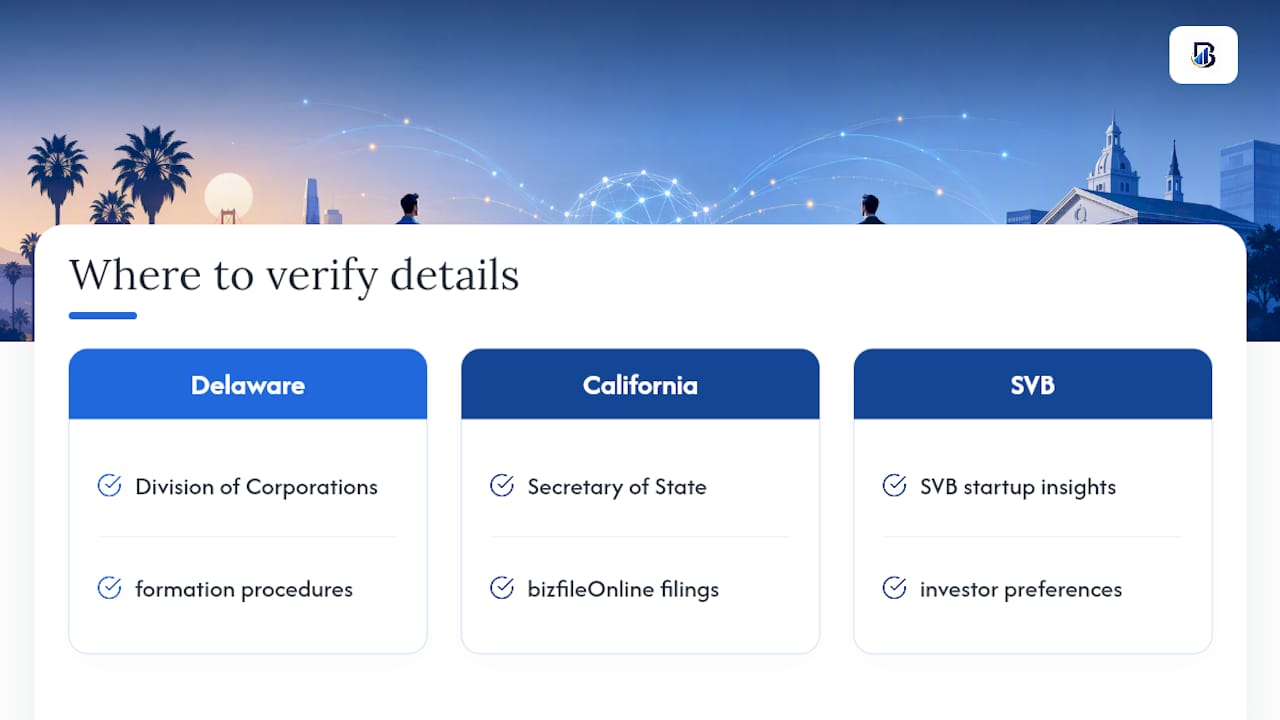
Confirm filing steps and fees directly at the source: Delaware's Division of Corporations covers formation procedures, California's Secretary of State handles bizfileOnline filings, and SVB's startup insights explain investor preferences in more detail.
Sources
- Why businesses choose Delaware | Delaware Division of Corporations
- Service options for business entities | California Secretary of State
- Why incorporate in Delaware? | SVB startup insights
FAQ
Is Delaware Always Better Than California for Startups?
No. Delaware is the stronger choice when you're pursuing institutional venture capital or a public exit, but California is often cheaper and simpler for bootstrapped, single-state businesses.
Do I Still Pay California Taxes if I Incorporate in Delaware?
Yes. If you operate in California, you'll need to register as a foreign corporation, pay California's minimum annual franchise tax, and file a Statement of Information regardless of where you incorporated.
How Much Does It Cost to Incorporate in California?
California's standard filing fee through bizfileOnline is $100, plus the annual minimum franchise tax and Statement of Information filing that follow every year after.
Can I Switch From California to Delaware Later?
Yes, through domestication, conversion, or a merger into a new Delaware entity. The process typically takes several weeks to a few months and is easier to manage before your cap table gets complicated with multiple funding rounds.
Why Do VCs Insist on Delaware Incorporation?
Institutional investors standardize on Delaware because its governance statutes and Court of Chancery case law make deal terms, exits, and board disputes more predictable across their entire portfolio.