

The single best way to approach family offices is to research mandate fit first, then secure a warm introduction through a trusted advisor before you ever send a pitch deck. Profile the office, identify one or two advisors who can make an introduction, and prepare a one-line statement of fit backed by two proof points. That sequence, research before outreach, warmth before pitch, is what separates founders who get a second meeting from those who get a form rejection.
TL;DR:
- Focus on securing warm introductions through trusted advisors rather than cold outreach, as credibility significantly increases the chance of a second meeting.
- Single-family offices tend to act faster and prioritize personal discretion, while multi-family offices require more documentation and longer review processes.
- Family offices now mainly seek direct private investments aligned with their long-term legacy, reputation, and family involvement, especially engaging the next generation.
- Thorough research to confirm ticket size, sector fit, and advisor networks is essential before outreach, and using dedicated platforms can speed up this process.
- Building long-term relationships with family offices involves consistent updates, engaging next-gen members, and offering tailored deal structures to reduce perceived risks.
Table of Contents
- What Are Family Offices and Which Type Should You Approach First?
- What Do Family Offices Actually Look For in a Deal?
- How Do You Research and Qualify a Family Office Before Reaching Out?
- What's the Best Way to Get a Warm Introduction to a Family Office?
- What Materials Do You Need Before Pitching a Family Office?
- How Long Does It Take to Close a Family Office Investment?
- Practical Perspective: Playing the Long Game With Family Offices
- How Bright Capital Helps You Execute the Family Office Playbook
- Sources
- FAQ
What Are Family Offices and Which Type Should You Approach First?
Before you approach family offices, you need to know which kind you're dealing with, because the structure dictates the speed and formality of every conversation that follows. A single-family office (SFO) manages the wealth of one family, usually with a small, trusted staff and a principal or a small committee making the final call. A multi-family office (MFO) serves several unrelated wealthy families under one roof, and it typically behaves more like an institutional fund, with formal investment committees, written mandates, and multistep approval chains. A third category, the outsourced or virtual family office, blends independent advisors, attorneys, and accountants who collectively perform family-office functions without a dedicated in-house team.
The practical difference matters more than the label. According to Goldman Sachs, single-family offices tend to move faster and decide with more personal discretion because they answer to one family's priorities rather than a committee. Multi-family offices, by contrast, often require more documentation and a longer internal review because they're balancing several client mandates at once.
Before you approach either type, look for signals that tell you which one you're facing:
- Staff size and titles listed on LinkedIn or the firm's website (a Chief Investment Officer usually signals an MFO or a larger SFO)
- Press mentions tied to a specific family name versus a generic "wealth management" brand
- Philanthropic filings or a foundation page, which often reveal the family's values and giving priorities
- Conference speaker lists and panel appearances, which tend to surface principals more than back-office staff
Outsourced family offices are trickier to spot. They often operate as a boutique advisory firm representing several families quietly, so a call with "the advisor" may actually be your first and only conversation before a decision gets made.
What Do Family Offices Actually Look For in a Deal?
Family offices weigh two very different sets of priorities at once, and founders who only address the financial side lose deals they didn't know they were losing. On the financial axis, expect scrutiny of ticket size fit, expected hold period, liquidity needs, and appetite for co-investing alongside other capital sources. J.P. Morgan's family office research shows a large share of family office capital now flows into direct private investments and alternatives rather than passive funds, which means many offices are actively hunting for exactly the kind of direct deal a startup or emerging fund can offer.
The non-financial axis is where most pitches fall apart. Family offices care about:
- Legacy alignment: does this investment fit the family's long-term narrative, not just this quarter's returns
- Reputation sensitivity: will this deal embarrass the family name if it goes public or goes wrong
- Philanthropic overlap: does the business connect to cause the family already supports
- Next-generation input: are younger family members being given a voice in the decision
That last point is no longer a footnote. Family offices have sharply increased their focus on family engagement and education since 2023, and Campden Wealth's operational research found that 62% of family offices now rank the "purpose of family capital" as a top educational priority. Founders who can speak to purpose, not just projected returns, are working with the grain of where this industry is heading, not against it.
How Do You Research and Qualify a Family Office Before Reaching Out?
Cold outreach to family offices rarely works, so the research phase is where most of your leverage gets built. A disciplined qualifying process turns a vague list of wealthy families into a prioritized set of targets with a real path to a warm conversation.
Work through this sequence for every office on your list:
- Confirm ticket size range. Look for prior deal sizes in press coverage or SEC filings tied to the family name; a mismatch here wastes everyone's time.
- Check for prior direct investments in your sector. An office with no history in your space is a longer, harder sell than one that has already written similar checks.
- Scan for sector signals, including portfolio company names on the family's own website, LinkedIn activity from principals, and mentions in trade press.
- Identify the advisors attached to the office, including outside counsel, accountants, and placement agents, since these are often your most realistic entry point.
- Map governance and geography. A geographically dispersed family with members across multiple cities usually means a slower, more consensus-driven decision.
- Build a contact map that runs advisor to Chief Investment Officer to principal, so you know exactly who needs to say yes before the family does.
Public sources worth mining include SEC filings, philanthropy and foundation pages, conference rosters, and trade publications that cover regional wealth. Curated investor databases, including Bright Capital's investor database, can compress this research into hours instead of weeks by surfacing sector focus, stage preference, and prior activity in one place.
Pro Tip: Treat your contact map like a sales pipeline, not a wish list. Every family office on it should have a named advisor or introducer attached, or it doesn't belong on the list yet.
What's the Best Way to Get a Warm Introduction to a Family Office?
Warm introductions consistently outperform cold outreach with family offices, and the reason is structural, not just etiquette. Family offices exist specifically to protect a family's capital and reputation, so a trusted advisor's endorsement does work that no cold email ever can: it pre-vets you before the first real conversation even starts.
Cultivating that access takes intention:
- Build relationships with wealth managers, estate attorneys, and accountants who serve multiple families, since they see deal flow before it becomes public.
- Attend the same conferences family office principals attend, not generic startup events, and follow up with anyone you meet within 48 hours.
- Ask existing investors or portfolio company founders for a specific, named introduction rather than a general "let me know if you hear of anything."
- Treat co-investors and syndicate partners as introduction sources; family offices often follow other family offices into a deal.
Once you have the introduction, your opening message needs to do a lot of work in a small space.
Sequencing matters as much as the message itself. Send your first follow-up no sooner than one week after initial contact, and no later than three. Share meaningful updates on a monthly cadence, not a weekly one, since over-communication reads as anxious rather than confident. Use industry events as a natural second touchpoint, and only escalate to a second advisor or a different family member if the first channel goes quiet for more than six weeks.
Pro Tip: Verified targeting combined with a curated warm channel beats mass outreach every time with this audience. A spray-and-pray approach that works on angel syndicates tends to fail badly with family office principals, who talk to each other more than founders assume.
What Materials Do You Need Before Pitching a Family Office?
By the time you're in a room or on a call with a family office, your materials need to answer questions before they're asked, because a second meeting rarely gets scheduled to fill gaps that should have been closed in the first one.
Have these ready before you take the meeting:
- A clean, current cap table that shows exactly who owns what and how a new investment would sit within the structure.
- A 12-month cash forecast that reflects realistic assumptions, not best-case fundraising math.
- Cohort-level unit economics that show whether the business actually improves as it scales, not just grows.
- Two or three customer references willing to take a call, ideally from customers who reflect the segment you're scaling into.
- A concise investor deck, ten to twelve slides, that leads with the problem and the proof, not the founder's biography.
Meeting flow matters as much as the materials themselves. If your team includes a technical founder and a business-facing cofounder, let the clearer communicator lead the conversation. Family Office Access's research found that families consistently respond better to founders who can explain the business simply, and a technical founder who dominates the room with jargon often does more harm than good. UBP frames this as a three-part discipline: understand, structure, orchestrate, meaning you understand the family's DNA and long-term vision, structure your pitch and terms around that understanding, and orchestrate the relationship over time rather than treating the meeting as a one-shot pitch.
Flexible deal instruments help too. Co-invest SPVs, convertible notes, and blocker structures can all reduce tax or operational friction for a family office, and offering to structure around their preferred instrument signals that you've done real homework. If you're offering any security to private investors, review current SEC guidance on offerings to accredited investors before you finalize terms.
How Long Does It Take to Close a Family Office Investment?
Patience is not optional when family offices are involved. The gap between a first meeting and a signed term sheet can run anywhere from a few weeks, for a family office that has invested in your sector before and moves fast, to twelve or eighteen months for a first-time direct investor working through a formal committee.
Diligence tends to hit a predictable set of asks:
- Legal review of your cap table, IP ownership, and any outstanding liabilities
- Tax structuring questions, especially if the family office is considering a co-invest vehicle
- Reference checks that go well beyond the two contacts you provided
- A request for a small pilot or trial engagement before committing full capital
You can shorten friction, though rarely the calendar itself, by offering negotiation levers that reduce the family's perceived risk. Staged investment tranches tied to milestones, co-invest options that let them bring in a trusted partner, and explicit reputational protections, such as approval rights over public statements, all signal that you understand what the family is actually worried about. None of these levers speed up a slow-moving committee, but they make the eventual yes easier to reach.
Practical Perspective: Playing the Long Game With Family Offices
Most founders treat a family office pitch like a single event: one meeting, one deck, one outcome. That's the wrong model, and it's the reason so many promising companies get a polite no. Family offices are built around continuity across generations, and they judge founders the same way they judge each other: through a pattern of behavior over time, not a single performance.
The highest-signal actions I'd point founders toward aren't in the pitch deck at all. Sending a selective, genuinely useful update every few months, even to a family office that passed on your last round, keeps you in their peripheral vision for the next one. Offering an exclusive pilot to a family's operating company, when you have one that fits, does more to build trust than any financial projection. And inviting a family office principal or next-gen member to an advisory conversation, even informally, turns a prospective investor into someone with a personal stake in your success.
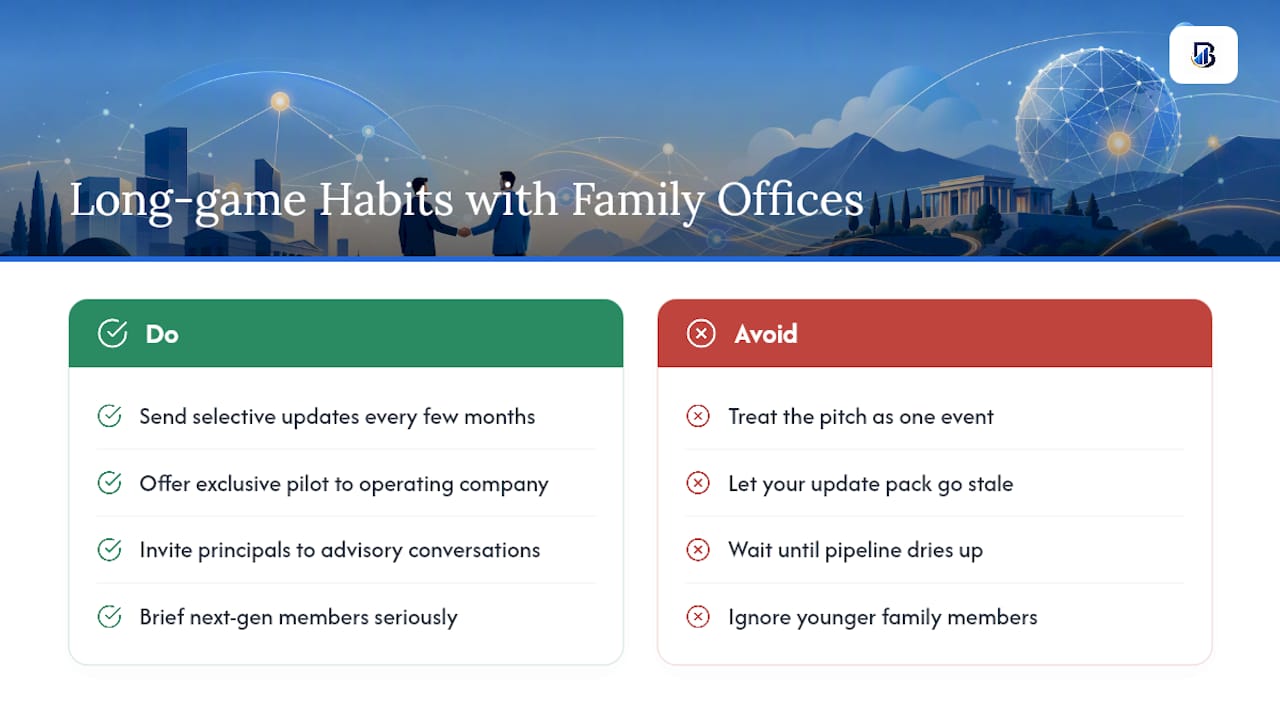
Next-gen engagement deserves more attention than most founders give it, especially as outlined in succession planning basics every South African SME owner needs. Younger family members are increasingly the ones pushing for direct deals and sector focus inside these offices, and a founder who takes the time to brief a 28-year-old heir apparent as seriously as a 60-year-old principal is building a relationship that will outlast the current decision cycle.
If you're running a fundraising process that touches multiple family offices, three habits keep your credibility high week over week: refresh your investor update pack monthly so it's never stale when a warm intro suddenly lands, reach out to one new advisor or introducer every week rather than waiting for your pipeline to dry up, and follow up with every event contact within 48 hours while the conversation is still fresh in their memory. None of this is complicated. Almost none of it gets done consistently, which is exactly why it works.
— Bright
How Bright Capital Helps You Execute the Family Office Playbook
There are platforms designed to replace the guesswork in this process and provide a unified workspace that maps directly to the checklist above, from research to matching to outreach to diligence.

The platform's investor database covers over 27,000 verified profiles, which means the research phase that once took weeks of manual digging through filings and press mentions can happen in an afternoon. AI-powered matching surfaces family offices and other investors whose sector focus and stage preference actually fit your company, rather than leaving you to guess from a LinkedIn scroll. Once you've identified a target, the platform's investor connections tools support the outreach workflow itself, while integrated cap table management means you're never scrambling to produce a clean ownership structure the night before a diligence call.
If you want a structured way to build the readiness checklist this article describes, from your one-line fit statement to a diligence-ready data room, the Funding Academy walks founders through each stage. Start by exploring private capital raise tools built for exactly this kind of long, relationship-driven fundraising process.
Sources
- Key considerations for working with a family office | Goldman Sachs
- Family office engagement: the new strategic priority | Altoo AG
- How to engage family offices: What most companies get wrong | Family Office Access
FAQ
What Is the Minimum Wealth for a Family Office?
There's no universal legal threshold, but most single-family offices serve families with well over tens of millions in investable assets, since that's typically the point where dedicated staff becomes cost-effective versus outsourcing.
How Much Does a CEO of a Family Office Make?
Compensation varies widely by office size, assets under management, and region, and no single figure applies across the industry; founders approaching a family office should focus on the CIO or principal making the investment decision rather than compensation details.
Which Billionaires Have Family Offices?
Many billionaire families operate single-family offices to manage investments, philanthropy, and succession planning, though most keep their internal structures private rather than publicizing specific holdings or staff.
What Creates the Most Millionaires?
Long-term equity ownership, whether through business ownership, real estate, or public and private market investing, is consistently cited as the most common wealth-building path, which is part of why family offices favor patient, direct investment strategies over short-term trades.
How Long Does It Take to Approach and Close a Family Office Deal?
A first meeting to a signed term sheet can take anywhere from a few weeks to twelve months or more, depending on whether the office has invested in your sector before and how formal its decision process is.