

AI for fundraising speeds up investor discovery, automates routine diligence and reporting, and connects cap table and pipeline workflows into one operational picture. It does not replace the judgment that closes a round. Founders who treat AI as a research and workflow accelerator, with a human sanity check on every match score and outbound message, raise faster without raising sloppier. Platforms like Bright Capital now build that structure directly into the fundraising process.
TL;DR:
- AI reduces deal sourcing and screening time from days to hours, allowing small teams to cover markets previously accessible only to larger firms.
- AI tools personalize investor outreach by matching investor theses and past deals, significantly improving engagement rates.
- Automating document analysis pre-fills forms and flags inconsistencies, raising pitch quality before investor review.
- An integrated platform like Bright Capital pairs verified investor data with seamless cap table management, addressing common workflow fragmentation.
- Human oversight remains essential for validation, managing model biases, ensuring data security, and maintaining compliance during AI-enabled fundraising.
Table of Contents
- How AI Is Reshaping Fundraising: The Practical Shift You Need to Know
- Core AI Use Cases for Fundraising and What Each Delivers
- How to Choose an AI Fundraising Solution: Evaluation Checklist and Red Flags
- Implementation Checklist: Pilot, Measure, and Scale an AI Workflow for Fundraising
- Risks, Governance, and Operational Safeguards You Must Put in Place
- Case Studies and Examples of Successful AI Use in Fundraising
- Bright Capital's Perspective: How an Integrated Platform Approaches AI for Fundraising
- If You Want a Single Platform: Where Bright Capital Fits and How to Get Started
- Sources
How AI Is Reshaping Fundraising: The Practical Shift You Need to Know
Private capital is splitting into two camps, and the split favors the underdog for once. Freshfields calls it a barbell effect: AI lowers the entry cost for small, lean teams that once could not afford a research staff, while large institutional firms use the same tools to build proprietary data advantages that compound over time. A solo founder or a two-person fund can now run investor research that used to require an analyst.
The gains are concrete:
- Speed — sourcing and screening that took days now takes hours.
- Personalization — outreach shaped by an investor's actual thesis and portfolio, not a generic template.
- Consolidated workflows — deal data, investor conversations, and cap table changes live in one queryable system instead of scattered spreadsheets.
The limits are just as real. Explainability gaps mean a model can rank an investor as a poor fit without a clear reason. False negatives can bury a genuinely interested investor under a low score. Compute costs and the governance needed to keep models current are ongoing expenses, not one-time setup work. A 2025 lifecycle framework describes this as a shift toward AI-native investment operations, not a bolt-on tool.
Core AI Use Cases for Fundraising and What Each Delivers
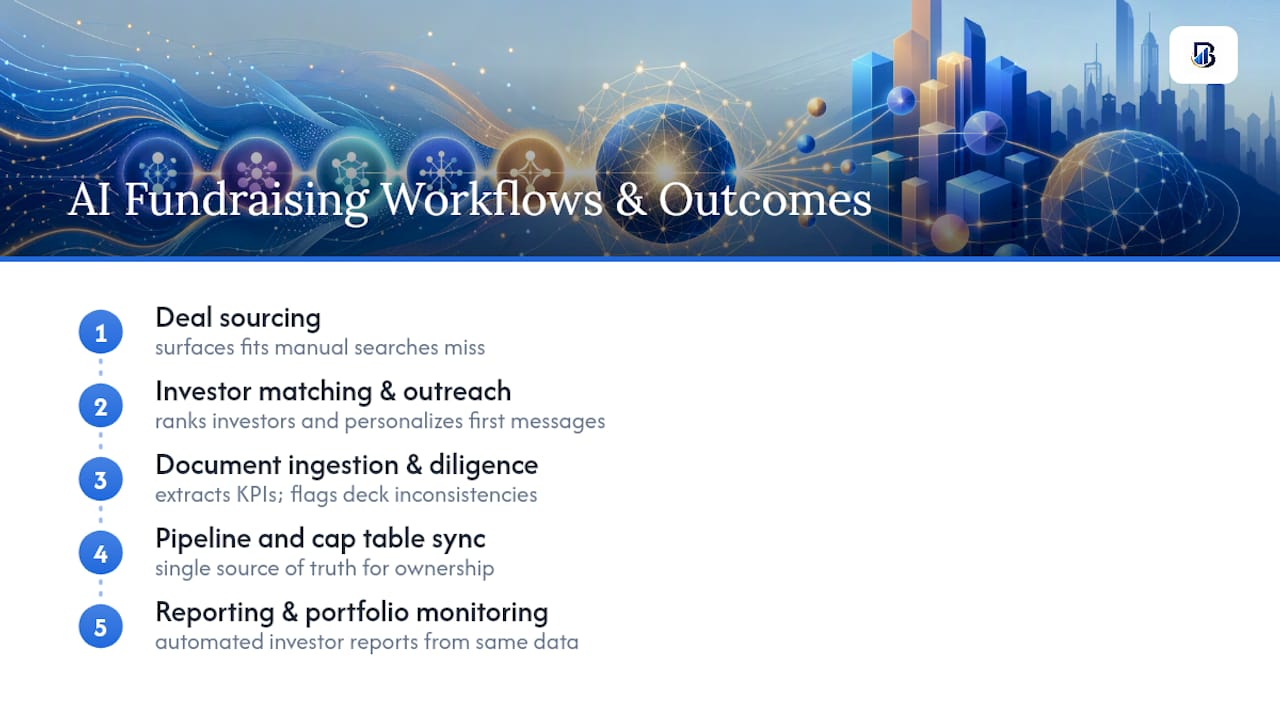
Most fundraising AI breaks into five workflows, and each one maps to a specific outcome you can measure.
Deal sourcing and discovery. Entity extraction and clustering algorithms scan investor profiles, portfolio patterns, and public filings to surface fits a manual search would miss. Business Insider's reporting on venture professionals found tools like ChatGPT and NotebookLM already in daily use for market mapping and thesis synthesis, letting a small team cover ground that once needed a full research function.
Investor matching and outreach. Profile modeling ranks investors against your round's sector, stage, and check size, then personalizes the first message using the investor's own language and prior deals. This is where an AI investor database filtered by sector and stage earns its keep.
Document ingestion and diligence automation. AI extracts KPIs, growth rates, and burn figures directly from decks, financial models, and contracts. Founders running fundraising webinars report AI pre-filling application forms and flagging deck inconsistencies before an investor ever sees them, which raises the baseline quality bar for every pitch.
Pipeline and cap table sync. Ownership, commitments, and round mechanics stay in one source of truth instead of a spreadsheet that drifts out of date after every SAFE conversion.
Reporting and portfolio monitoring. Automated updates pull from the same underlying data used for matching and diligence, so investor reports do not require a separate manual assembly process.
Pro Tip: Run your deck through an AI consistency check before your first investor call. Fixing a mismatched revenue number in a private draft costs nothing; catching it in a live pitch costs credibility.
How to Choose an AI Fundraising Solution: Evaluation Checklist and Red Flags
Vendor claims about "AI-powered matching" vary wildly in what they actually deliver. Run any candidate tool through these five checks before you sign anything:
- Data coverage and provenance. Ask exactly which investor signals feed the model, how large the dataset is, and how often it refreshes. A directory that has not updated fund status or check size in a year will waste your outreach.
- Integration depth. Confirm compatibility with your CRM, cap table system, document storage, calendar, and email. A tool that cannot sync with your existing round data creates a second system of record, which defeats the purpose.
- Human-in-the-loop controls. You need visibility into why a match scored high or low, and the ability to override it. A black box that silently deprioritizes an investor is a liability, not a feature.
- Security and privacy. Check for encryption at rest and in transit, role-based access controls, and clear policies on how investor documents and cap table data are stored and shared.
- Commercial model. Look past the headline price. Trial length, per-seat costs, and add-on fees for data room storage or additional investor records can double the real total cost of ownership.
Red flags worth walking away from: vendors who cannot explain their data sources, tools with no audit trail on outreach, and platforms that treat cap table management as a separate paid module rather than a native part of the fundraising workflow.
Implementation Checklist: Pilot, Measure, and Scale an AI Workflow for Fundraising
You do not need a full AI overhaul to see results. A narrow, measured pilot beats a company-wide rollout every time.
- Pick one measurable use case. Investor discovery or deck ingestion are the easiest starting points. Define success upfront: response rate, hours saved per week, or pipeline conversion.
- Standardize your inputs. Clean up your deck, financial model, investor interaction history, and cap table snapshot before feeding anything into a model. Messy inputs produce messy matches.
- Run a controlled pilot. Keep a human review gate on every outbound message and every match score for at least the first round. Set a clear rollback rule if results disappoint.
- Measure and iterate. Compare response rates from AI-matched investors against your prior manual list. Freshfields' analysis points to starting with the smallest useful use case, proving the return, then expanding.
- Scale with governance. Set a retraining schedule, version your data, and cap the compute budget before you extend AI into new parts of the round.
Pro Tip: Before scaling past your pilot, review Bright Capital's fundraising readiness resources to confirm your data and materials are clean enough to feed a wider rollout.
Risks, Governance, and Operational Safeguards You Must Put in Place
The Ripple Ventures case, where a firm let AI agents handle research, sourcing, and even term-sheet drafting, is instructive precisely because the team kept human checks on anything touching final numbers or decisions. That discipline is not optional.
- False negatives: a model can miss a strong-fit investor entirely. Keep human review before any rejection or deprioritization decision.
- Model drift: investor theses and fund status change constantly. Schedule retraining and version your underlying data.
- Privacy exposure: encrypt data at rest and in transit, enforce least-privilege access, and keep audit logs on every document shared through a secure workspace.
- Recordkeeping: investor communications and accreditation checks often carry compliance requirements. Automated tools should log, not obscure, that trail.
Academic surveys on AI adoption in venture capital confirm this pattern: efficiency gains are real, but data quality and explainability remain the primary adoption barriers that firms have to plan around, not ignore.
Case Studies and Examples of Successful AI Use in Fundraising
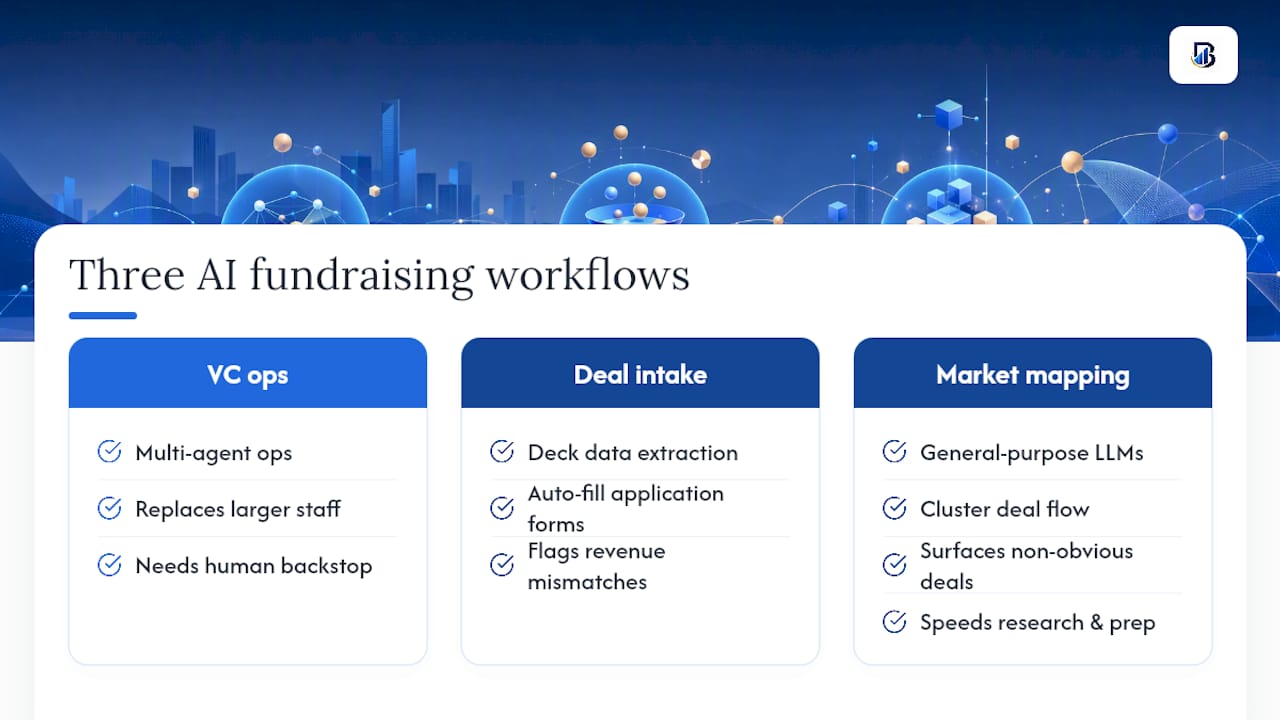
Ripple Ventures offers the clearest public example of AI-driven fundraising operations at scale. The firm built an internal system, dubbed Ripple OS, that runs multiple AI agents across research, sourcing, reporting, and draft term sheets. The result was a small team performing work that historically required a much larger staff, and the firm's own account of the buildout is candid about where automation succeeded and where it needed a human backstop before anything reached an investor or a legal document.
On the founder side, Dealum's webinar series with two active investors documented a quieter but equally telling shift: AI tools now extract structured data from pitch decks and pre-fill application forms during deal intake, cutting manual entry and forcing more consistency across submissions. The same investors noted that AI has raised the bar on pitch-deck hygiene, because a model flags a mismatched revenue number between a deck and a financial model almost instantly, something a human reviewer might not catch until diligence.
Business Insider's interviews with working venture professionals point to a third pattern: AI used for market mapping and thesis development, where a general-purpose tool like ChatGPT or NotebookLM helps an investor cluster deal flow and surface non-obvious opportunities faster than manual screening allowed. None of these examples replaced the relationship-building that ultimately closes a round. They compressed the research and preparation time around it.
Bright Capital's Perspective: How an Integrated Platform Approaches AI for Fundraising
Most of the friction in AI-assisted fundraising comes from stitching together five disconnected tools: a scraper for investor data, a CRM for outreach, a separate cap table system, a document room, and a reporting template nobody updates. Every handoff between those tools is where data goes stale and where errors creep in.
Bright Capital America built its platform around avoiding that handoff problem entirely. Its directory of more than 27,000 verified investor profiles feeds directly into cap table and fundraising pipeline tools, so a matched investor, an updated commitment, and a cap table change reflect in the same workspace. That structural choice, pairing AI matching with a single data source, is exactly what the barbell effect rewards: a lean team operating with the data discipline of a much larger one.
— Bright
If You Want a Single Platform: Where Bright Capital Fits and How to Get Started
Bright Capital exists for founders who want the checklist above solved in one place instead of assembled from five vendors. The platform's investor directory covers verified profiles across sector, stage, and geography, so matching runs against real, refreshed data rather than a static export. Cap table management sits inside the same workspace as your fundraising pipeline, which means a commitment update shows up everywhere it needs to, instantly, without a manual sync step.
Security and data provenance are built into that workspace rather than bolted on. Documents move through a secure data room with access controls, and every investor interaction has an audit trail. If you are earlier in the process, Bright Capital's Funding Academy walks through fundraising readiness before you ever run an outreach campaign, which matters if your deck and financial model still need cleanup.
Start by exploring the investor marketplace to see how matching and directory access work together, or go straight to the private capital raise tools if you are ready to move.
Sources
- Eyes on AI: The artificial intelligence outlook for private capital in 2026 | Freshfields
- Advanced Artificial Intelligence in Private Equity and Venture Capital: A functional framework for lifecycle transformation
- How VCs use AI to find deals, prep for pitches, and move faster - Business Insider
- What happened when a VC firm let AI do almost everything - The Logic