

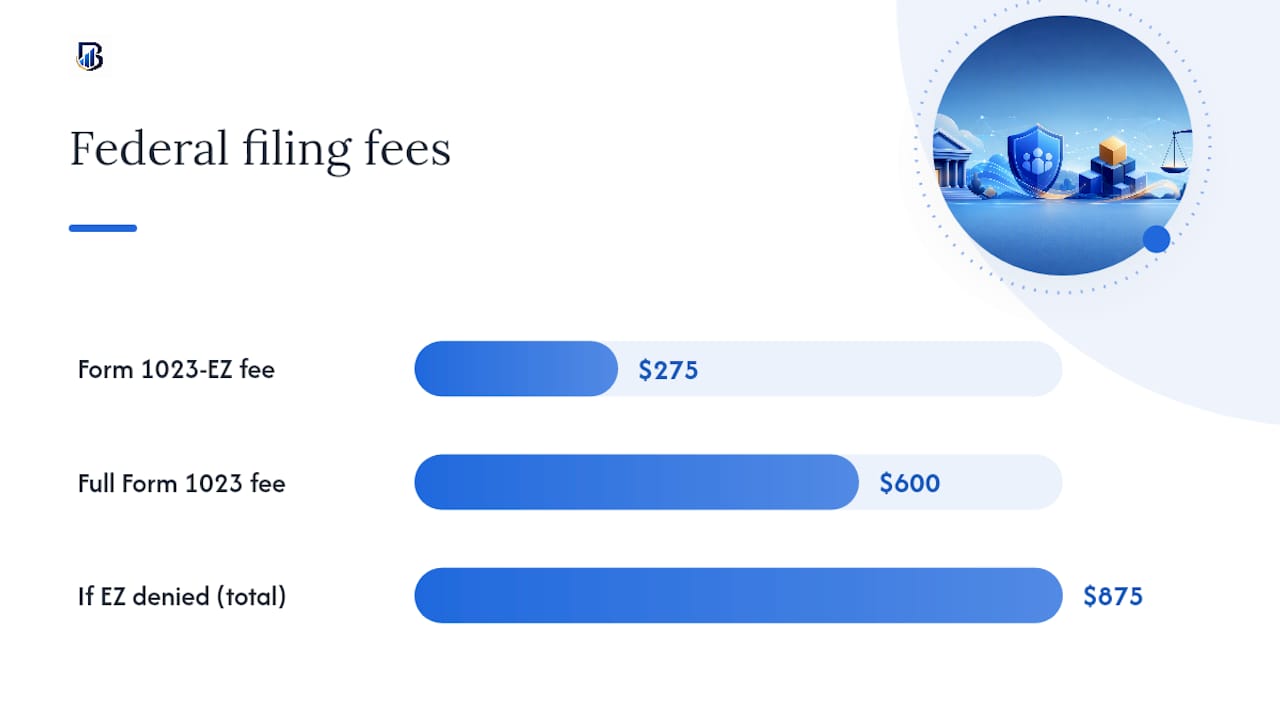
The IRS charges $600 to process Form 1023 and $275 for Form 1023‑EZ, both paid through Pay.gov and non‑refundable. A bare‑bones DIY filing can cost a few hundred dollars once state fees are added. A typical filer using professional help spends $1,500 to $5,000 or more, driven by attorney fees, state incorporation costs, and the risk of filing the wrong form.
TL;DR:
- Filing the IRS Form 1023 costs $600, while Form 1023‑EZ is only $275, but choosing the wrong form can lead to paying both fees and delays.
- State incorporation fees vary widely from $25 to over $150, plus optional costs like registered agents, certified copies, and legal help can add several hundred dollars.
- Filing the full Form 1023 typically costs $1,500 to $5,000 with professional help, compared to a DIY minimum of approximately $700 to $900 for simple organizations.
- Processing times differ sharply: EZ takes a few weeks, while full Form 1023 can take several months, affecting cash flow and donor communication.
- Mistakenly filing the EZ when not eligible can result in paying $875 in fees and losing months of processing due to reapplication and eligibility clarifications.
Table of Contents
- What Drives Your 501c3 Filing Cost
- Form 1023 vs. 1023‑EZ: Picking the Right Path
- When to Hire an Attorney and What It Actually Costs
- How Long the IRS Takes and How to Manage Cash Flow
- Your Budget‑Ready Filing Checklist
- How Bright Capital America Cuts Hidden Filing Costs
- What the Numbers Actually Tell You
- Get Formation Help Without the Guesswork
- Sources
What Drives Your 501c3 Filing Cost
Every nonprofit founder's budget breaks down into three buckets: statutory fees you pay to the government, mandatory setup costs, and optional professional services. Treating these as separate line items keeps you from getting blindsided halfway through the process.
IRS user fees. The federal government charges $600 for the standard Form 1023 and $275 for the streamlined Form 1023‑EZ. Both go through Pay.gov, and neither comes back if your application gets rejected or withdrawn. This single fee is usually the most predictable number in your entire budget.
State incorporation fees. Before the IRS even looks at your paperwork, you need a state‑recognized nonprofit corporation. Fees here swing widely by state: some charge as little as $25 to $50, mid‑range states run $75 to $125, and a handful charge $150 or more once you add certified copies and expedited processing.
Small extras that add up. These rarely break a budget alone, but skip them and you'll be scrambling:
- Registered agent service, if you don't use your own address
- Certified copies of articles of incorporation for bank accounts and grant applications
- A basic accounting setup or bookkeeping software before your first fiscal year closes
- Postage, notary fees, and domain registration for your organization's website
A rough spreadsheet might read: $600 (IRS fee) + $100 (state filing) + $50 (registered agent) + $40 (certified copies) = roughly $790 before you've paid anyone for advice. That's your floor for the full Form 1023 path. Add professional preparation and the total moves into four figures fast.
Form 1023 vs. 1023‑EZ: Picking the Right Path
Choosing the wrong form is the single most expensive mistake in this entire process, and it's one most founders don't see coming.
Form 1023‑EZ exists for small organizations: you generally qualify only if you project gross receipts under $50,000 annually for the next three years and total assets under $250,000. Certain activities disqualify you outright, including operating a school, a hospital, or a donor‑advised fund, regardless of your revenue numbers.
Processing speed differs sharply between the two paths, which matters if you're racing a grant deadline or a donor's fiscal year:
- Form 1023‑EZ: commonly processed in a few weeks
- Full Form 1023: commonly takes several months, longer for complex activities
Here's the number that should make you pause. If you file the EZ and the IRS later determines you weren't eligible, it keeps your $275 and requires you to refile the full Form 1023 with its $600 fee. That's $875 total in federal fees alone, plus months of lost time waiting for a second determination letter. Founders who guess wrong on eligibility don't just pay twice. They restart the clock on retroactive exemption, which can complicate early donor receipts.
When to Hire an Attorney and What It Actually Costs
DIY filing works fine for straightforward organizations: a single founder, simple programs, no related‑party transactions, and clean eligibility for the EZ. Once your structure gets more complicated, professional help stops being a luxury and starts being cheap insurance.

Attorney fees for 1023‑EZ preparation tend to sit at the lower end of the market, since the form itself is short. Full Form 1023 preparation runs $1,500 to $5,000, with complexity, related‑party disclosures, and unusual revenue models pushing costs toward the top of that range. Formation services that bundle document review with filing typically price between those two extremes, giving you a middle path between pure DIY and full legal representation.
Three realistic budget scenarios:
- Bare minimum DIY: IRS fee plus state filing fee only, roughly several hundred to around a thousand dollars total, assuming clean 1023‑EZ eligibility and no professional review.
- Mid‑range DIY with review: self‑prepared forms plus a paid document review or formation service, typically costing low to mid thousands.
- Full professional preparation: attorney‑drafted full Form 1023 with governance documents, often costing several thousand dollars including state and incidental fees.
Pro Tip: If you expect to apply for grants or accept large institutional donations within your first two years, budget for the full Form 1023 path even if you'd technically qualify for the EZ. Grant officers and major donors often ask to see your full application, and a thin EZ filing can raise questions the full form answers up front.
How Long the IRS Takes and How to Manage Cash Flow
Patience isn't optional here, and neither is planning around it. Form 1023‑EZ applicants typically hear back within a few weeks; full Form 1023 filers should expect several months, sometimes longer if your activities require additional IRS review.
Your determination letter's effective date usually reaches back to your incorporation date, provided you filed within 27 months, so donors can generally claim deductions retroactively once approval arrives. Until then:
- Keep detailed donation records so you can issue proper receipts once your exemption is confirmed
- Avoid representing yourself as tax‑exempt in writing until the determination letter is in hand
- Budget operating cash to cover months of waiting without exemption‑dependent revenue like certain grants
Don't treat approval as the finish line, either. Miss three consecutive years of required Form 990 filings and the IRS automatically revokes your exemption, forcing you to reapply and repay the original fee.
Your Budget‑Ready Filing Checklist
Work through these steps in order, and price each one before you start:
- Get your EIN. The IRS issues it for free, often the same day you apply online. Skip any third‑party site charging for this.
- Incorporate in your state. Budget $25 to $150+ depending on your state's fee schedule, plus any registered agent cost.
- Draft governing documents. Bylaws, a conflict‑of‑interest policy, and board resolutions, either self‑drafted from templates or attorney‑reviewed.
- Choose your form and file via Pay.gov. Pay the $275 or $600 user fee, save your payment confirmation, and keep a copy of everything submitted.
Sample totals: Minimum around $700 to $900. Typical DIY around $1,000 to $1,500. Typical with professional help around $2,500 to $5,700.
How Bright Capital America Cuts Hidden Filing Costs
Most rework and surprise attorney hours trace back to disorganized documents, not the IRS form itself. Bright Capital America's nonprofit and company formation workflows keep incorporation, governing documents, and secure storage in one workspace, alongside fund administration and philanthropy tools for what comes after your determination letter arrives.
What the Numbers Actually Tell You
Most advice on this topic treats the $600 or $275 IRS fee as the headline number, and that's a mistake. The federal fee is the most predictable line in your budget, not the biggest risk. The real financial exposure sits in eligibility guesswork: founders who file the 1023‑EZ without carefully checking the revenue and asset thresholds often end up paying both fees and losing months to a second review cycle.
The research also points to something conventional cost guides underplay: filing the full Form 1023 when your situation calls for it isn't just a compliance formality. Better governance documents and clearer program descriptions upfront tend to reduce legal costs later, especially once grant officers or major donors start asking questions.
If you take one thing from this guide, prioritize getting your eligibility determination right before you touch Pay.gov. Every dollar spent confirming which form you actually qualify for is cheaper than the $875 combined fee for guessing wrong.
— Bright
Get Formation Help Without the Guesswork
Filing costs add up fastest when documents get redone, deadlines slip, and attorneys bill for cleanup work that better preparation would have avoided. Bright Capital America's formation services handle incorporation, governing document prep, and secure storage in one workspace, so your filing moves through Pay.gov once instead of twice.

Paid formation help makes the most sense once your organization has related‑party relationships, plans to seek institutional grants, or simply wants a second set of eyes before submitting a non‑refundable federal fee. If your situation is straightforward, our Funding Academy resources can walk you through the DIY path step by step. When you're ready for hands‑on support, start with Bright's formation page to see what's included and get a clear price before you file.
Sources
- Form 1023 and 1023-EZ amount of user fee | IRS
- How to apply for 501(c)(3) tax-exempt status — Virtue CPAs
- How much does it cost to start a nonprofit? — Wylie Advisory